VAT. Guillem de Castro, 118
The Vanguards transformed art and culture from top to bottom, but they failed miserably in their attempts to change the world.. After them came the fascisms, the Nazi genocide, World War II and the atomic bomb. Adorno wondered how to make poetry after all that barbarism and art looked for ways to be reborn and reinvent itself.. Those of Jean Dubuffet were very daring and ended up creating shapes that were called “art brut“. The Frenchman maintained that true art was not in institutions but was produced on the margins of society., it was the one made by children, arrested, mentally ill or indigenous. That's why, from 1945 He looked for works by people free of artistic culture who demonstrated a new ability for invention, as Aloïse Corbaz, admitted to a Swiss psychiatric hospital. You can see from her in the IVAM ghosts in love made with colored pencil, geranium juice and sewn papers.
Dubuffet himself was an unorthodox artist who practiced “primitive” and naive painting with which to laugh at officialdom and challenge Western cultural institutions.. He managed to challenge the concept of Western white modernity. The title of this retrospective, Jean Dubuffet. A barbarian in Europe, with which the IVAM crowns its thirtieth anniversary, refers to the book A barbarian in Asia of the poet Henri Michaux (portrayed by Dubuffet in the painting Henri Michaux actor Japanese, where he questions the notion of portrait) in which its author discovers that, when entering another culture, he is the barbarian. After the catastrophe of World War II, Dubuffet wanted to proclaim the values of humility and modesty to highlight the portrait of the human being naked of any particularism.. This is exemplified by the painting “Naked” (1945), where he rejects military honors to celebrate the common man, o in “The Geologist” (1950) in which a small character, with a magnifying glass, on a landscape of layers stratographic symbolizes that man is not the center of the world and does not have the measure of all things. Dubuffet was interested in the cultures called “primitive”, a term that, In his opinion it was invented by Europe to colonize the world. As Gaugin, He traveled far to isolate himself from Western culture and combine his artistic work with that of an ethnographer., in this case, in the Algerian Sahara, where he encountered a desert culture he did not expect. He became interested in the anthropomorphic stelae of the Eurasian steppes., very difficult to classify and study because the ancient Greeks called them “barbarians.”” to the towns that produced this art. That is precisely what interests Dubuffet, the unclassifiable, as “Orient beard” (1959). Defender of animism as a system of thought, He was fascinated by discovering figures in natural objects, in a piece of wood found on the beach that I call “The buzzer” the andn butterfly wings with which he composed andThe beautiful painting “Le jardin mulatto“.
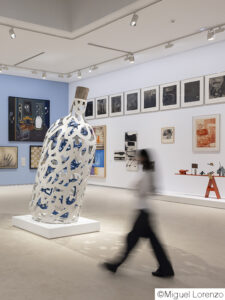
In the years 60 his art drifted towards a game of pure abstraction, imitated after, which also has something childish, like the one seen in the polyester sculpture Character to jowls (1967). Dubuffet eI was convinced of that every point of view has been culturally constructed, which means that there are other possible ways of interpreting the world. His heterodox and controversial approaches brought criticism hostility against him, said it looked bad, but time later (years 70-80) artists like Jean-Michel Basquiat or the Equipo Crónica become interestedthey were going a lot for his work. In the end, like any of the barbarians before him (and then) they questioned the artistic institution, has ended up swallowed by it to throw it up again, already as a “domesticated barbarian”. S.M.