
VAT. Guillem de Castro, 118
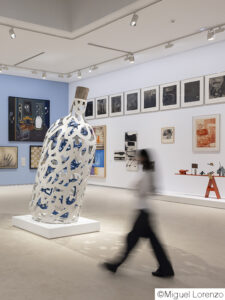
Beauty stopped being the ultimate goal of art a long time ago, the ability to imitate nature ended up devalued because a gadget appeared that made it much better and faster, the photographic machine. At the beginning of the 20th century, the automobile and the airplane had also been invented., the phone, cinema and radio, Machines were increasingly present in the lives of ordinary people and the art of the moment would perfectly reflect it, walking at the pace of technological advances.. Peasants went en masse to work on factory assembly lines that had embraced serialization and repetition of the taylorism y, consequently, We became more urban and the city with its rhythm and speed became the fundamental theme of art during the first decades of the 20th century.. This new situation is, Broadly speaking, which is described to us exhibition Mechanical and technical imaginaries in the IVAM collection, that starts between steel, appliances, beams, levers, wheels and gears to contextualize the moment.

The poster Praise to the heroes, 1936-1939 by Arturo Ballester shows the symbiosis of the human being and the machine, the photomontages of Heartfield job alienation, the photo book Metal of Germaine Krull the expansion of industrial buildings across the landscape and the signs of Valentina Kulagina o Natalia Pinus the construction of the proletariat with women in the foreground. The room 2 shows how cinema subverted the artistic principles inherited from the past, For example, in the hands of Moholy Nagy, and then explain how personalities and artistic movements wanted to destroy traditional work, seeking new forms of expression that diluted the border between continent and content.. We talk about Marcel Duchamp, Francis Picabia El Lissitzky, Man Ray y Alexander Calder, whose hanging mobile hangs from the ceiling representing how he altered the ancient principles of sculpture, going from statism to movement and reversing its traditional position in space. The Cold War also unleashed an unprecedented technological revolution, Electronic computers appeared and the space race led to man landing on the moon.. Artists embraced science and mathematics, In Spain, developing abstract art with geometric roots between the fifties and sixties, is the case of Soledad Seville with its reticles, Yturralde with his on art, Alfaro with its methacrylate sculptures or Sempere, whose luminous relief is displayed along with the rest in a room converted into a dynamic geometric painting with rhythm over which the viewer walks. Angels Frame exposes a staircase that leads nowhere and Yturralde a “kite” that does not fly, in a section that teaches how, for art, machines stopped being utilitarian and became visionary. The technical possibilities of the video camera, serial production as an artistic technique, the interdependence between technology and corporeality, and the dissolution of the border between the organic and the mechanical are the themes that appear in the last part of the tour of this great IVAM exhibition. AU