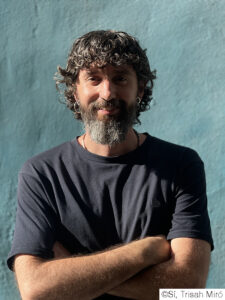

Vicente Monroy is Cineteca programmer in Madrid, collaborates with the Spanish Cinema Academy and is author, besides, of essays, novels and several poems. Your last text, (Anagram, 2025), He proposes a reflection on the need to preserve the film room as that intimate space in which the images charge their true meaning. The subtitle of the book says everything: a defense of the rooms in Al era del streaming. A defense of darkness as a refuge before that blinding light to which, supports, New technologies condemn us. G.LEON
While reading your book, Junichirô Tanizaki's book came to mind, Shadow. ¿It is an influence? Did you inspire you in any way to write this Brief history of darkness?
Yeah, Tanizaki made me a retrospective suit, Among other things because I would have liked to call my book “Praise of darkness”. Evidently, It is an important reference, especially because Tanizaki, Just as I try to do in this book, What tries to raise is a balance between light and shadow. More than being a book that defends the shadow in architecture, What Tanizaki does is try to raise that gray scale where I think the most interesting things happen, both in architecture and in our lives. It is a book that deals with architectural terms from a spiritual point of view, That is what I have also tried to do with the movie theater.
At the beginning of the book and almost as a starting thesis, You mean the need to maintain those shadow territories as a condition to imagine other possible worlds. In that sense, What does darkness represent for you?
Bueno, The darkness is, evidently, A polysemic term. I serve the idea of the movie theater rather to talk about something that is happening to us as a society, which is that we are increasingly overexposed, About enlightened, We are increasingly unable to find spaces for self -reflection, For recollection, For prohibited pleasures, For a series of things that, traditionally, They have been conceptually linked to darkness. Darkness for me means many things. Means a territory of opportunities, also reinforce the terms of this social pact that we have and that for too long has been based on the idea of transparency, In "The Light of Reason". In that sense, The darkness of film rooms has been a space that has resisted especially in cities that, Throughout the twentieth century, They were filling light. In increasingly illuminated cities, The rooms have remained as spaces where very special things have happened. It means many things. For me, It is a very rich space and concept.
One of the problems of that loss of darkness is related to the loss of a collective meeting space, of the whole community. What implies for you the loss of that social space?
Yeah, Of course. Mira, In the reading that some journalists and some people are making the book bothers me not to have been able to make this clear. For me, The idea that you have to safeguard or return, To some extent, a to the room of whom, It is not at all a melancholic vision. I don't think you have to recover the old audiences or the old cinematographic model. For me the movie theater is rather a space of opportunity to get together to dialogue, To chat and think about what images we want for the cinema of the future and for the world of the future, How is the cinema we want to see from now on. And I think the film room must be that space of community discovery. And it is because cinema platforms and digital models, The screens, They are making us watch cinema in an increasingly lonely way. We see the movies increasingly alone, In the darkness of our halls, In public transport, etc., And I think this condemns us to much less complex thoughts than those we had when we shared the viewing in a later colloquium or in the subsequent discussion in the corner bar. These are moments that enrich the film experience and that allow us to generate much more complex thoughts. For me the movie theater is, above all, A space to be together. And every time there are fewer spaces where to be together in our cities and in our villages.
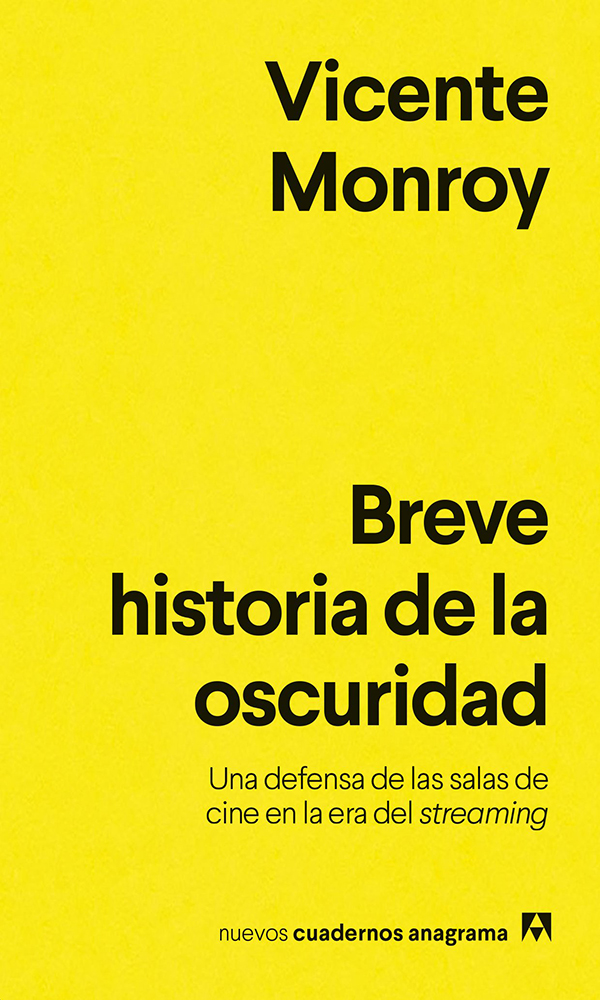 In your book you highlight the loss of the movie theater such as that space where many fortuitous meetings are also produced, sexual encounters, In some cases, or intimate in general. What do you think means the loss of that space at the level of a certain affectivity, either social or individual?
Bueno, is that the cinema has been, From its origins, A love phenomenon, largely. It has been a phenomenon in which we have linked to that image of the world that gave us the screen in a body way, in which we have involved our entire body. When the cinematographic phenomenon works in a magical way, brilliantly and beautifully, Not only do we involve the view and ear, We invite our entire body. The films become tactile, They absorb us, They introduce us in worlds that we can, even, smell. It's not just seeing colors. We can smell Rossellini's India, We can see your vibration, How the air moves on the screen, There are many things. And I have the feeling that this was happening , above all, When we were able to treat the images with the same love as with which they treated us. I think the images require care, ATTENTION, a sacrifice or, better, A commitment. The fact of going to the cinema, to move from your home to the movie theater, to enter for two hours into the dark, to let your body begin to be part of another world that you have no control, It is a form of sacrifice, of commitment. And today we are losing it. We treat images as a kind of spojos ("Content" is the term we use) that fill our few empty time spaces. We arrived from work, After working 8 hours (plus extras, I mean, 12-laughs-), And we have 45 minutes of time to dedicate it to the audiovisual. And we relied it to a series that treats us like we treat it. We come to see her tired, Without either desire, And the images that are returned are also tired and tired images. It seems to me that, indeed, That great affective phenomenon that was the cinema, which formed several generations, that taught them to dress, to smoking, to fall in love, Today it is very degraded on small screens. I doubt that the same level of passion can be found in the years 60 In a movie theater, In a netflix content. It seems to me that this is very unlikely to happen.
There is one thing that has been very curious and that is associated with group shows (cine, theater, music) and darkness. Today we see it as usual, But it was not always like that. In your book you have the anecdote of that opera theater that Wagner built for his works where, For the first time in history, It is imposed that the representation is surrounded by darkness so as not to distract the public's attention. This is closely related to the consideration of cinema as a major art, Something that I think is forgotten when we claim the validity of the cinema or the movie theater.
Bueno, It is that the cinema was born at a time when the rest of the arts were thrown in a kind of suicidal route towards their own dematerialization, decomposition and transformation into conceptual and antimatheric arts. In that context, The cinema collected what the rest of the arts were abandoning. Collected the great stories of the novel, collected the pictorial character of the impressionists and, As always went to, It cost him a lot to recognize himself as great art. In fact, To recognize itself as great art he had to make conceptual assignments that seem a bit suspicious to me. For example, The author's idea. It is a totally literary concept that the French impose on the cinematographic model, When cinema is an art always made in community, that has to be made in community and perceived in community. But what I understand that you mean is a consideration of cinema as art that forces us to think, that transforms us, that does much more interesting things than just entertaining us, And I think there, indeed, Cinema is getting closer and more to advertising forms. In this terrible market alliance with digital technologies, the cinema, indeed, becomes content and what was previously to see, Now we talk about "consume". And is that this audiovisual content does not be far from what we see in Tiktok, From what we see on Instagram, that is to say, They are market phenomena, mercantile phenomena. I think that a large part of the cinema is now a tour of this tragedy of its transformation into content.
I told you above all because, In the book you aim an idea that, more or less, would come to hold that, In the chronicle of any art, It is necessary to consider the space in which it is represented. And I have the impression that, When we talk about cinema or, even, When making movies, We have forgotten that space where it reproduces and what influence does it have when expressing itself as art.
Yeah, Yeah, Of course. But it is that the history of cinema has not yet written. The only story that has begun to write for now is an industrial history of cinema, An American and very westernized nature story. I think that in most of the stories that are told about cinema, Although I think historians would not dare to accept it, It is more important to the Marshall Plan than Ciudadano Kane. They are stories of cinema as a great phenomenon of light, of the stars, of the stars, of the flashes, of the festivals, This great phenomenon that occurs in light. But a film story implies many more things. That is why my obsession, From the previous book, Against cinephilia, to try to tell small stories of cinema against, that is to say, to count the counterpart. If the history of cinema so far has only been told as a story of what happens on the screen, I am much more interested in our history, that is to say, The history of cinephiles, The story of all those things we have thought about the images, How we have evoked in them, And indeed, as you say, The history of the spaces where we have entered to discover this great continent that is cinema. And this was also the obsession of this book, Tell the story of that counterplane, of what happens to us. It seems more important and more interesting what happens to someone inside a cinema room than what happens to Humphrey Bogart in The eternal dream, With all my love for The eternal dream (laughter).

In the book you comment that, Because of that multiplicity of screens, The image has become again, as in the origins of cinema, In something accessory, a kind of complement that entertains us, But that does not focus our attention or our gaze. However, Much of the current speech is telling us otherwise, that is to say, that true cinema has gone to television. I understand that you don't share it at all.<
No, I don't share it, at all. But I don't share it, above all, Because I think we need to think what is really happening with the cinema when he moves from the great to the small screen. In that sense, It seems to me that this statement is born from a certain unconsciousness when thinking that the translation of the films, from the cinema room, to the small screen, It is a transformation that does not entail consequences. And it entails them and very important. The images, The type of images that are recorded, I'm talking about photography, of the frames, I mean planning, I mean how movies are counted, is changing in a hurry. The platforms try to convince us that what we are seeing is real cinema, That is why the great HBO series to what they aspire is to repeat The godfather more of 50 years later. That is to say, They continue to mainly maintain that aesthetics that reminds us of our old cinema idea, But that's not cinema. I think that, in the cinema, When it's real cinema, The images it offers are always new images, They are always different images, me too, at least, I don't see that in Netflix series, In what is happening on television. Rather, on the contrary, What I see are melancholic products that repeat the same images without stopping. It really seems to me that where real cinema is being produced, What I understand how cinema, that is to say, where I still find reasons for astonishment and for the discovery of things that I did not expect, It is still in the room, Maybe because I'm lucky to program at Cineteca, where I discover a lot of cinema. And also in the darkest corners of the Internet. There are still kids of 20 years producing things never seen, But I think those things are not put in Netflix or Filmin. I think that escapes conventional reproduction windows.
In the book there is a time when you say that, somehow, The cinema has been veiled by the industry itself. Do you mean the last one you just commented on?
Yeah, Yeah, fully. Cinema is especially immediate art. As Werner Herzog said, It is an illiterate art, that is to say, an art that does not require, Like literature, great stylistic formation or knowledge of the literary tradition or, Like painting, A knowledge of academic norms. It is a very young art that was born with that vocation that anyone could be a cameraman. Since the camaragraphs of the Lumière brothers, Cinema was born with a vocation to be an art of the people, An art capable of registering the political transformations that were occurring in the twentieth century, to offer thrilling images about things that literature cannot reach because it does not arrive at the precise moment, Not even painting, which also requires subsequent production. Y, however, It was an art captured by capitalism, that quickly transformed into a tool at the service of globalization, of imperialism. This is, largely, The history of industrial cinema, of commercial cinema. It is a cinema that offers images at the service of an idea of the world based on the rules of capital and market. And well, I think that, largely, That could only end bad. That link between an art and an industry, It seems to me that it can only end badly because it is a matter of time for art to degrade because the industry has its own agenda and that is very difficult to dodge. By many directors who subdiate the rules or offer us risky images, It is a toxic relationship.
The other question I was going to ask you is related to these new generations of filmmakers you were talking about. Here I always stumble upon a paradox that is related to that statement that made, I think it was Martin Scorsese, about the fact that, yet, Young directors keep wanting to see their films embodied on a large screen. What I wonder is, How is it possible that, being that we dissociate these new generations with the movie theater, Young directors keep wanting to watch their films on a screen? Something fails. Or young people don't really think so or we are confused.
Bueno, I think there are several confusion here. It seems to me that the new generations are rediscovering the movie theater, y, besides, of ways that my generation, For example, was not able to activate. Now, The kids (At least this is my experience as a Cineteca programmer) They have an interest again, For example, For film formats, For cinema in celluloid. For my generation, (I have 35), The idea that seeing a movie in 35 It is better than seeing it in a DCP [digital reproduction format] It was not an especially important thing. But now the kids demand and pilgrimage to watch movies in 35 millimeters, in 16 millimeters, even the super recovers 8. Us, For example, WE MAKE SUPER PROJECTIONS 8 They interest a lot. Y, at the same time, indeed, There are young directors who are producing films designed for movie theaters. We have a fairly powerful example in Luis Patiño's penultimate movie, Samsara, which is a movie designed so that you can only see in a movie theater. There is a part of the movie that looks with your eyes closed and, Of course, The effect it produces can only be perceived in a movie theater. As much as Filmin's managers insist on convincing us that it can be seen in Filmin, You can't see in Filmin. Oh well, I think this also has to do with what we are realizing that the cinema requires the community show, of enjoyment with friends. The thing is, For a director, See a movie in a room and discover that brightness in the eyes that spectators have when they come out, If the movie is good and excites them, It is something that cannot be compared to putting your movie on a platform.

You said and hold in the book that the proliferation of screens implies more light, which also implies a decentralization of the look and, As a consequence, A decentralization of one's own thinking. What consequences does this have for you?
I have the suspicion that we are attending a very accelerated decomposition and very difficult to reverse the value of the images. It seems to me that we receive the images more and more dispersed, more fragmentary, We are involved in a flow of images that hit us and we don't know very well from where the blows come to us, which prevents us from generating great stories around the images. And it seems to me that images and stories, images and words, They have always been feedback throughout the history of mankind, They have worked in a unified way that has made us progress and make our thoughts progress. ENSE meaning, I think that the decomposition and devaluation of images and words will have very great consequences (bueno, is already having them) Because thoughts become more and more basic, simpler, We are more unable to weave complex thoughts that give solutions to the complex problems of the world. But, above all, It seems to me that behind this there is a strategy. I do not know to what extent there is a strategy raised from the factual powers in the world, But it seems to me that this benefits the market and capital a lot because when we are not able to generate complex thoughts, We are more fragile, We are more likely to deceive us, to fall into marketing campaigns, We become potential victims. I believe that all this is very favoring a certain sector of the world and is degrading, in the end, Culture, that I think that is what sustains us as civilization.
I recognize you that the final stretch of the book seemed a bit ambiguous because, on the one hand, You seem to regret the loss of that darkness, And then you talk about an exit to light like the recovery of a space for freedom, A flight from the Platonic cavern that would be the movie theater. If escaping from darkness is to leave the Platonic cavern and free, so, How do we defend the darkness?
Bueno, As I commented at the beginning, My intention is not to defend that cinema should only be seen in the movie theater. I defend a healthy intermediate space, A gray scale. I think it's where important things really happen. I am part of a generation that has formed watching cinema on computers' screens. For me digital cinema has been very important, among other things, Because it has allowed me to access a cultural heritage and a film heritage that would have been impossible to access only through the programming of movie theaters. For me, Leaving the room is very important, But it is to leave the room in several ways. I think the cinema really starts when one leaves the room. The cinema is not the screening of the film, It is not there where the important cinema happens. The important thing happens when we start thinking about movies, To talk about them, When we introduce them into our life. I believe that the defense we have to make of film rooms is a defense again as spaces of opportunity to think about the future. We should not think about movie theaters as the cinephiles of the years thought 50, Like that Platonic cave that has to serve as a religious space and temple of cinema. For me the room is not a temple, For me the room is a kind of device that can be used in very different ways to think and enjoy community. For me, that ambiguous space that remains between the interior and outside of the room, It's really interesting. It seems to me that we have to learn to take advantage of what has a good internet. We have to keep pirateing, We have to keep looking for films that cannot be found anywhere and, at the same time, We have to defend that wonderful invention and that unique heritage that is the movie theater.
There is a moment, At the end of the book, in which you say that the ease of circulating videos online has generated a new cinephilia that you describe as more inclusive, Less dogmatic, Anglophile, endocentric, more open, Less macho and conservative. To finish, I wanted to ask you if, In this aspect, You are not very optimistic [laughter].
Bueno, I think that what characterizes me is optimism (laughter). But, again, My experience as a programmer is that new generations are much more curious than we think. The problem is that most of ours. Mass culture treats us as asshole. So, When they treat us as asshole, We become asshole. I mean, If you give your thought and give power to someone who treats you like a asshole, You become asshole. But I really think we should not belittle the new generations because they are waiting for us to hold out their hand. And there are very, Very curious, eager to learn. The cineteca rooms have them full of kids of 20 years that are discovering classic cinema, They are watching avant -garde cinema, who are trying to think and discover what new things can be done or can happen inside a movie theater. Us, For example, We have a team of young programmers who schedule a session every weekend and is an exceptional session in which it is seen, besides, A type of cinema that escapes our radar. I think we have to respect new generations a bit. But, indeed, There is also all this contemporary tendency with this return to conservatism, to fascism, to the machismo and to everything else that is very dangerous and that has a lot to do with the way we have become devoured of unconscious images of the world. So, Of course. Indeed, There are nuances to make this statement about cinephilia, But I also have confidence in what can happen to the cinema of the future. In that sense, more than being optimistic or having hope, I have the prudence of believing that something that I am not able to anticipate is happening.