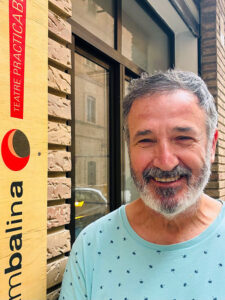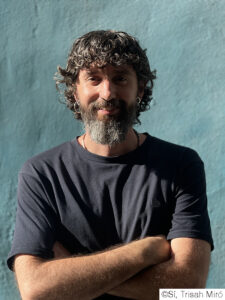
Tomás Navarro grants us this interview, a psychologist in love with people and what they feel, they think and do. Founder of a consultancy and an emotional well-being center, He currently divides his time between technical writing, training, the consulting, conferences and advisory processes and coaching personal and professional. Among his published books: emotional strength y Kintsukoroi. In this case, We asked him about his latest book. Wabi Sabi (Paidos). GINÉS J. VERA
In the first part of the book he talks about how many books stop at the theory of attitude., in the fact that, but they do not address the how.Instead, In 'Wabi sabi' the wabi sabi philosophy is promoted as a method to develop a change of attitude in a didactic way, to apply it practically in everyday life. Tell us about this substantial difference supported by your experience in consultations.
In self-help literature, slogans are often thrown like someone raising a toast to the sun., but the truth is that if you ask its authors how to achieve what they propose and that is so, They don't have a coherent answer to give you.. En Wabi Sabi, instead of telling you what to do, I try to show you some alternatives, inspire you with some resources and I'll explain how. I love sharing my knowledge. Sometimes living better is not that complicated and the only thing I do is explain the same thing that I explain in consultation adapted to the intimacy and freedom that a book provides you.. Wabi Sabi is a concept that encompasses a series of steps, of practices and knowledge that will help you incorporate a change in attitude, compiled in a didactic and entertaining way, without losing anything of rigor. Wabi Sabi is a psychology book written by a psychologist.
As he did in his book Kintsukoroi, again includes a part of fiction, as a story, with japanese characters. Tell us about this approach to Japanese culture and, on the other hand, why you have structured the book in three parts after the introduction.
Japanese culture fascinates me, good like so many others. To this day I have not found any culture from which I cannot learn something.. Bueno, all cultures, including ours, They have good things and not so good things. Well, the reality is that Japanese culture fascinates me with the cultural transformation that began after the Second World War in which they sent transmitters all over the world to design a profound change in the educational model.. Being contemporary with this change is a privilege.. Besides, I love looking for inspiring elements outside our borders to enrich our lives. On the other hand, the free one has a first part in which I explain in detail what the Wabi Sabi concept consists of., influencing the process in which I contacted him and how I decided to transform that beautiful concept into a vital attitude.
In the second part I provide keys to incorporate Wabi Sabi into your daily life., in the different vital areas such as with the incomplete, the loss, perceptual processes, social relations, serenity and calm, detachment or adversity. Finally, in the third part, I explain how living a vine in Wabi Sabi transformed me. This part is a novelty in my books since for the first time I speak in an intimate and personal key..
Part of the wabi sabi philosophy consists of a personal transformation starting with a change of attitude, a more realistic one, contextualized and relaxed accepting imperfection. Is it so?
Definitely, that is the basis. Attitude is what gives meaning to what we perceive and what decides what response to give to the world.. If we are able to have a more realistic attitude, we can better adjust our expectations; if we can contextualize what happens to us, we will be able to give you a better meaning and a better answer; y, finally, if we are able to relax, we can live another life different from the one we usually, much more adapted and full, away from the fear of everything that could happen to us.
I especially liked the differentiation that we read - and at the same time we have to question ourselves- about whether what we pursue at a moment in life are needs or desires. Differentiating them is key to establishing the urgency of what we are going to implement in this regard.. It even gives some tricks to distinguish them. Do you tell us?
Need comes with anxiety, unlike desire. I have to affirm that we can have whatever needs and desires we want., but they have to meet two conditions: The first is that they are ours, no taxes and the second is that they do not have to limit us. Starting from this basis, the problem is when we confuse a desire with a need.. When we have a need we will feel anxiety until it covers us.; while with a desire we will not feel that anxiety. The problem is when conditioned needs come into play, that is to say, that which becomes a necessity without being one. When you associate a smartphone with your self-concept, a car to your self-esteem or a partner to your happiness, the absence of those objects or people ends up causing you anxiety.
I usually use a trick to identify if something is a want or a need., I mention it in the book, I usually wait, a few minutes, hours, days… If I can wait without problem, It's usually a wish, If I can't wait and my anxiety grows, It is usually a necessity. Nevertheless, Asking yourself the question of whether what you need so much is a desire or a need is enough.