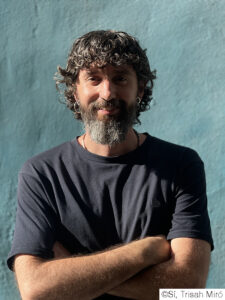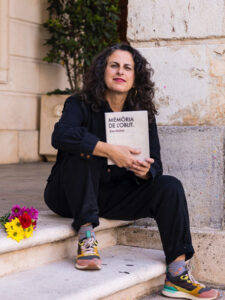

This week Pepe Monserrate gives me an interview, author of the book Elevate (Planet). Ten years ago, Monserrate had not set foot in a workshop, instead today, its large-format sculptures attract art collectors. He had a successful career working in management positions in large companies and entrepreneurship in sectors such as the Internet and renewable energies.. Currently sculpting in bronze, iron or refractory paste, exhibits and sells successfully abroad. GINÉS J. VERA
The first thing the reader discovers in this book is the free spaces, almost like a book in progress. In his biography, at the end of it, I think it gives us the key. Elevate It is a book-tool for personal transformation where the reader is the protagonist. Is it so, It is a book halfway between Pepe Monserrate and each reader?
No, no, I only lay the foundation, I invite you to use a methodology that has worked for me. The true author of Elévate is each one.
The book Elevate is coming, somehow, with a partner 2.0; I mean a mobile application, the Elevate app. With it we can continue using the method it proposes without having to carry it with us. Tell us about this app and its advantages for new digital readers.
Like the tool book, The App has been created as a guide and support tool in our personal transformation process (that never ends!). helps us stop, reflect, decide and, above all, to remember day by day what each one wants and has decided to do. The App is a complement to the physical book in case one day we don't have it on hand. It also allows us to easily incorporate images from our reel that help us visualize and feel strongly about each goal we have set for ourselves..
“Remember that before money comes your emotion, and your values”, We read. Also that we must focus on “what excites you and you know you can do and the money will come later”. I found it curious given the value it has., especially in times of crisis, money and its achievement; let's not say its urgency. I would like you to tell us about it.
Once we ask ourselves important questions and answer them full of emotion, it is likely that we will find clear objectives and the first steps that we believe we should take to get closer to that objective.. It is not about breaking with everything and dedicating ourselves to a baseless dream.. It is about, regardless of what he feeds us, take steps every day towards what excites us. 365 steps a year in one direction make many things happen, among others, the possibility of starting to receive income from what we are passionate about.
In the section titled Prioritize, We read a phrase that I would like you to explain to us. It is the one in which he tells us that it is normal for our brain to try “boycott any changes”. Tell us about that internal boycott when even we turn against ourselves.
The internal boycott has to do with the thousands of automatic responses with which our unconscious works.. The brain works the same as when we ride a bike through the countryside and we tend to follow the beaten path, through which it is easier to travel. The brain doesn't care if that path benefits you or harms you., It only shows you the easy path that you go through a thousand times. You have to create a new path so that when you detect that you are going down the usual path (that you know where it takes you) replace it with that new one (that takes you where you want). This tool is extremely effective in any facet of our life. (personal relationships, body and energy, professional life…etc.). It forces us to stop and think and decide on a strategy and a concrete action plan to achieve an objective.. We create algorithms, automatic responses, applied tools that help us transform our lives by eliminating things we don't want or like and incorporating responses that make us feel in control of our lives.
In addition, I would like you to tell us that “our observations help create reality”. I think it is related to John Wheeler's participatory anthropic principle. I find it very interesting. I invite you to tell us briefly about it in light of your book and the Elévate method..
For Wheeler, the true nature of reality must be sought in the laws of quantum mechanics., who say that before the observation is made, a subatomic particle exists in several states. Once the particle is observed, instantly collapses into a single position. He was wondering “Are life and mind irrelevant to the structure of the universe, or are the center of it?”. According to Wheeler, reality is created by observers.: “no phenomenon is a real phenomenon until it is an observed phenomenon”. According to your “Participatory Anthropic Principle” (PAP): “our observations contribute to the creation of physical reality. We are not mere spectators on a cosmic journey, “We are creators living in a participatory universe”. I am not a scientist, but I am fascinated by this principle and it reinforces what I thought about the power of our attention. If you put your attention only on what you really want, you will have a much better chance of it happening than if you let your attention jump from one option to another randomly.. The challenge for any person is to decide exactly what they want in each area of their life and, when it is clear, Put your attention only on what you want and remember to take steps towards it every day.