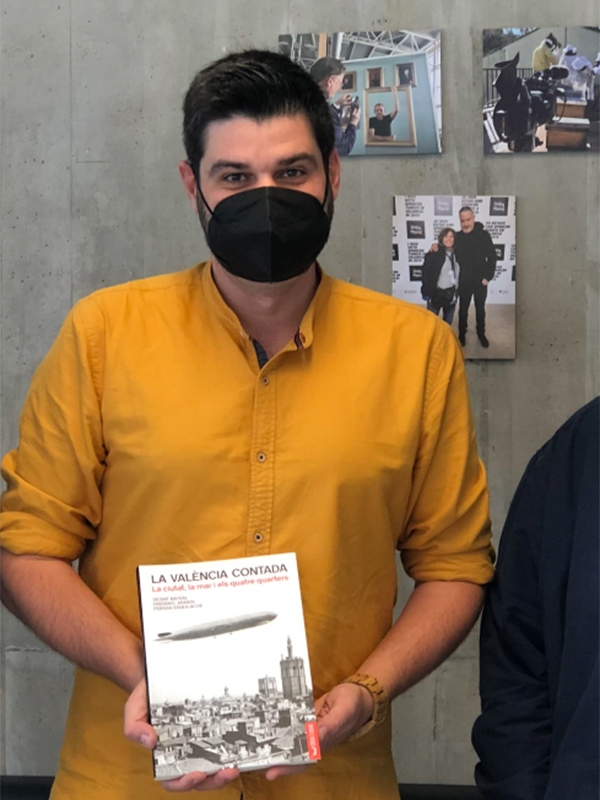
Valencia was a Roman city that was practically in ruins between the 7th and 8th centuries and today it is one of the 150 cities (with more than 500.00 habitants) oldest on the planet, that is to say, that hides a lot of history that needs to be unearthed. Between 2016 i 2019, the historian Vicenta Baydal coordinated a cycle of public meetings that analyzed the historical particularities, social and cultural of different neighborhoods of Valencia: The Carme, Russafa, the Cabanyal, Benimaclet, Patraix, Sant Marcel·lí, the Eixample, Campanar and Velluters. The La València Contada initiative consisted of bringing people together in our social center par excellence, the bar, within the neighborhood to be studied, with architects, archaeologists, historians, sociologists, journalists and people of culture to talk relaxed, with a beer in hand, of the particularities of each place. The book was born from those meetings The Valencia told edited by Drassana, which we talk about with its authors, Baydal himself (VB), Frederic Aparisi (FA) i Ferran Esquilache (FE), to discover that, indeed, Valencia never ends.
We have torn down walls, we have let farms die, palaus, walls, convents and mills, we despised the vegetable garden… It is clear that Valencia has not been able to take care of its historical heritage as it should, do you think that the local administration has been particularly negligent if we compare it with that of other places in the Spanish state? What "disappearance" do you particularly feel??
VB: Yeah, here there has been a greater destruction of heritage than in other places. What remains of Roman or Andalusian Valencia, for example? In other cities there is a lot left, but here practically nothing. likewise, from the 18th and especially the 19th century, after the Bourbon monarchy eliminated the political institutions of the Kingdom of Valencia and lost the collective pride of a remarkable past, historic buildings were left to be lost without compassion, like the Town Hall, the Palace of Mossén Sorell, that of Ambassador Vich, etc.
FA: In any case, when the walls of Valencia were demolished on 1865 it is done in accordance with urban planning needs and within a general logic in other European cities. Another thing is what has happened in recent years 50 years. Then it was known what was being done and the heritage value of what was being destroyed, as is the case of the departure from La Punta.
FE: I agree. Although today we consider it a tragedy that the Palau del Real was also demolished in the 19th century, the Casa de la Ciutat or the Convent of Sant Francesc, which are some of the buildings that I would have liked to see standing, it must be understood that when this was done there had not yet been generally developed a social sensitivity for heritage. Per cons, that even at the beginning of the 21st century the Convent of Sant Domingo remains closed to the public is a shame or that medieval farmhouses were demolished in Partida del Pouet de Campanar was not only a tragedy, but a conscious patrimonial "crime"., that those responsible have not paid.
And citizenship? The Valencians are famous for meninfots justifiably? We know how to appreciate what we have?
VB: Meninophotism was historically instilled in us by sticks. On the basis of taking away self-government, impose the militarization of the administration, to instill that their own language and history were dirty and contemptible, etc. Fortunately in recent decades, in parallel with the attitudes that have tried to maintain that same line, an awareness of valuing our heritage has also been developing and spreading. Now there are many people who, regardless of their ideology, knows how to appreciate what we have done collectively throughout history and wants to preserve it, enjoy it and keep it for future generations.
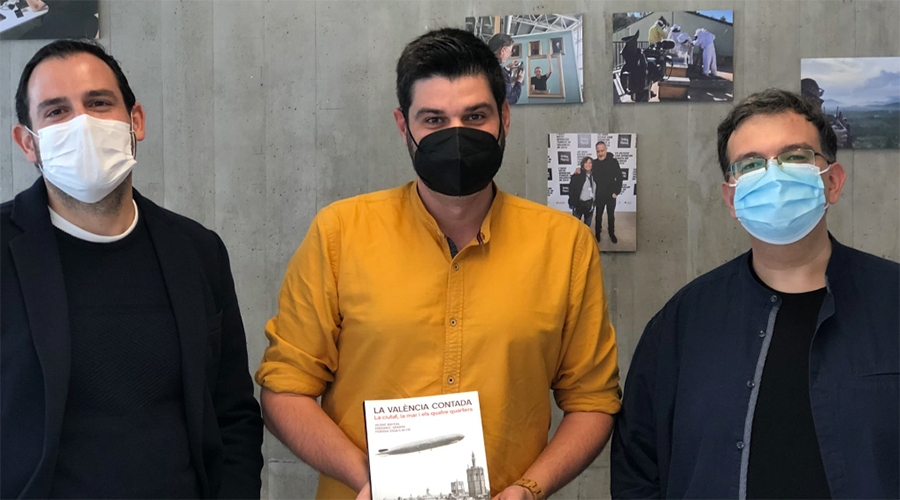
We read a The Valencia told that the sea line was coming (before the port was built) at the Cabanyal market approximately or that the Russafers moved through the ditches of the area in boats propelled by hooks, as now in the Albufera. Or that the convent of Sant Francesc stood in the town hall square, demolished with the confiscation of the 19th century. Or that it happened in Patraix 1927 the founding meeting of the FAI. Tell us about some notable features of the city that people don't know about.
FA: Indeed, many people are surprised by the urban changes. For example, Calle la Pau, which today is an essential artery of the center, it is only a hundred years old and was built at the cost of destroying what had been the city's Jewry or street. I, without leaving this street, Plaça de la Reina is also the product of a very recent transformation. Before the 20th century it did not exist, rather, it was an island of various houses and that is why the Ferros de la Seu gate has a fold-based design, which gave a feeling of spaciousness in a space that was originally quite cramped. We buy, instead, the door has lost all its expressive force. likewise, without going too far, few people know that the Casa de la Ciutat stood on the garden right next to the Palau de la Generalitat, predecessor of the current city council and which was as big as the Generalitat itself, but it was demolished in the decade of 1860.
VB: In the long term, I would emphasize the importance of political structures in the materiality and self-consciousness of the city's inhabitants. In Roman times, Valencia was a discreet provincial city and in Visigothic times, in fact, was greatly reduced, with a very small space of houses and streets. At the time of al-Andalus, it stood out from the 11th-12th centuries, but neither could it be compared to other large Islamic cities of the time. Instead, during the late medieval period, from the moment it became the capital of the Kingdom of Valencia created by James I, the city begins to grow incessantly until it becomes the largest and richest in the Iberian Peninsula in the 15th century, in front of Lisbon, Barcelona or obviously Madrid, that she was very small then. That capital, and the awareness of leading an entire kingdom, it was very important until it was cut off from the limelight 1707. Later on, the move to disaggregation and provincialism have also influenced the development of the city and the self-awareness of its inhabitants. That is why I think it is very important for Valencia to recover that collective leadership.
God in the book that Valencia rose where it rose to take advantage of the advantages provided by a navigable river like the Tyris that, paradoxically, he did a lot of damage because of his "love" of overflowing. It is true that Valencia has lived with its back to the sea for a long time? What do you think the explanation is??
FA: actually, the exclusively positive view of the sea is very recent, from the second half of the 20th century, linked to the development of mass tourism. Until then, a more negative view prevailed. It is true that it was the main way of communication, essential for international trade, but it was also the entrance route for maritime attacks, the epidemics, etc. Geography didn't help either, since just behind the coastline predominate the wetlands and the marshland, which in historical times was a very sparsely populated space. Impossible to build res there. For that very reason, if there were not very advantageous geographical conditions, cities used to be built slightly away from the coast to avoid the dangers of the sea and the marsh. In that sense, Valencia is no exception. I, in any case, at least since Andalusian times there were always activities and a certain population in the maritime strip, linked to naval trade and fishing, and that, despite being a few kilometers from the urban core, always considered part of Valencia. The idea of living with your back to the maritime strip is much more recent, and sometimes mediated by political interests.
History filters down to the present, shaping customs, gastronomy, streets and, even, language. For example, in the book we read that the noise made by the seder masters hitting the wood of the machinery was so great that they ended up coining sayings like: "chillies more than velvety". What other current characteristics have we inherited from the towns that have passed through Valentia over the centuries?
FE: Obviously, the further back in time we go, the less things have been preserved, because history is change. We have some customs from the Romans, starting with the worship of the saints, which are nothing more than the Christian adaptation of the pagan gods, although in most cases we are not aware that they come from so far away. But it must be clarified that they do not come directly from the Romans who lived in Valentia, because there are several social ruptures throughout history and, therefore, they are things that will be preserved in other places in Europe and will be brought to us later in the Middle Ages by the Christian settlers who came from the north. We also keep things from Islamic society, for example the gardens, and fundamentally some gastronomic characteristics, but because Muslims coexisted with Christians between the 13th and 17th centuries, until the expulsion of the Moors in 1609.
VB: Reis's hull, for example, which has been talked about so much lately, it is finally an Andalusian heritage, since the Muslims were the introducers of sugar, and sweets similar to marzipan, in the Iberian Peninsula and Europe. Or also rice, which is a product carried by them as well! On the other hand, the Valencian language is the result of the medieval colonization of the Catalans and Aragonese who came with James I and his successors. Or the toponymy is also a clear example of the long history of the city: Valencia is a toponym of Roman origin, but also Campanar or Patraix, while Xerea, Russafa, Malilla or Benimaclet are of Andalusian and Arrancapin origin, Stages, the Carme or Velluters from the late medieval period. The city is like a great historical map from which we are erasing parts, but at the same time we trace them again with other hands and the sum of all of them constantly forms a new city, which is the same but different.
We inherited from the Romans and the Arabs, but what happened to the jews? There is something left in today's Valencia?
FA: It is true that little remains visible, although physically there is more to it than people usually think. At the entrance, Between Carrer Colom and Plaça dels Pinazo are the remains of the Porta dels Jueus, which receives that name because the cemetery of the old Jewry was nearby. On the other hand, foundations of Jewish houses have been found in the basement of the historic seat of the University of Valencia and some streets such as de la Mar have survived from the Jewish community, which was one of its main axes, or that of the Medinas. likewise, the historical existence of Joan Lluís Vives would not have been possible without the Jewish presence in Valencia, since he belonged to a family of converts. With everything, the footprint is smaller than that of other societies because they were always very much in the minority; until his expulsion in 1492 they never exceeded the 10% of the city's population.
It is affirmed in the open: "if Campanar had not existed, at present the island of Cuba would not be an independent State". Explain that bold statement.
VB: It is one boutade, obviously, but with this we also introduce into the book the always problematic role of individuality and chance in history. Without the revolutionary work of José Martí, Cuba probably would not have become independent from Spain in 1898, or he would have done it at another time and under very different conditions. On the other hand, José Martí would not have existed without the family that gave birth to him and raised him, that of Leonor Pérez and Mariano Martí, who was the son of a family from the Horta de Campanar and evidently had a great influence in the life of the revolutionary himself. Therefore, pulling the rope, we can say that without Campanar the island of Cuba would not have become independent… recently, studies by José Luis Grosson have shown that Mariano Martí's family also lived in Benimaclet, the Canyamelar and Carrer Sagunt, on, in fact, he was born. His Valencian roots were deep.
Vicent says that Valencia never ends… Which parcels do you think have an in-depth study pending?? What remains to be discovered?
VB: There are thousands of topics to learn about and research from many different historical eras, from Antiquity until now. From the Middle Ages only with the information available in the Municipal Archives of Valencia, the Archive of the Kingdom of Valencia, the Valencian Library and the Municipal Newspaper Archive, which are inexhaustible mines of information, we could make books and books and books about topics that are not known or about which very little is known, both demographically, genealogical, social, cultural, politician, institutional, linguistic, technological, military, legal, economic, professional, etc. On the other hand, there is also a lot missing in terms of the history of the neighborhoods, since traditionally historiography has always focused on the past of the great city, what is now Ciutat Vella, but he has left aside the knowledge of the rest of the nuclei that currently also make up Valencia.
FE: I would add that archeology still has a lot to contribute to our knowledge of the history of Valencia. In recent decades, a lot has been excavated following the boom urban planning, but there is still much more that remains to be excavated. And not only in Ciutat Vella, but also in the garden there are still many things to discover.
Of all the cobbled corners of Valencia that have survived over time, which one do you stick with and why?
FA: For me the University, for everything it represents as a center of knowledge, but it is also a space of silence and calm in the midst of all the hustle and bustle of the city.
FE: There would be many, for example the Market, that no matter how famous it is, it is still a delight, but I am clear about it for professional reasons: the vegetable garden of Valencia. Many people think that it is a natural space, but in reality it is a human construction as much or more important from a historical point of view than any heritage building. The city of Valencia could have passed for centuries without the Llotja, but not without the vegetable garden.
VB: There are so many I can't choose: the view of the Torres de Serrans crossing the river by the homonymous bridge, the Portal of Valldigna, the Plaça de Sant Vicent Ferrer and the church of Sant Joan de l'Hospital, the Renaissance cloister of the Carmel Convent, Roteros street or Serrans street (with the view of the tower of Sant Bertomeu in the background), Redona Square and Lope de Vega Square, the hermitage and the Pouet de Campanar corner, Vera's… I think I'm in love with Valencia.