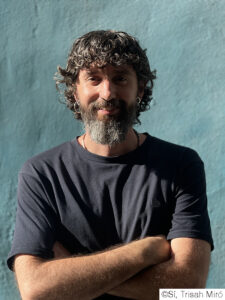
This week I launch myself into the literary sea to interview Luis Mollá, author of the novel The Admiral (to lunch). Luis Mollá Ayuso (Rate, Cadiz. 1955) He is a ship captain in the Spanish Navy.. As part of your profession, has been on board different ships, highlighting his role as a teacher on board the Juan Sebastián Elcano school ship. Stand out, as a writer, who twice won the maritime narrative literary contest Boatswain. The first in 2004 con Scorpion venom and the second in 2008, con The seventh wave. In 2005 won the Virgen del Carmen award from the Spanish Navy with the novel The Tomb of Tautira. He is a frequent speaker on topics related to the sea and a collaborator with numerous journalistic articles in different media outlets., publications, naval forums and radio programs. The Admiral, why I ask you, It is his eleventh novel. GINÉS J. VERA
Some details of the time have caught my attention, which in addition to making reading his novel entertaining., they enrich it. For example, the fact that the decks of ships were painted red, helping to scare away fear when the blood of the crew ran; or that there was a 'smoking' area on ships, because tobacco had been the cause of fires and loss of ships. Tell us these curiosities and others, if you consider it, of the time included in the novel.
Actually, These are true notes., Well, those he mentioned were seafaring customs of the time.
The Catalan population, we read in several paragraphs of the novel, was not a supporter at the beginning of the s. XVIII of the arrival of a Bourbon to the Spanish Crown since he was a supporter of reformist and centralizing policies, thus endangering their privileges. On the contrary, Archduke Charles was willing to establish his capital in Barcelona. It seems that the friction between the Bourbons and Catalonia comes from afar.
It is exactly as you mention it.. And from those rains, these sludge, how can you read, see and hear today in any media.
The courage and intelligence of Blas de Lezo was evident from the first fight in which he participated., but I think that where he stood out for his leadership capacity was in Palermo, aboard the Winner. Can you tell us about this outstanding event in the life of our protagonist??
Actually, His leadership ability was evident in all the battles he participated in.. The aid to Palermo and Peñíscola can, nevertheless, seen from a different perspective, since they were the first campaigns that were developed under his total responsibility at an age that in most cases would have been too early.
In the final epilogue he explains his reasons why he believes that the fight between the Velvet of Lezo and the Stanhope by John Combs, since apparently there are sources that vary the version of this combat. Let us know this point, Well, I think it is interesting for those who approach the novel with a more historical spirit than a playful reader..
In reality, I do not maintain that the combat took place with complete certainty., but it could have happened, Contrary to what some historians claim, they deny it., at the same time that they admit many shadows in the biography of this great sailor. I can give it because it is in the line of your procedure, and the fact that a Stanhope ship does not appear in the list of English ships of the time does not mean much, Well, a country capable of erasing a battle from its history (Cartagena) What wouldn't you do with a ship beaten by a smaller one?, español, and under the command of the hated Blas de Lezo.