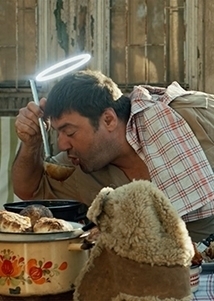
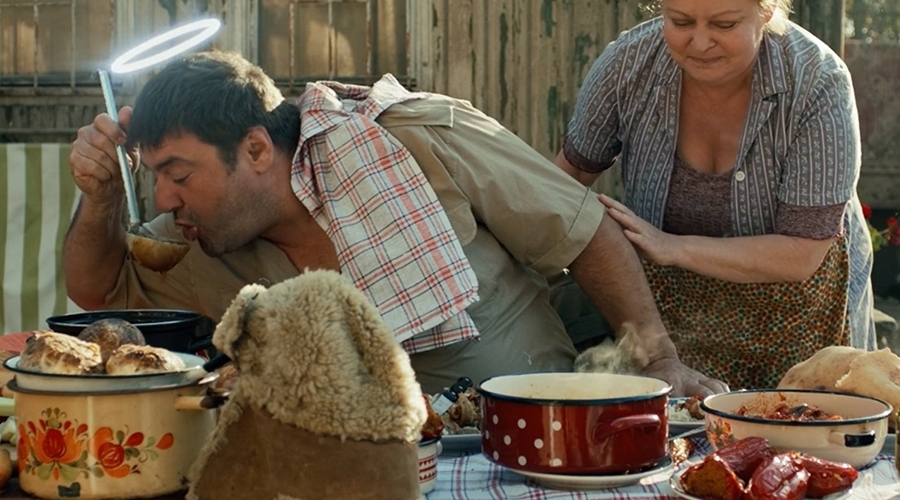
Put ourselves before a movie like Heavens above by Serbian director Srdjan Dragojevic perhaps requires a warning, Well, we are facing a kind of pastiche, a somewhat bizarre cocktail of elements that result in, at least, a peculiar job, for extravagant moments. there is here, at least, three stories. In the first of them, A man of very good character receives the gift of holiness in the form of a heavenly halo that suddenly appears above his head. But the phenomenon, more than a sign of divine blessing, It seems like a sentence when he faces rejection from his wife., who is worried that he has become a weirdo in front of his neighbors. As a strategy to recover your previous state, and at the direction of an orthodox priest of more than dubious morality, she will try to corrupt her husband. In the second of the stories, a madman believes he receives a call from the virgin through a mobile phone, while in the third a street painter invents a new style of painting that allows him to feed the people who look at his paintings., what will end hunger in the world.
If the impossible adventures that its protagonists live could be considered small miracles from God, More miracle is Dragojevic's own work, a movie that, for the first time, has had the economic support of all the countries that formed the former Yugoslavia. A process that has nothing casual, but is the result of years of work at the core of a political space in which the traces of war still remain fresh in the memory of its inhabitants and, above all, in his cinema. “I grew up in Yugoslavia. I made my first film in 1991, when the country was divided. Since then, I have made films despite the circumstances of the war. Movies that have been very popular in all the countries that were part of the former Yugoslavia, what made this movie possible. Thirty years after the war, "At last all Yugoslavia together has been united in a single work", commented the director at the festival press conference.
That idea of community, transversal to the entire territory, pivots on a story that does not settle in a specific space, but in a whole that encompasses it physically and culturally, a deliberate decision on the part of the director. “It was one of the most important decisions during the writing of the script.. All the countries of the former Yugoslavia have similar experiences with communism and atheism. We have lived for more than fifty years in atheist countries and when Christianity returned, had a lot of influence on a lot of people. But it came back in the form of a strange hybrid that wasn't exactly the same as before., with new rituals, some very extravagant. It was a time of great challenges that reminds us of the early days of Christianity, when the pagan and Christian world coexisted", Dragojevic reflected after the screening.
The story arises from Dragojevic's own interest in the stories of Marcel Aymé, French writer who developed his work in the first half of the 20th century and who was very important in his intellectual formation. to this experience, Dragojevic joins other more personal, as is the fact that, suddenly, his sister became a nun, something that pushed him to take the pulse of the role of religion in his life. But this is not the only reflection to which the film invites us.. So, in the third story, the one with nutritious paint, Dragojevic proposes that we think about the function of art and the contradictions that new forms of consumerism push us into.. "Around 1930, Marcel Aymé wrote a story that was based on a reflection on left-wing writers. Marcel Ayme, who was right-wing, He thought that left-wing writers used art as a nurturing medium in order to influence their audiences.. My interpretation is totally different, It's a metaphor for consumerism., of what today is called creative industry. There is an idea that refers us to neoliberalism when art has to make money. It's a question I ask myself. Should my movies make money? Should they be a way for my subsistence? Or should I only create things I like??”, I was reflecting.
Returning to the question of God, Dragojevic found that his film provoked conflicting reactions among his acquaintances.. For your sister, For example, It was a deeply religious film., while his atheist friends highlighted an ironic sense that referred to Buñuel. “It is not easy to make a film about faith and Christianity. The movie has a lot of metaphors that I don't expect everyone to understand.. For example, one of the ideas about the golden calf is a metaphor about idols, about our present faith in consumerism. Below, It is also a metaphor for God's intentions.. In that sense, in the background, Aren't we all like little dots of paint in an abstract painting created by God?”, said Dragojevic before the audience at La Mostra.
And as for the mix of styles, Dragojevic, will state: “I consider myself a postmodern director. Before embarking on my career as a director, I was a clinical psychologist and psychotherapist and I often use psychotherapy in my films.. Sometimes my films are tragicomedies, I like to extract the intensity, the emotion, I can start with a comedy and then move towards a drama. sometimes I fail, of course, but I like to experiment with different methods. On the other hand, I don't know exactly what Balkan aesthetics is.. I grew up with Buñuel, Italian neorealism and the British comedy of Ealing, so I don't consider myself a Balkan filmmaker, although I do not deny my roots, of course." To finish, and as a suggestion, Dragojevic asked himself this question that he tries to answer or, at least, present your film: “The miracles, Are they the work of God or the devil? What is the true nature of God?”The answer will be in each of us, the spectators.
Very far away, both in style, as in the background, from the Croatian film, but with broad similarities between each other, were the two French productions of this day and the Official Section of the festival. We refer to Playlist, first long work of the comic artist until now, Nine Ancient, y The world after us, debut also in the feature by Louda Ben Salah-Cazanas.
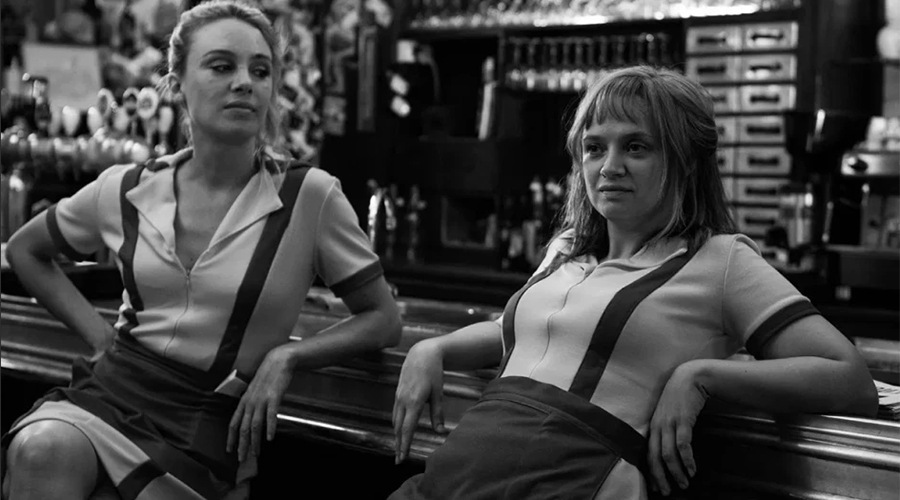
Let's go with the similarities. First, the argument. In the first movie, we meet a young woman, Sophie, road to thirty, who works as a waitress in a bar, but whose dream is to become a comic artist. When the narration begins, The young woman has an interview at a publishing house for a secretarial job, but the experience turns out to be unsuccessful and he must return to his job of waiting tables.. In the middle of all this, her sentimental tribulations appear with all types of men, none of which seem to fit his profile and, or they take advantage of it, or are they too rare. In The world after us, the story introduces us to another young man, I have to, at a similar age. Labidi works in a home service company (what is known as riders), but his dream is to become a novelist. When starting the plot, Our protagonist has just signed a pre-purchase contract with a publisher for a novel he is writing.. Everything seems to be going well in his life, except for the fact that he doesn't have much money, thing that worries you, especially when he meets a girl he falls in love with and starts dating., and whom he will try to entertain with his meager income.
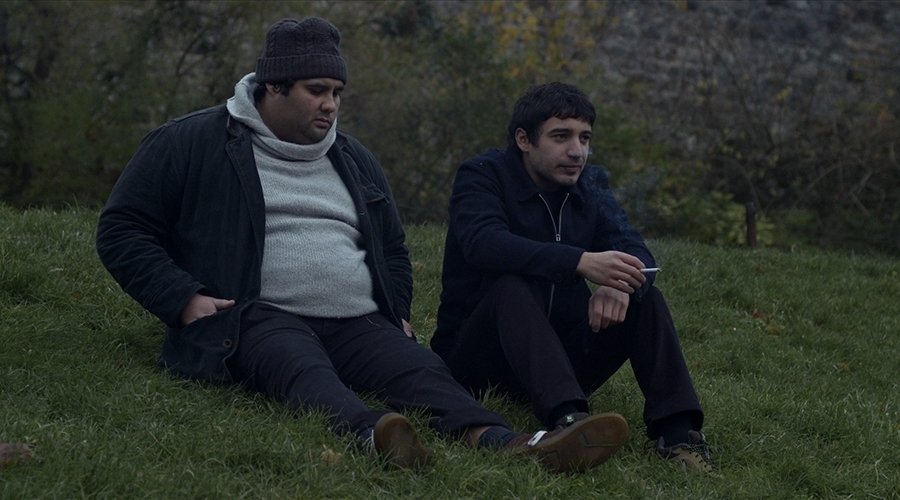
But if there is something similar about these films, it is not so much because of the plot but because of how it serves as a background to give us a sample of the problems of the generation born around the turn of the century.. In the case of Sophie, His ambitions clash with his lack of academic training and his insecurities., both on a sentimental level and with regard to his talent. This problem will lead you to make all kinds of mistakes: again and again, she will choose the least suitable man for her, while doubting his abilities, feeling increasingly disoriented. In the case of Labidi, we are on the same ground. In front of his girlfriend, will try to pretend that it is more financially solvent than it really is, which will lead him to commit all kinds of tricks to sustain the farce that has been created, while, professionally, You might miss the opportunity of a lifetime..
So much Nine Ancient, like Louda Ben Salah, they make a detailed drawing of a generation lost in the face of the conflicts that the system poses to them, without a clear horizon and unable to put order in their lives, especially if we compare them to the generation that brought them into the world. In the case of Labidi, his parents have a modest bar, business that, without enjoying great expenses, At least it has allowed them to lead a dignified and organized life (and save some savings). And the same thing happens in Sophie's case.. We don't know what his parents do., but after multiple comings and goings, the family home will be, as in the case of Labidi, your refuge when things go wrong. This wandering from one side to another, no direction, trying to find your place, It is presented as the only and very painful way to solve your problems. in the gaps, We will meet your closest friends, perhaps simpler faces, less ambitious than them and to whom, for one reason or another, will end up unconsciously despising at some point in the narrative. All of this, and in both movies, seasoned with good doses of very witty humor that lightens the internal drama, example of the talent as creators of situations of both directors and scriptwriters.
Where both films perhaps separate is in that political background that is found in Ben Salah's film. Indeed, Labidi is the son of first-generation immigrants, a shadow that weighs on his record and that will be an important part of his personal development. Despite his ingenuity, Labidi feels displaced in a society that, he understands, looks at him with suspicion. But that vision of himself is pure fiction. It is his own complexes that distance him from others, especially from his girlfriend, who doesn't quite understand what's happening to him. one dimension, that of the immigrant, which is not found on the Nine Antico tape that, in its resolution, is more open, without that, apart from overcoming their insecurities, let us come to appreciate what the “lesson” is that it leads us, something that is better captured in Ben Salah's film. G.LEON