Two radically different proposals for this second session of La Mostra de Valencia-Cinema del Mediterrani.
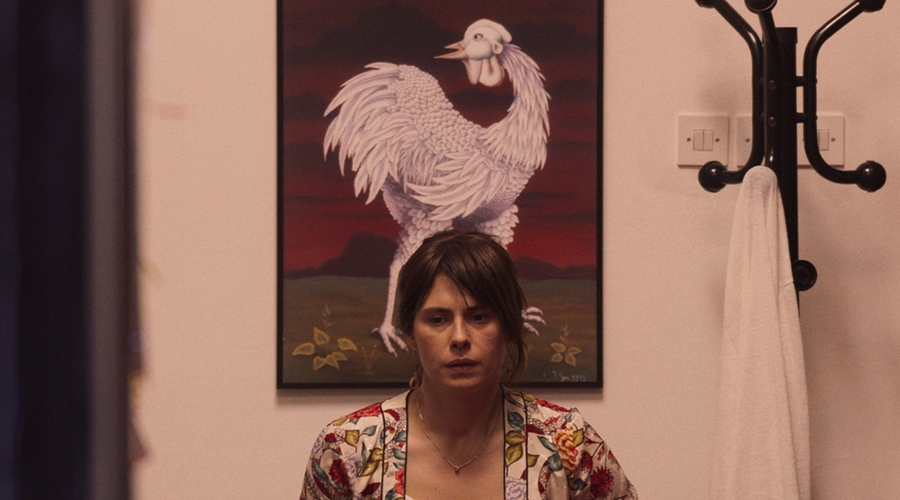
In The staffroom, Croatian director Sonja Tarovic literally takes us into the background of a secondary school. Titles such as The class de Laurent Cantet o Today it all starts by Bertrand Tavernier. But if the two French directors paid attention to the problems or conflicts that affected the students of the schools that were the subject of their films,, Tarovic sets his sights on teachers. So, like an intruder, settles into their meetings and intrudes on their small conversations, to discover a world in permanent collision.
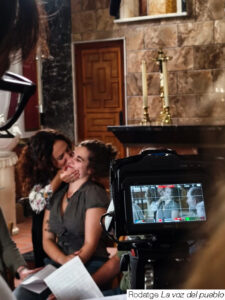
Anamarija comes to this small world, a young school mediator. Anamarija tries to integrate into the school team and do her job as well as possible, but soon the misgivings of his own companions, instigated by the matriarchal figure of the director, they will turn against her. Anamarija will try to overcome the rejection and constant questioning to which she is subjected, putting their own insecurities on the operating table. In the confrontation between the torrent of emotions that unleashes these conflicts, Tarovic draws an intricate picture of the cynicism and lack of empathy on which modern societies are built.. After appearances, however, the weaknesses of a community that feels disoriented appear, a game where truth and lies, reason and unreason, They move in a fluid space that is difficult to specify..
“When I started writing the story, I looked at the institute as a microcosm, trying to imagine what life was like for adults at school. A world that represents how I see adult life in general. It was a good excuse to convey the feelings we have, not just in any workplace, but in any space.”, explained the Croatian director at a press conference after the first screening of her film. In this environment, Anamarija appears as an essentially moral character. So, He will try to worry about his students where his colleagues seem to have deserted their pedagogical responsibilities., not only in regards to the teaching of the subjects they teach, but in his intimate relationship with them. Disenchanted, frustrated in their personal expectations, His new colleagues seem back from everything. Anamarija will also dedicate her energy and commitment to her work to them.. You will soon realize, however, that those principles, so clean, They serve little purpose in a world where everyone has their own motivations for behaving the way they do.. One might ask here, even, if it is not Anamarija herself who is putting her own personal interests of self-realization first, to his real job. “This is not an autobiographical story., but there are many elements of these characters that are familiar to me, people I know”, explained Sonja Tarovic about its creation. “Marina [Redzepovic, the main actress who plays Anamarija and who accompanied the director in her debut] and I worked together on the script, and in it we tried to create an atmosphere in which it was not always known who was right. Everyone is right and, at the same time, everyone is wrong. Thus, you can empathize with all the characters in the room, so you can forgive them for what they do wrong. This emotion was something we wanted to convey to all the characters., “Not just a main character.”
To give greater veracity to your work, Tarovic usurps the forms of the documentary genre, giving your film greater dynamism and freshness, y, at once, achieving a difficult balance between extracting from his characters that intimate naturalness that the project required, while maintaining a distance from them that would reinforce the most objective view possible on the reality that he intended to portray., avoiding all judgment about her. Judgment left in the hands of the viewer. “The most important thing was to share the same energy”, actress Marina Redzepovic explained about the filming of the film. “She wanted each actor to be familiar with her directing methods.”, in the technical part of the film. That made it a challenge for the actors. Some of us had made some short films with Sonja, so we knew how she understands and feels the movies. When I remember the filming, I think about that feeling of us all moving all the time on stage. There was no private moment. My character is between extreme loneliness and an equally extreme desire to feel integrated.. Somehow, "It was very similar to what happened behind the cameras.", remembers the actress between laughs.
“Regarding the entire process, I was writing the script for a long time, It took me several years to finish it because what I wanted to do with this story was very difficult., “even to explain it to someone,” the Croatian director recalled when asked by journalists.. “The story does not address a single event that changes you or changes the life of a character. It's about how certain small events interact and how you make leaps and bounds until everything ends badly.. In general, in any work environment, Many times you wonder how a certain problem can have no solution.”, I was reflecting. With these elements, The staffroom It is presented as a travel manual around the contemporary world where the everyday becomes a thousand-headed monster., and routine our worst enemy. Shapes, objects and actions, They get married like this to reveal the ultimate meaning of what they want to tell.. ”There was an intention to build the film around the color red because that color is part of national folklore and inherited values.. The school is a claustrophobic arena of those values that are transmitted in society. A school year is like a cycle. It always has the same beginning and the same end. Every year it repeats the same structure. At school we celebrate the changes of season, national holidays, something you see in children's drawings, through the walls.” Tarovic explained. “In the film some images of paintings by the Croatian painter Ivan Generalic are mixed, who is a painter who has a naive style, and whose paintings have an even somewhat lunatic tone. In his paintings, repeats these cycles and in them terrible human characters appear in the midst of the beauty of nature. Beauty that this folkloric element has that is wonderful and, at the same time, It is claustrophobic and represents a very heavy load.” After leaving his previous job, Anamarija faces the same problems again. But now he can't run away. Trapped by her own complexes and social demands, will have to get out of that quagmire.
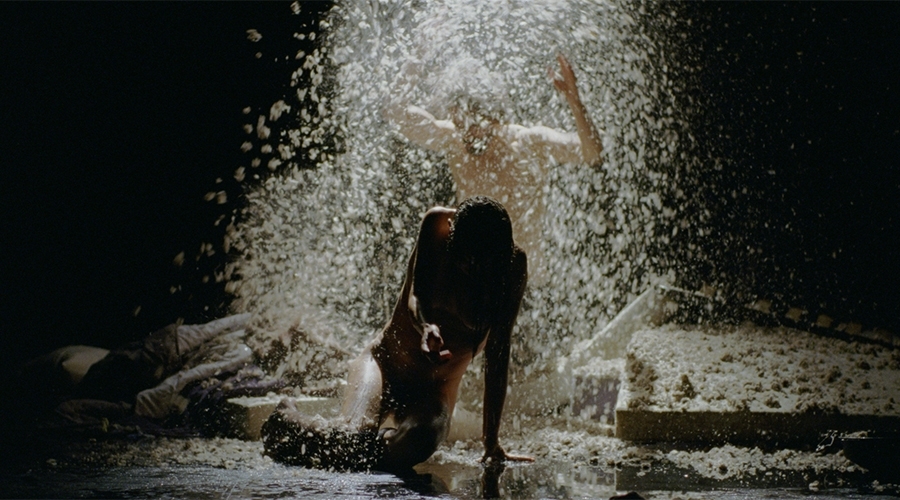
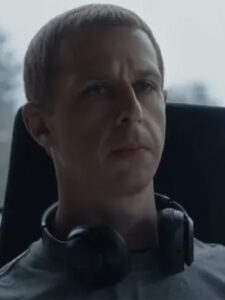
In a radically different tone it was presented Life's losers, by Portuguese director and producer Rodrigo Areias. surplus, in this case, talk about argument. A man moves through the empty space of an abandoned movie theater. After visiting several rooms, find some cans of film. Place them on the projector and watch the screen from the cabin. What we will see below is a series of excerpts from several of the shorts directed by the Portuguese throughout his career.
It is not at all easy for the viewer to establish the relationships that make up the images that Areias puts before our eyes.. However, The director leaves here and there some clues that we can grab onto to put together, maybe, our own interpretation of an elusive work, whose reading is taken firmly at times to the same extent as, the next moment, it escapes us like a leech or a fish that we would like to catch in a fish tank with no help other than our hands.
Definitely, cinema itself configures one of those clues that the director offers us. Film as a photosensitive material, but also as texture. In Areias's film, The photochemical image is contrasted with the digital image in a dialogue that proposes a confrontation between the old and the new, present and past, in a nostalgic look that, at the same time, resists being, to become vindictive. The image in super-8, 16mm o 35, shows his warmth and humanity on the screen in front of a pixel that creates distances, that hits us.
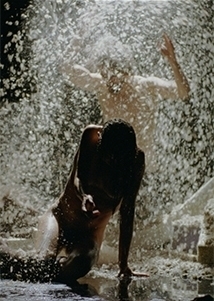
These elements, They allow the Portuguese director to offer us a reflection on the position of contemporary men and women in the face of the impositions of the prevailing economic system.. So, in one of the fragments, A man escapes from a factory where he works to bathe in a nearby river. After undressing, He keeps his clothes in a suitcase with which he floats in the waters of the river. On the shore, a woman has sexual relations with several men, while the factory machines don't stop working. Both characters will end up together, in the river, fleeing from that industrial and predatory hell. In another of the pieces, Another guy tries to establish a relationship with the woman who works at the reception of a museum where he works.. She gives him a book by Pessoa, while he returns the detail with an edit of The capitalthe Karl Marx. Poetry and politics come together in an almost comic dialogue that tells of two souls lost in the midst of the maelstrom of a consumer society that looks at the past without seeing anything., because this has lost all its meaning for us.
and the bodies. Bodies of men and women. Bodies that touch and join, are needed and, finally, bodies that are rejected, that collide, because all love also ends up being violence undertaken between two. And in the background, to Rodrigo Areias, All this serves as an image of your country, Portugal, long immersed in a lethargy from which there seems to be no escape. “This whole movie has to do with Portugal. With its economic situation in permanent crisis for centuries.”, the director will say at the presentation of his film. "We're not sad about that or anything like that.", everything is fine, but, at the same time, There are times when it is more difficult to be poor. “My films are also about the difficulty of surviving in a country like Portugal.”. The quote from Eça de Queiróz that opens the film resonates above the images at all times.: “For a man, being defeated or defeated in life depends, not from the apparent reality to which it has arrived, but of the intimate ideal to which he aspired”. G.LEON