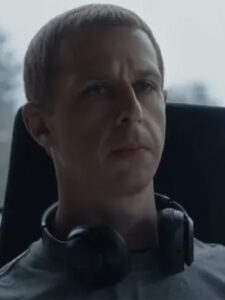
Original title: Busy · Thomas Vinterberg · Denmark · 2020 · Script: Tobias Lindholm, Thomas Vinterberg · Interpreters: Mads Mikkelsen, Thomas Bo Larsen, Magnus Millang…
Original title: Curveball · Johannes Naber · Germany · 2020 · Script: Oliver Keidel, Johannes Naber · Interpreters: Virginia Every, Dar Salim, Thorsten Merten…
The cinema of the Danish Thomas Vinterberg jumped onto the international scene with Celebration, his very successful second feature film, inscribed within what was known as the Dogma movement, formed together with his compatriot and friend Lars Von Trier. Since then (We are already talking about the end of the years 90), Vinterberg's filmography has followed a somewhat irregular path: less inspired when he delved into the realms of genre or historical narrative (Far from the madding crowd, At the commune), more accurate when he returned to that scathing analysis of the society of his time, case of the also held, The hunt. Within this second group we find his brilliant latest production.

another round introduces us to Martin, a high school teacher who is in the full maturity of life. Martin attends his history classes with profound disinterest, both because of the subject he must teach and because of some students who do not listen to him when he addresses them.. at home, Things are not going much better and his relationship with his wife and children is almost as distant as the one he has with his students.. Apathy and an apparent detachment from everything around him seems to have taken root in Martin's heart.. Even though everything is collapsing around him, He is like an intruder at a party that no one has invited him to.. And the same thing happens to the rest of the group of friends he hangs out with., all teachers from the same institute where he works and with whom he goes out to dinner from time to time. At one of his dinners, one of them, Nikolaj, He presents to his companions a curious theory that says that the human body suffers from a necessary permanent amount of alcohol in the blood.. According to this theory, presented by a prestigious psychologist, it would be enough to replace (drinking) this absence of alcohol, to achieve fullness in our social skills. To support your thesis, Nikolaj remembers historical figures such as Ernest Hemingway or Winston Churchill, illustrious drunks and great geniuses in their respective careers. No sooner said than done: Martin and his friends decide to put the theory into practice, willing to change their gloomy existences.

With this premise, another round It is presented as a devastating analysis of personal relationships in contemporary society. We have already discussed Martin's family problems, But the rest of his friends aren't doing any better.. Nikolaj lives under the yoke of a woman on whom he depends financially, but the one he can't stand (not even she can stand him) and some children with whom he has a purely documentary relationship, Peter looks for a partner he can't find and Tommy lives alone since his wife left him.. Past middle age, They have nothing left, more than waiting for death, what they haven't done, they won't do it anymore, and what they were is so far away in time that they don't even remember it. around you, the next generation of those teenagers they once were, oozes life from all the pores of their hormonal bodies. As already happened in The hunt, Vinterberg targets his country's declining middle class, to which, objectives achieved (casa, family, According to the case, a safe job and, we understand, well paid), They no longer have any vital stimulus left to keep them straight..

However, This first reading is misleading, well, as the tape progresses, We will discover that it is not that Martin has forgotten the true self that he was at some point in his now disastrous life.. That self has been buried, gagged by the demands imposed on him by the conventions of that society. A few drops of alcohol will be enough to break the chains that bind him. From that moment, things will take a turn. Martin is witty with his students and a new interest is awakened in him to share his knowledge.. And the same thing happens in the family area, where Martin is much more diligent., allowing him to regain the attention of his wife and apathetic children. However, The problem arises when his little secret is revealed. There the fears will appear again, the uncertainties and insecurities.
From a formal point of view, Thomas Vinterberg treads familiar ground. Those provocations of the Dogma movement are far away. (that the tireless Von Trier still follows). His cinema has become, in this sense, more conservative. The camera is still on my shoulder, but it is much more stable, and the lighting responds in accordance with technical standards. On the other hand, acting improvisation has disappeared and in its place there is an iron script, although very well structured, written in four hands with his collaborator Tobias Lindholm, director of the very interesting A war. But none of this detracts from his work or prevents Vinterberg from exploring new terrain..

In this sense, It is worth highlighting the essential humor that the film exudes in each of its frames.. Vinterberg is discovered here as an excellent director of actors and choreographer, for which it has a cast in a state of very notable inspiration. In the best tradition of the cinema of comedians like Chaplin, Buster Keaton o un Howard Hawks, Vinterberg relies part of the effectiveness of his proposal on the face and expressions of his actors and how they physically function in the space that surrounds them.. It will be especially hilarious, in this sense, the supermarket sequence (which we will not describe so as not to spoil the surprise). There are many more.
Con another round there are many interpretations. There will be those who appreciate in the film that social criticism that we have already mentioned.. There will also be those who interpret it as an exaltation of alcohol and it is possible that someone who dares to censor it will appear here.. But I think that if this production stands out for something, it is for its profound humanity.. In Vinterberg's cinema the characters are not individuals of a single piece. They are men and women who doubt, who feel lost, confused. But from that effort to face (even clumsily) to that state of confusion, realize the best of themselves. Setting aside the conventions imposed by an order that, in the background, not only does it not order anything, but it leaves us abandoned to fate and without a handhold on which to hold on to face adversity and confusion., the child who still wants to play and enjoy life appears. In this sense, The ending of this movie may seem somewhat enigmatic to us.. Nothing further, because there where it seems that nothing is resolved, everything is resolved for us. a delight.

It seems like a long time ago, but, In fact, It was just yesterday when two passenger planes crashed into the so-called Twin Towers in New York City.. After the attack, the world went crazy. However, Until now we knew the facts and what private and political interests pushed the United States to unleash the shameful war in Iraq. What perhaps we did not know as much is how the mechanisms were articulated that justified that war without a cause that condemned, according to some estimates, hundreds of thousands of civilians to completely unnecessary death.
Based on real events, war of lies puts us in front of the story of Dr. Arndt Wolf, a biological weapons expert who is searching for evidence of them in Iraq still ruled by Saddam Hussein. Your mission, however, is canceled and Wolf must return to Germany, your country, to continue his work for the government. But a series of coincidences will put him ahead of Rafid Alwan, an Iraqi refugee who says he has information about the weapons, they suspect, Saddam is hiding somewhere. Alwan's testimony is confusing and he does not seem willing to speak until the German government provides him with the documentation and protection that guarantees his safety from the Iraqi intelligence services that, dice, they chase him. Wolf suspects that Alwan has what he needs, which pushes him to help him against the criteria of some of his superiors. At last, Alwan will give information that is equally ambiguous. However, The government has decided to believe him to anticipate the espionage work of the Americans. Germany recovers, So, its international position. or so they think.

war of lies puts us in front of an unquestionable fact: all governments lie. And if, By now we are used to cinema addressing these issues. What is somewhat less usual is that he does so referring to a European government.. As soon as the lie is discovered, a series of events, not always visible to the eye of the viewer, they are going to get going. Events that will end up involving the German secret services and the CIA itself, who has set his eyes on this story. In the middle of all this mess, Wolf represents the common man, the one who remains outside the interests of those who have true power. In this sense, The film by German director Johannes Naber places our innocence as ordinary citizens as the first victim of those lies fed by the powerful.. Wolf is determined to reveal the truth, but his search leads him to discover that his entire world, your beliefs, are based on equally false assumptions. And Wolf's principles, They hold as long as it is assumed that certain rules are respected.. Some rules that, In fact, They are pure fantasy.

The other victim of this war is, of course, truth in its most abstract meaning. If everyone lies, if we can't trust anything or anyone, what do we have left? But perhaps where Johannes Naber's film becomes most interesting is in the way it shows us the facts.. war of lies It is a tape that is presented as a thriller of spies with a certain documentary inclination. Little by little, however, that realistic tone is taking on a more theatrical nuance, exaggerated, even, buffoonish. So it is so that, at times, that cartoonish accent ends up making a dent in the verisimilitude of what we are seeing. However, This strategy makes perfect sense..

war of lies It is a piece that develops in chapters as the years go by., from 1997 until 2003, when General Colin Powell presents his evidence against Saddam Hussein to the UN Security Council in one of his most memorable meetings, broadcast live to the whole world. Each of these chapters is accompanied by real documentary images that show us the historical context in which the events of the fictional story that is told to us take place.. This contrast between the form, increasingly overacting, of the cinematographic story versus real events, televised, They reveal the true meaning of the latter and reveal to us the message of this film.. The charade, the carnivalesque, is opposed, So, to reality, which is now revealed to us in all its clownish nakedness, much more ridiculous than what fiction itself can create. In the hands of Johannes Naber, politics becomes, in this way, in an exercise of absolute shamelessness, so ridiculous that one wonders how it can still be sustained. A monument denouncing human foolishness. GERARDO LEON