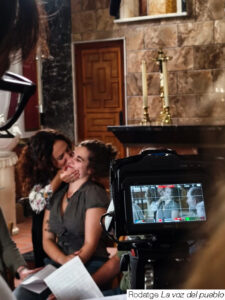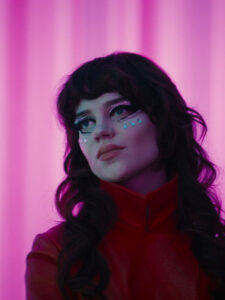
Original title: Under the Stars of Paris · Claus Drexel · Francia · 2020 · Script: Olivier Brunhes, Claus Drexel · Interpreters: Catherine asked, Dominique Frot, Mahamadou Yaffa…
Original title: Kanashimi no Beradona · Eiichi Yamamoto · Japan · 1973 · Script: Yoshiyuki Fukuda, Eiichi Yamamoto · Animation.
There are films that reveal new cinematographic spaces to us and others that, simply, follow the established rules. The first could always seem to be the most interesting when it comes to evaluating the work of a director.. The second seems like it would be devalued precisely because it belongs to the realm of comfort., of what was previously and formally already explored. But this doesn't have to be like this. Often, That experiment that aspires to dazzle us can turn out to be empty if it is not accompanied by something that moves our sensitivity., while, on the other hand, That story that follows conventions can give us a very enriching emotional experience. This is the case of Under the stars of Paris, latest production by the German director living in France, Claus Drexel.

This work tells us the story of Christine, a woman who lives under one of the bridges of the Seine, in the city of Paris, with no other possession than four belongings that accompany her everywhere. Christine gets up every morning and goes out on her daily route. Go to a soup kitchen, where do you have breakfast, and then she walks through the streets and parks of this enormous city where she shares her time with the birds that nest in the treetops or searching through the trash for a magazine to entertain herself when night falls and she is left alone again in her modest shelter.. One day, a child comes to invade that space. He doesn't speak their language and, for what he discovers after finding documentation that he has hidden in his jacket, is looking for his mother, African immigrant, almost certainly, has been detained by the police for immediate deportation. At first, The child's presence seems to disturb Christine's organized life.. But, as the two get to know each other, a strong bond is established between them.

Having read the general lines of the argument and considering the production model, We might think that we are facing the umpteenth commercial proposal produced by our northern neighbors. But being a film that does not intend to put the viewer in a particularly compromising situation, Under the stars of Paris explores terrain that deserves recognition. In this sense, The way in which the script that articulates the plot unfolds its arguments without barely resorting to the use of dialogue is striking.. This circumstance is intelligently conditioned by two factors.. The first, the very impossibility of communication between the two main characters. Christine only speaks French. Still, the child he ends up taking in, he only knows his native language. This limits, input, The narration, a difficulty that, curiously, It stands in favor of its structure and serves as a metaphor for one of the multiple messages contained in the film.. Little by little, A new articulate language is built between Christine and Suli based on signs and short phrases that the child understands.. Christine and Suli are two solitary characters who live outside the current of that more prosperous world that takes place on the surface of this other reality., dirtier and sordid, to which they are condemned. It is the language of those who remain on the margins, of the river and life, of those who have needs so basic that they do not need words to express them, just look into your eyes to understand: need for affection, need for protection and security, need to be a “themselves” that no one recognizes.

Claus Drexel treats his characters with affection, without falling into sentimentality, but without delving too deeply into the wound. Drexel is very aware of the terrain in which it moves, what a viewer filled with stories of improvement expects, well-intentioned, but, frequently, aimed at appealing to too basic emotions. to surprise him, the director decides that the audience themselves should speculate about what is going to happen. So, build some prototype characters that, however, They will escape from this, as the story progresses. Para Christine, Suli appears, at first, as a hindrance that will bring you many problems, to the point that, because of him, is expelled from her hiding place under the bridge. However, The succession of situations that he is going to experience causes small images of his previous life to emerge in his head.. Thus, the character development doesn't just happen around the interaction with Suli, but of what awakens in Christine. Helping Suli doesn't just mean saving the boy., means finding yourself again, with that woman who was before falling into the well.

Under the stars of Paris It's a movie that, ultimately, serves as an excuse to show us a landscape. Dedicated, in much of his career, to the documentary, Claus Drexel had already addressed the theme of begging in other previous productions. From those experiences, The director now rescues this modern story to address what had been left out and that he could only deal with through the mechanisms that fiction offered.. But that documentary filmmaker's vision is also captured in the film. So, Under the stars of Paris It's kind of a walk, guided tour for neophytes to that world that, literally, pulsates under the streets of the big cities. Drexel shows us, in this way, what is out of our sight, what we assume, but we don't know, what is never talked about on television, ignored by a majority absorbed by the rush and detachment imposed by our routines and individual needs. We walk through any of the streets of the city in which we live and, at our side, someone catches our attention. He asks us for money, a help. We passed by and, almost instantly, we have forgotten that presence. But, how do those people live?, we would wonder if we paid a little attention. Even Christine herself will discover that, over there, next to her, very close, in other spaces, There are others who suffer the same exclusion that you are suffering and of which you no longer seem to be aware.. Your situation may still be, even, more complicated. In the distribution by steps of the so-called social ladder, there is always someone who is even lower.

In his eagerness to expand his historical film collection, The video-on-demand platform Filmin offers us this week the premiere of one of the most strangely attractive pieces of Japanese animated cinema. We're talking about the cult classic Belladonna of Sadness (in its English title), from director Eiichi Yamamoto, film that would make up the last installment of a trilogy produced by the legendary Mushi studios and that, on this occasion, Osamu Tezuka would not direct, responsible for the two parts that precede it.
Belladonna of Sadness places us in France, in some undetermined place in the Middle Ages. two young people, Jeanne and Jean, they get married. As custom indicates, The couple heads to pay their respects to the local lord, to whom they offer payment of the corresponding tax. But the amount that the couple gives to the rich lord of the castle is not enough. Unable to account for the high price that is now demanded of them, The young couples implore the Lord to forgive them their debt. But this one seems inflexible. However, there is something that could compensate for the loss of profit and satisfy the lord. So, Jeanne, a young girl still virgin, will have to surrender to the sexual pleasures of the noble and decrepit old man and his ruthless entourage. Unable to resist the power of his lord, Jean is expelled from the castle. Desperate, helplessly waits for Jeanne's return, who soon returns to the couple's humble cabin, his body now defiled, humiliated. At first, Jean welcomes Jeanne and invites her to forget what happened and get on with their lives.. But, at that same moment, something stirs inside him and tells him that he will not be able to live with that affront.. Jean ends up disowning his wife and she is forced to flee.. Alone and desperate, You will find the support of a demon who will give you the power you need. But that power will make her, in the eyes of the rest of the town's inhabitants, in a witch. Jeanne plans, So, his revenge.

The first thing that will catch the attention of any fan of anime is that we are not facing a conventional production. Belladonna of Sadness It is built based on small, almost fixed prints with almost no movement., beyond some panoramic views of them or some specific object that stands out in the image. Having said that, It might seem like we are watching a movie of static frames. Nothing further. It will be, precisely, in that game between movement and stasis where this work ends up unfolding all its dramatic and aesthetic potential.
Indebted to a certain psychedelia of the time (The production is dated 1973), Belladonna of Sadness reminds us of tapes like Yellow Submarine, the work of George Dunning with those colorful The Beatles as the protagonists of an almost bizarre adventure. Here, Yamamoto uses certain similar spatial games to take the viewer through a world that we do not know if it moves in reality., the vigil, or perhaps the subconscious of the characters. Jeanne is disowned by her husband. In his escape, hides deep in the forest. In these actions, the characters do not walk through scenarios, but rather they move at a fixed point in the frame and it is the background that changes, distorting, passing, at times, from inconcrete shapes to real image, so that the desperation of its protagonist is exposed by the maelstrom of textures that surround her and that seem to be harassing her..

So, The greatest achievement of this production is to introduce the viewer to a river of very vivid sensations., despite the apparent immobility of the image, exploring terrain, despite the length of the film, We find them very original. Yamamoto achieves powerful physical emotions with his work. Images that, at times, they pass through us, not only because of what they are showing us, but because of how they do it. How to represent the internal tear of a body that is being violated? How to make the viewer feel the sensation of helplessness and helplessness of someone who has no one to help them?, of the one whose body is literally being pierced and feels that his spirit is being equally separated from that physical body of which it is no longer a part? Sometimes, The violence of these scenes is such that we feel the need to look away from the screen..

Yamamoto deploys with great talent an enormous disparity of graphic resources in a work that puts us on the ropes as spectators of our time, Well, we are faced with a proposal that goes in a direction that is radically contrary to the traditional codes of what an animated film should be.. But the movie doesn't stop there.. What is really interesting is how this explosion of styles leads us to wonder how the mechanisms of society work.. Jeanne is raped by the lord of the lands where she lives. But, against all logic, It is she who suffers the rejection of her husband who, paradoxically, will end up working for the one who has crushed his little dignity as a vassal. Helped by the devil, Jeanne achieves great power that she uses to help her people who end up loving her like a goddess.. That unleashes even more the envy of the man who, with greater boldness, will try to destroy what's left of her. The consequences of this confrontation are unpredictable. Y, in the middle of all this, the woman's body, origin and beginning of everything, entity that reflects all the revolutions that have occurred throughout History. It is no coincidence that the film also ends with a still image. In the box that the screen shows us, another woman, the half naked body, leading the masses, in his hand a flag that points the way to freedom. GERARDO LEON