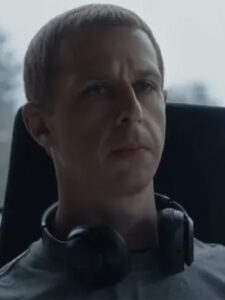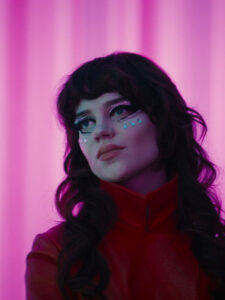
Day 7. And we arrive at the last day of presentation of the titles of the Official Section in competition for this edition of La Mostra. The poster included two other tapes. The first caught us very close with a Valencian production directed by newcomer Iñaki Sánchez. In whatØ, two characters, a man and a woman, they wake up in the middle of a desert. They don't remember their names. They do not remember where they come from or any details of their past. But if there is something they ignore and are really worried about, it is what they do there.. Mario and Julia (names with which they baptize themselves so that they can address each other) They begin to walk without a clear direction through that arid landscape, trying to find a way out, a clue that allows them to escape from such a situation. Mario and Julia spend the whole day walking without getting anywhere. Night falls and they fall asleep. when they wake up, They realize that they have returned to the starting point. Meanwhile, Mario begins to have dreams of a previous life... with Julia.
Mix of science fiction genre with a more personal and realistic story, whatØ would reach the hands of its director as a commission from the production company responsible for the project. To make it closer, Iñaki Sánchez would be involved in writing the script. “We start from an original idea by Ferran Brooks, the screenwriter. I came with a version of the script that was more of a fantasy type and what we did was an adaptation, respecting its origin, but adding things that are more of my interest and concern, related to what I have done so far. The idea was not to lose the spirit of what there was, but try to make it mine. I think you can't get involved in something you don't believe in and, just as it was, “I needed something that would allow me to make it more personal.”, Sánchez commented before the public and press. The story begins, So, to take the definitive form that, later, would be reflected on the screen. “To that part of fantastic we added the part of the drama of the characters in real life, and we looked for a way to fit those two lines together so that there would come a point where the two stories would merge.. I considered, and I think it's drawn in the movie, two relationship lines of the same couple. In one line, a relationship is being formed that seems to be going further., and in the other it is being destroyed. I liked to think that it was like an X, with a point where they touched that is marked in the film and from which each one goes their own way.", Sánchez concluded.
Thus, Little by little, a project would be shaped that had its many peculiarities due to filming carried out in desert spaces., issue that complicated production. “We filmed five weeks in different deserts, with the technical complication that this entails”, explained Jorge Acosta, executive producer of the film. “Getting to places where cars don't go… I remember that the last desert involved a “small” forty-minute walk until you reached a location that was impossible to access.” After filming, Post-production took almost a year on a montage in which Sánchez was also involved.. “We started setting up when we finished filming. At first, I created some scenes at home. “I think it is a very personal film in which the script is very similar to what appears on the screen.” Being the editor of the film brought some advantages and disadvantages. “Disadvantages are that a year after filming I was still involved with the editing”, the director commented with a laugh along with the producers and part of the film's cast.. “Advantages because the luck of the small thing about this type of project is that you can go around, make a mistake, try again. It has been a long assembly process. The first cut was one hour and fifty minutes long., of which we managed to get off for twenty minutes.”

But if this film rests on anything, it is on the shoulders of some actors who carry at all times the weight of that underground line through which the individual conflicts on which the story centers travel. (Careful, spoilers!) “The starting point of the character that Juan plays is something that I think is very common and that happens in society., and it is the fear of being told that, probably, you die. It is a very intimate fear. I myself fight not to act this way, but I'm very afraid of these kinds of things. His conflict and the conflict on this side of the plot is something that comes from my personal experience., of being paralyzed by the possibility of something”, The director commented. On these premises, Juan Blanco, actor who plays Mario and also present at the session, I would build a character that, in many aspects, he escaped from his own personal experience. "On the one hand, was the part of the deserts in which, as an actor, I was more into discovering, in understanding what is happening; these are dreams, They are not... And in parallel there is the other part that focuses on the work of fear and, once it progresses, of the blame. And all of this comes together in the final catharsis.”, explained Blanco, very enthusiastic about the final result of his work and about the tape. “These things that I mention are the things that I felt I could hold onto to give a certain naturalness or verisimilitude to very extreme things that fortunately I have not experienced and that I hope not to experience.”
And so, con Between two seas, We reached the last of the proposals of this edition of the contest. Directed by Anas Tolba, The film narrates the daily life of a woman in contemporary Egypt. Mother of two girls whom she is watching grow up, Zahra's life runs with a certain normality and joy until an unfortunate event will disrupt her entire world.. Without her knowing, Her mother and her husband conspire to perform the practice of excision on one of her daughters.. The operation does not end as expected and a drama is revealed that will turn his relationship with the family and the established order upside down..
“In Egypt, especially in rural areas, is very steeped in tradition. And that is very difficult to change. That's one of the reasons we made this movie.", commented producer Abdulrahman El-Garawany, who came to La Mostra to present the film. “We made this film in collaboration with United Nations Women and the International Council Bureau. In fact, we collected many stories about ablation. It is not something very easy to change in Egypt and that is the reason why we are trying to make many films, “to make people aware that it is very dangerous and unhealthy for girls.”
The basis of what is told in this work is based on the title of the film itself.. “The film in Arabic is named after the island where we filmed and which represents the difference between knowledge and ignorance.. This is what we wanted to reflect.”, commented El-Garawany. “We see two very different places separated by the sea. On the one hand, is the most impoverished side of the island. And then there is a more buoyant urban center on the other side, with hospitals, with education, that is to say, a good place to live. Hence it is called between two seas.”

The practice of excision in Egypt is today prohibited by law. However, The State does not reach where custom takes force. “These types of operations are illegal. According to the law, who commits said crime, whether a doctor outside the hospital or in the hospital, is punished by law. This implies, besides, to any family member, mother or father, who has participated in said intervention, especially when there is an injury or death. According to the law, Any type of medical practice without a license or authorization is also punishable, “something we want to highlight in the film”, the producer explained. “There are two precepts or laws that regulate this, one that does so in the event that there is no injury and another in the event that there is an injury. In the first case, Prison sentences of between one and three years are expected., and if there is, sentences of up to twenty-five years are foreseen. However, The important thing here is that people don't say it., whether or not there is an injury. even less, when they are involved in the operation. In that case it is not known.”
The problem, So, part of the measures taken by the State, but they go much deeper, to the most intimate space of the individual, the family. “There is no type of sexual education in schools., It's something that is not talked about, and in the case of ablation it is an enormously sensitive topic. Light has recently begun to be shed on the risks posed by, but even when addressed in schools, women are never the ones who make the decisions. They do not have any capacity to decide for themselves and it is the responsibility of their families.. Not only in this, but in many other matters.” To these problems, We must add religion as an element of enormous influence in a population that submits to the directives of its representatives. A fact that, besides, It only confuses those who are carried away by its advice and direction.. “In certain areas it is considered a practice stipulated by religion, when in reality it is only mandatory in very specific cases and as long as there is medical supervision. But this is not well understood. This doesn't just affect families., but to religious leaders. In rural areas, The imams are the leaders of the community and they are the ones who establish what can be done and what cannot be done.. In that sense, people follow orders without thinking, among other things because they believe that if they do what the imam says they will be closer to God. And this includes practices like ablation. The family believes that if they do it it will be good for the girl and for them”, explained the Egyptian producer.
But, beyond what is narrated, For Abdulrahman El-Garawany, the film goes beyond the framework of fiction to become a tool for mobilizing society against a practice that is rejected by activists and the international community.. According to what he declared to the press: “Our goal is to create a movement and reach out to families, especially in rural areas, where the practice of ablation is widespread, not only through film, but also many other activities with which we want to reach families. The government has also just started a movement in relation to these excision practices together with different United Nations organizations, who participate in awareness campaigns so that everyone is aware of the enormous problem that this represents.”