
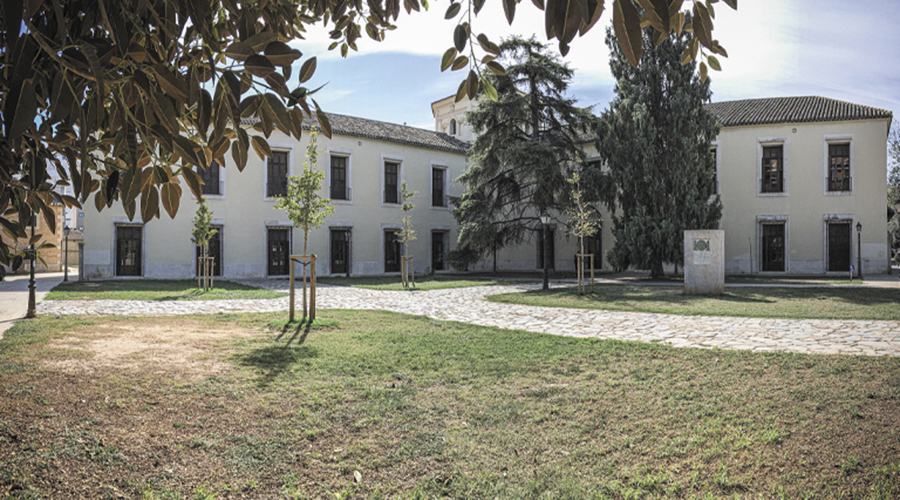
Surrounded by two major arteries of the city such as Avenida del Oeste and Guillem de Castro., Hospital Street extends, a little vein that pumps life and charm with every heartbeat. And boy does it beat. Every day its terraces vibrate under the Valencian sun, the one we love in winter and summer, and that there never abandons us. cane goes, cane comes, The bars do not cease their activity on a road with very little traffic that breathes the modernity of a museum like the MuVIM and, in turn, It reminds us of remote times when it housed the old hospital that gives its name to the street and of which some remains are exhibited in the beautiful garden., like the gothic door of the infirmary (There are also remains of the old Faculty of Medicine). The imposing Municipal Library, that building about which we Valencians know so little and that houses so much knowledge, presides over the complex with solemnity and welcomes us to an area that holds many surprises: a bookstore specialized in travel, Mountain and nature, The interesting museum and school of major silk art or the most complete musical instrument store in the city.
PATAGONIA BOOKSTORE
— Hospital, 1
Exciting temple of books and travel guides, mountaineering and nature, unique in the Valencian Community, where we will find specialized maps (hiking, topographic…) and all articles related to the mountain, like compasses, razors, prismatic, backpacks or glasses. We can also purchase watches with GPS, although experienced mountaineers know that you cannot sell your luck to these devices, because they can fail, and in the end there is nothing like a good paper map, lifetime. Among the innumerable bibliographic proposals we find mountain narrative, historical expeditions, stories of great explorers, practical climbing manuals, nature guides (arrows, animals, plants…) and books on ecology. The rich bookstore coexists with the travel agency that organizes both mountain and urban trips, for a diverse client made up of travel enthusiasts, the mountains and nature. With the times that run, the perfect alternative to restlessness is nature, so a visit to this temple of wisdom can give us many ideas and, even, wake up a new hobby.
NASTASIA. SPINNING STORIES
— Roger de Flor, 12
In front of the Patagonia Bookstore there is a pleasant square. There is this cozy place, full of rolls of fabrics of different colors. All of them are ecological, of organic cotton made without pesticides and in non-expansive cultivation, good for our skin, our health and for the environment. We can choose any model we see on site or access your website, where the variety is impressive. In addition to store, we see that everyone sews there, each one at their own pace, sometimes with teacher, and sewing and pattern making classes and workshops are offered, fashion drawing, embroidery and patchwork, For adults and children. Something that differentiates them from other similar places is that we can go whenever we want., rent a sewing machine, even ask for a private teacher who adapts to our schedule. We see fewer men than women, Well, we know that the world of sewing is to a greater extent conquered by the female gender., but this topic is changing and, increasingly, men are interested in this art.
MAJOR SILK ART MUSEUM AND COLLEGE
— Hospital, 7
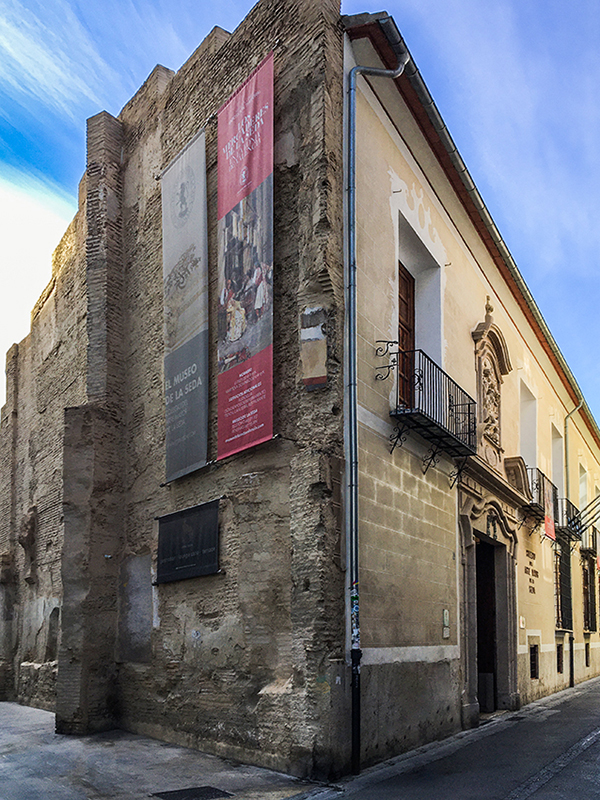
We continue our walk and a beautiful building catches our attention: It is the Silk Museum. The property, one of the most notable- fallen from Valencian architecture and culture, dates back to the 15th century, It is Gothic based and contains an important- so much heritage wealth inside in the form of frescoes, murals and mosaics. True gems are hidden in its skeleton, like a delicious gothic staircase, the floor of the Hall of Fame made by Vicente Navarro, custom made tiles with images of the silk guild, the ceiling frescoes of one of the main rooms painted by José Bergara, or the more than pleasant interior patio (now occupied by a restaurant) where to taste something in the sun that will brighten your day. The collection it exhibits is no wonder., because it has beautiful costumes from different periods, of fabrics such as damask, brocade or velvet (Did you know that the Valencian velvets wore a silk badge on their cape because they were the highest ranking in the guild??), and valuable information about the history of silk in our city. Apparently, A group of artisans who arrived in Valencia in the 15th century formed the Gremi de Velluters to guarantee the quality of manufacturing such a precious material.. So precious that it became the most important craft sector in the Valencian economy between the late 17th and 18th centuries.. The live demonstration room is impressive where we will see how silk is extracted from cocoons (heating the cocoons and carefully removing the threads with a spinning wheel) and how it was woven on a real old loom. Definitely, a discovery that we highly recommend to connect with the history of our city, our society and our art.
Public Library
— Hospital, 13
Many Valencians are still unaware of this imposing building that breathes in the gardens of Hospital Street., after so many years and so many incidents. On the site of the current library, the Hospital de Folls de Santa María de los Inocentes stood in the 15th century, the first asylum in Europe. Later, for its growing prestige, It changed its use and became the General Hospital of Valencia, the reference hospital of the capital and the kingdom. The health complex continued its activity until the sixties, when the General Hospital was inaugurated on Tres Creus Avenue. It was then that the demolition of the Hospital Street building began and the disaster began, Well, not even the protection as a historical-artistic complex signed by Franco, Not even the order to preserve all the Renaissance columns prevented the looting, and today, It is still not known where many of the pieces that made up the architectural complex are located.. Luckily, The citizen mobilization managed to stop the demolition just when the demolition of the pharmacy began, the current Valencian Institute of Youth (VAT), and the nursing building, where the library is located today. The impressive Greek cross floor plan helps the current distribution of its different services, which is located in the entrance wing of reference books, magazines and a magnificent collection of fanzines and comics, the loan service on the right, children's and youth material on the left, at the bottom, the newspaper archive service and, on the upper floor, the wings of humanities, Sciences, offices and local fund. The interior is overwhelming and invites concentration with its enormous and strong columns supporting the building presided over by an enormous dome..
Muvim
— Quevedo, 10
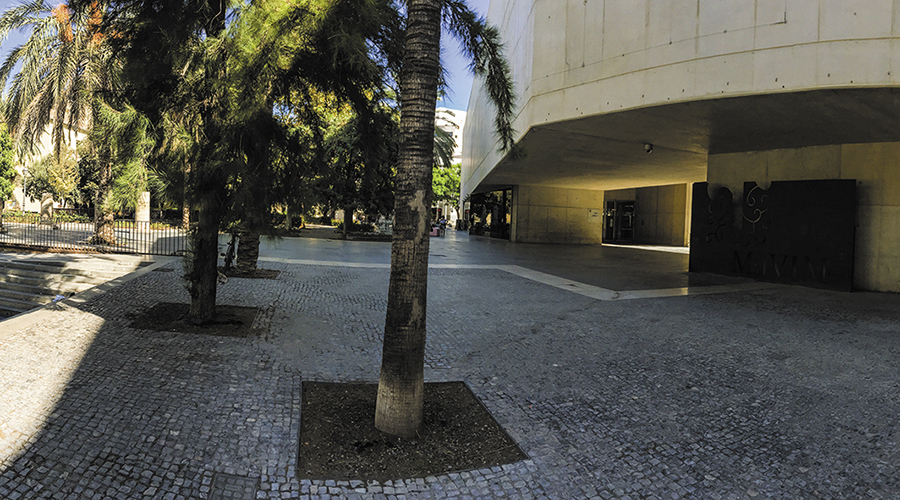
Although a little further from the complex, We cannot miss the opportunity to write a few lines about this museum that rests next to the library in its wooded park. This is our museum of Enlightenment and modernity, which was conceived as a space to publicize the ideas that have made the modern world possible. Many great exhibitions have passed through its rooms, In recent years we have been able to enjoy, For example, of the magnificent exhibition dedicated to republican Valencia with which the new management team made its letter of introduction. From there, Very interesting exhibitions dedicated to Japanese art have passed through this great cultural container., to the Cuban cartel, to contemporary photography or comics, and is home to relevant events such as the Avivament philosophy festival. These are not good times for the museum, which had to slow down its activity in September 2019 for the works to improve the building's air conditioning, but they have returned to the fray and in October you will be able to visit the large mural by the urban artist Vinz Feel Free inspired by the experiences lived during confinement and the exhibitions by Olga Sinclair and Francis Montesinos, among other. Besides, In the lobby the beautiful model of the city is displayed according to Father Tosca's map of 1704 that three-dimensionally reproduces the Valencia of the 18th century.
HERMITAGE OF SANTA LUCIA
— Hospital, 15
Leaving the gardens, We come across the beautiful façade of the Hermitage of Santa Llúcia. Declared a National Historical Artistic Monument and Asset of Cultural Interest, This small sanctuary was built even before the hospital that gives its name to the street and has miraculously survived the looting that the rest of the complex suffered and, later, to war. It is made up of two ships, a gothic main, which was later covered by vaults. Currently, The temple has a baroque appearance inside, with works from the 17th centuries, XVIII and XIX, among which the main altarpiece with the image of Santa Llúcia stands out, the canvas of Our Lady of the Forsaken, by Gaspar de la Huerta, or that of Evaristo Muñoz. An interesting day to visit could be the day of Santa Llúcia, the protector of sight, he 13 December, or maybe, even better, the day before, during the "tabalà", where almost two hundred musicians with tabal i dolçaina invoke Saint Lucia so that on the shortest day of the year the hours of light will be lengthened again.
WINE MASIA
— Hospital, 16
from outside, the place seems rather to demand a foreign audience, but once inside any Valencian is curious. The tapas look great: At the bar they display a fat tortilla, anchovies in vinegar and chistorras with peppers. traditional decoration, with Valencian tile and terrazzo floor, It is combined with solid wood medieval style furniture that gives a curious touch to the premises.. Here antiquity is shown without fear, because an attic that was previously a home remains standing (you can sense what the rooms were like before), and they tell us that the space now used for the kitchen was previously used by the family that lived in the house to sell mattresses.. But where good eating and drinking reign supreme is on the ground floor., equipped for a small committee agape or to celebrate an event, either in your main hall or in one of your private rooms (one with capacity 12 and another for 26 personas). We can also snack on something informal at the barrel at the entrance or buy some of the typical products that are displayed inside to take home., like nougat, sangria, chickpeas or beans, oil or saffron.
RIVENDEL
— Hospital, 18
We could write a report just about Rivendell, but we will try to be brief despite how complicated it will be. At a glance, a bar, with an impressive terrace, sunny like no other, and a simple but appetizing letter, which includes salads, tapas (deadly Idiazabal cheese croquettes and tequeños come- zolanos), burgers (the real ones), and dishes such as veal Milanese. But when we scratch the surface a little, that's when the interesting part emerges.. This Argentine family, two brothers and their mother, They started setting up an internet cafe, but their endless cultural concerns and their unconditional love relationship with cinema has led them to create a program that is as active or more active than that of a cultural center.. The proximity to the library has led to a union from which such interesting proposals as the MIC cycle have emerged. (Contemporary instrumental music- hurts), where jazz sounds, tango and rumba, or Cinema de la terreta, in the wonderful library esplanade, in which we see Valencian-produced films that have no release in commercial theaters. They also organize the fight of illustrators Rivendell Drawing Fighters, silent film sessions with live music, theme nights with gastronomic offer, and trivia or retro video game tournaments. Their inventiveness and positivity is contagious., well, even during this hard confinement that we have experienced, They invented the Cine-Tapa at home, a cultural plan that allowed us to enjoy a movie proposed by them from home and combine it with the main dish that appeared in the film. They have convinced us that we would emerge from captivity stronger, more cultivated and more beautiful. That's how they are.
UME. MUSICAL UNION
— Guillem de Castro, 34
The last place on this beautiful street is the Unión Musical Española (UME), It has been more than a hundred years since it opened its first store in our city., although there were already offices in other cities in the country. From that first, on Peace Street, The sign “Spanish Musical Union” remains engraved in the brick on a protected façade and, therefore, untouchable, although now the lights of Ale-Hop shine in its window. Luckily, the company has not disappeared: The largest store in the city is located on the same street as La Paz., in front of the original facade, There is another smaller one in Nuevo Centro and, the most modest, closes Hospital Street. Despite being the smallest of the three that are spread around the city, The venue is a temple for music in all its aspects, where both the professional and the amateur can find everything they are looking for: keyboards, guitars, mixing desks, speakers, amplifiers, pianos, Violins, ukelele, batteries, drums, bells, microphones, mandolinas, mandurrias and even Tibetan bowls. For the most freaks, a guitar signed by the actor from the series The Embarcadero, Roberto Enriquez (yours for €475). They confess that the pandemic has not affected them because (It seems that the guys from Rivendell are right and we come out of this more cultured) Many Valencians have started learning to play new instruments and their sales through the web have increased, and they know for a fact that they had clients looking forward to the reopening. In such a critical moment that we are living, it is nice to hear something like this.. Long live the EMU.