UNTIL SUNDAY 30/8
F. BANCAJA. Pl. Tetouan, 23
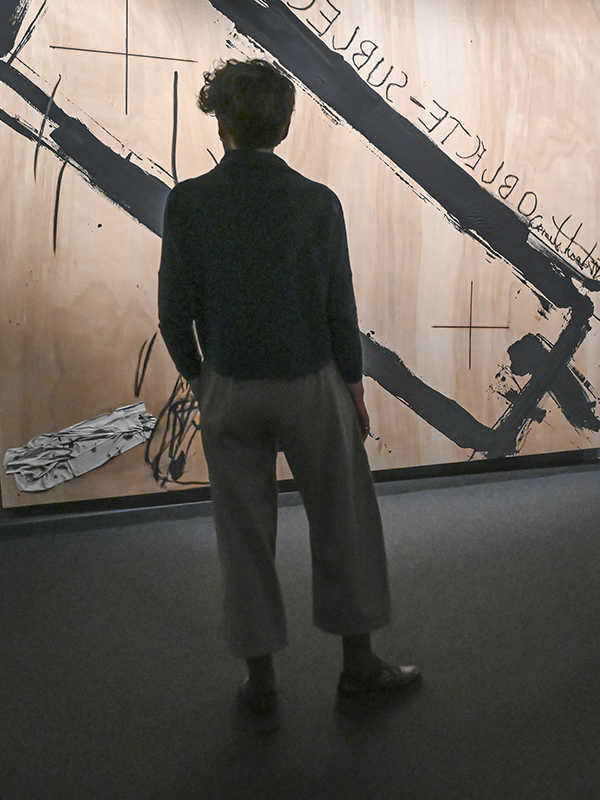
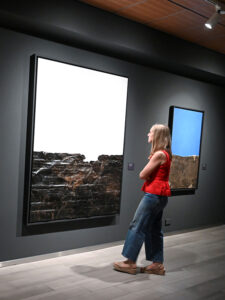
Antoni Tàpies It wasn't a minimalist.. His art was not at all obvious, nothing to do with it what you see is what you see of minimalism. Nor was it an abstract in use. Is more, according to the painter Antonio López, Tàpies was the most realistic painter in the world. Nor was it exclusively informal, although it was the facet that opened the doors of international recognition. He 1952, the artist removed all figurative elements to give the matter absolute protagonism. This matter, sense form, and surrounded by sober colors such as grey, brown or ocher, applied on surfaces that looked like walls, would become a symbol of Catalan identity. Precisely the walls on which he developed his material painting were the object of study in the last exhibition dedicated to him in Valencia, VAT specifically, there for 1992. The concept of a wall had an ambiguity that Tàpies found very attractive: on the one hand it symbolized separation or distance; But, for the others, it could be a means of expression on which to pour slogans of freedom. Tàpies infringed incisions, scratches, marques, footprints and degradations on fabric, wood, cardboard, paper or plywood; later on, I would add strings, in turn, marble dust, racks, brush and barns, even, whole doors. I would also insistently paint ics and crosses (some T-shaped) which have little to do with Catholicism, rather with the intersection of opposing forces.
The Bancaja Foundation sample, wallpapered in black and softly lit to invite gathering, it begins by telling us about the birth of everything: it turns out that one day Tàpies picked up a painting by the edges when it was not yet dry and his prints were left on the surface. Here he understood that his mark could be born from direct contact with matter; that art is not something that is only looked at, it's something you touch. Definitely, understood the importance of the object per se. "I have always believed that the painting does not represent things, but it is something", states one of the painter's quotations printed on the walls of the room. He did not want - as the surrealists had claimed a few decades earlier - to create hidden connections between the conscious and the unconscious, but to present nondescript but authentic objects.
Tàpies placed the wall at the center of his production. He began to work on its surface as if it were a real brick, esquençant, nailing, grabbing and pressing matter. He discovered that a single scratch is violent, but a thousand, they convey serenity. It could easily have been planted here, to the cim, recognized as one of the world's greatest exponents of informalism. But he was not a self-satisfied artist and he was going to take on tough risks in the end.. you cover. last decade. 2002-2012 it focuses precisely on his last years of life, the lesser known, those who were marked by the intimacy and melancholy of old age. It is made up of works lent by the family that have rarely been seen publicly, and despite being simple, synthetic and extremely refined, They contain a cruel force and a total radicality, According to the sample commissioner, Fernando Castro. Besides, add, they are absolutely contemporary: “This is younger than a lot of young painting. You don't have to go to Arco, you have to come here".
Think that, after World War II, Europe floated in anguish, pain and depression. This helplessness was picked up by the existentialist movement, embodied in literature by two authors whom Tàpies followed with fruition: Sartre i Camus. The artist was an intellectual committed to social justice and freedom, very interested in Freud and Jung's theories about the unconscious, the scientific approach to the universe, the idea of emptiness of Eastern philosophy and the political situation around it. He was a pro Catalan who defended his language and his land in a context of repressive Franco dictatorship. At that time, the artistic avant-gardes from Paris and New York did not reach Spain, but Tàpies found a way to be seduced by poor art, l’assemblage, the Fluxus movement, the work of Joseph Beuys, Joan Miró or Paul Klee, l’art conceptual, Surrealism and Dadaism, founded on ready mades by Duchamp and Tristan Tzara's manifesto. S.M.