
UNTIL SUNDAY 15/6
Mubav. Saint Pius V, 9
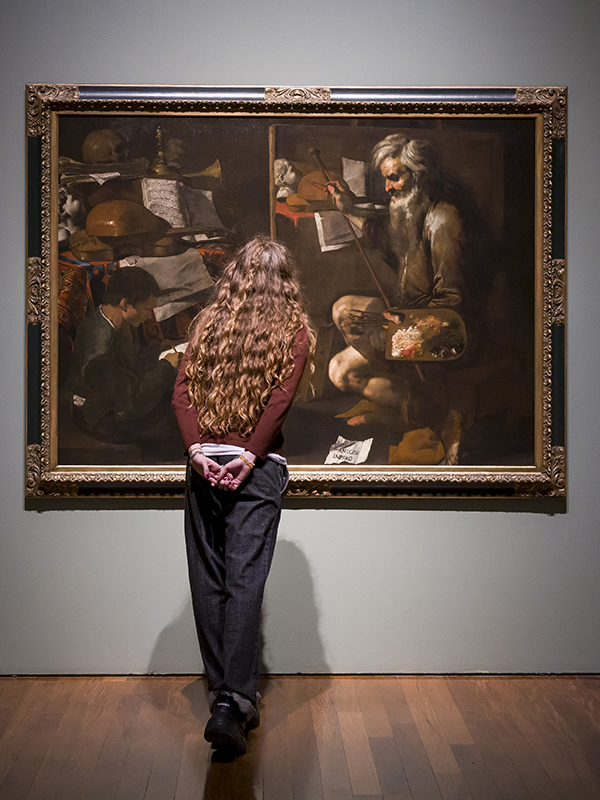
The battle of the painters of the 16th-17th centuries to demonstrate their ability to create matter and replicate nature (mimesis, they call it), had already held artists' swords high during Classical Greece. Pliny the Elder says that Zeuxis and Parrasius competed to faithfully represent reality: Zeuxis painted grapes so apparently real that birds, deceived, they landed on them; while Parrasio painted a canvas that Zeuxis wanted to move aside to see the painting, without realizing that this was a trompe l'oeil. Feeling cheated, he, more than birds, Zeuxis granted the victory to Parrasio without waiting for the judge's decision.. We remember this legend because it revolves around the still life, the decorative genre that is easy to understand and consume that stars in the new exhibition at the Museum of Fine Arts. probably because of that, for digestible, he has been missed for a long time. It wasn't, therefore, nothing high, certainly nothing comparable to the portrait or the historical and religious paintings that invested their authors and their possessors with cachet.. But what started out as vulgar, ended up dressing with prestige and sophistication, hence painters began to sign their still lifes. Now yes, works of art without buts.
It's not entirely clear, but it could have been a certain Caravaggio, when painting your fruit basket, the one who inaugurated the genre itself. Consciously or unconsciously, The Italian painter became the first great painter to opt for still life and opened the door to others who would come later., as Juan van der Hamen o Alexander of Loarte with its sober approaches, Juan de Arellano inclined to full baroque, Luis Melendez with its refined compositions, Juan de Zurbarán (son of the famous Francisco) making a show of simple things or Tomas Hiepes, the most outstanding still life painter of Valencian baroque painting. All of them are part of the Musaveu Collection, which arrives for the third time at the Museum of Fine Arts, in this challenge, with its still lifes from the Spanish Golden Age (XVII-XVIII).
We talk about Mass, one of the private collections (active) most important in the Spanish state, whose collection of Spanish still lifes, after passing through Seville, Asturias and Madrid, arrives in Valencia with four new Italian and Flemish paintings recently acquired. So, we can see on site the differences and agreements between the paintings of the peninsula and those of the other two European centers of art of the moment. The Spanish still life began being organized, symmetrical, realistic, austere and unimaginative. We see it in the painting by Juan Bautista de Espinosa, that arranges the rich silver trousseau and the American clay containers (very expensive) on a laid table, rare thing in Spain, where the still lifes used to be displayed on the kitchen windowsill or cornice. In contrast we have, among others, a Juan van der Hamen, who embraced European influences in his disordered flowers, attractive and colorful that conveyed an exuberant sensation of opulence.
During the Middle Ages, representations of food were integrated into works with religious themes, within scenes depicting the Old and New Testaments and the lives of the saints. A new Christian outlook governs the life of European nations, for whom nature is the work of God, and as such, is worthy of admiration. In this sense, The exhibition shows a series of allegorical paintings from the workshop of Juan de Arellano, based on flamenco engravings, but with a particularity: the characters are dressed. Oh Catholic morality! A life lesson in a religious key injected in small boxes within the oil painting shows how Adam and Eve are having trouble in different passages of the Genesis, until the great final fight that expels them from paradise. Partridges and bream close the route in paintings that, despite being part of a natural history cabinet, They rest on a kitchen bench, not in a laboratory. Although the end is scientific, the painters did not dare to abandon the decorative packaging. The chambers of wonders spread in all European courts guided by the fashion of taste for the extraordinary.. They collected strange objects from the natural world., so that, at the end of the 16th century, An intellectual framework had been implemented that combined interest in scientific naturalism with the spirit of collecting works of art., which led to a growing demand for still lifes. The shine of the scales, the wateriness of the bream's eyes, the preciousness of the lace and the fold of the scarf, the juiciness of the interior of the fruit, The transparency of the glass vessel or the reflections of the silverware give a good account of the tactile preciousness of a genre., not at all minor, which enters the Museum of Fine Arts in its own right after more than twenty years of absence. S.M.