
UNTIL SUNDAY 25/10
CAHH. Mar, 31
If anyone can go shopping and take home a Kiefer it is Hortensia Herrero. He is a harsh and gloomy artist for his taste, but also capable of creating somewhat sweeter paintings, as The flowers of evil, the first of the three that the patron bought —Evil flowers, Valhalla y Death and the Maiden— to support the German artist as one of the axes of his collection. That first canvas makes up this first temporary exhibition since the Hortensia Herrero Art Center opened its doors two and a half years ago.. Mrs. Herrero was not at all convinced of the move., To set up a temporary exhibition, sixty pieces had to be removed from the building., reorganize six galleries and put away those jewels of yours that exude status and power. But he ended up agreeing. Now we can see in Valencia, next to the works of Herrero, some others that had never left Anselm Kiefer's studio, inspired by nature, the poetry of Baudelaire or Rilke, Schubert's music or Greek mythology.
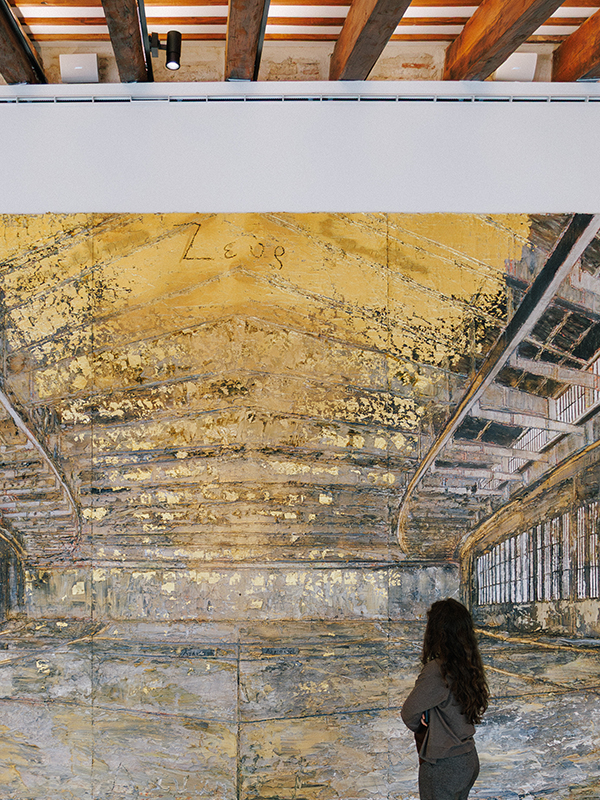
Precisely mythology merges with history in the big picture (more than thirteen meters wide) of this exhibition: Danaë. Kiefer, an artist with a genius complex, He was born in a Germany in ruins after the Second World War. Literal. He came into the world in the basement of a hospital because his house had been bombed that night.. He was one of the first German artists who dared to confront his country's Nazi past.. And the great Germany that Hitler's regime projected included monumental architecture built in stone., like the roman, to be able to bequeath to posterity some good Aryan ruins. And a beautiful ruin is what can be seen in Danaë, a monumental painting that recreates what remains of Tempelhof airport, the largest building in the world until the construction of the pentagon. The title refers to the Greek myth according to which Zeus transforms into a shower of gold to escape Danae's confinement., impregnate her and give birth to her son Perseus. Who would end up accidentally killing his grandfather Acrisio (king of Argos) with a puck during a sports competition, thus fulfilling the prophecy of the oracle. Kiefer reinterprets this classic theme that had already been addressed by artists of the stature of Titian, Rembrandt and Klimt, but in your case, golden rain falls on an airport that pioneered commercial aviation in the 1920s, architectural symbol of Nazi Germany and instrument of resistance during the Soviet blockade of West Berlin. The artist does not narrate the Nazi past, but he paints his footprints. The landscape and architecture, for him, They are never innocent, They are a historical backdrop.
Keifer is the artist who creates life-size lead airplanes and builds reinforced concrete towers from shipping containers. everything is great, monumental, elephantiatic. Also his fame. We talk about the most famous contemporary German artist; of which, for some, is the living painter (has 81 years) most important in the world. Especially if the economic criterion governs: His canvases usually reach record prices at auctions.. Surrounding landscapes, excessive architectures, the materiality of surfaces splashed with layers of plastic paint, straw, ash, clay, tierra, tar, lead (the only material heavy enough to evoke the burden of human history, according to him) and gold are common in the works of this artist who looked with admiration at Joseph Beuys. Merging the purely physical of his earthly materials with the ethereal of his ideas, Anselm Kiefer invites us to reflect on humanity and its history. S.M.