Fourth session of films from the Official Section in competition at La Mostra with two works that bring us closer to the easternmost end of the Mediterranean.
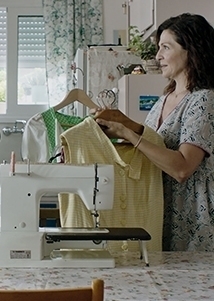
From Greece came Tailor by director Sonia Liza Kenterman, a comedy that introduces us to Nikos, a man out of his time. Despite being in middle age, Nikos still lives with his father, retired tailor and owner of a tailor shop where Nikos himself works who, following tradition, continues to make custom suits for his clients. But these are not good times for haute couture. The economic situation the country is going through seems to have left aside certain luxuries. Tastes change, The prices of raw materials are through the roof and people demand other things that are more suitable for their battered pockets.. Result: The lack of clients drowns Nikos in debt, which is forced to close. This situation, will force you to look for new forms of business. So, and against his father's opinion, a severe and conservative man who considers him unworthy, Nikos decides to set up a traveling stall to go to the street markets in search of new customers for his suits.. For a man raised in a culture focused on class and distinction, this is a jump back, almost a humiliation. But, against all odds and despite the problems he will have to face, Nikos will find his way.
On this argumentative basis, Sonia Liza Kenterman has created a small modern fable that invites us to reflect, first of all, about people's ability to overcome life's difficulties. Nikos must reinvent himself or close the tailor shop and look for another job. in front of him, his father clings to the codes of the past. Liza Kenterman builds an unreal world around these two men that, for its texture and its aesthetic and production resolution, approaches the work of Jean-Pierre Jeunet, Palm of Honor at this year's Mostra. That unreality with which the film permeates, allows the Greek-German director to take us down paths that border on the improbable. Or isn't it incredible that a man of Nikos's age, He barely knows anything about the world outside the walls of the house and the store he inherited from his father.? But we don't care. Once the rules of this game are established, everything will be familiar to us.
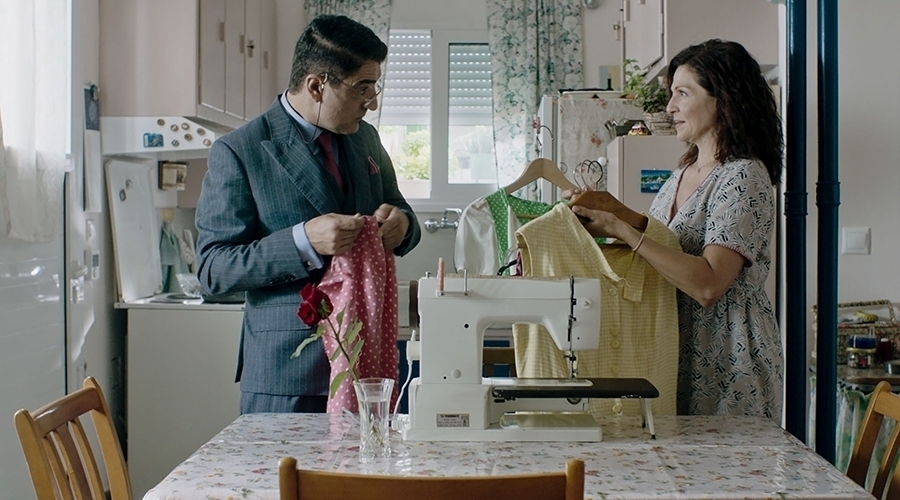
With these premises, in the background Tailor wants to be an approach to the problems suffered by contemporary Greece. When you go outside, The world poor Nikos encounters has nothing to do with his father's store.. In that world, ordinary people survive in dilapidated apartments and buy at low prices.. After the images, the financial crisis of the year comes to the viewer's memory 2008 and the consequences of the subsequent policies that the European Union applied to the country, coupled with the poor management of successive governments that, over the last decade, brought Greece to the brink of bankruptcy. However, For Nikos this new world that opens before his eyes is full of life.
Well then, There is no doubt that this is the greatest achievement of this film (which is not saying anything). Tailor es, first of all, a celebration of life in the face of calamity. Infused with gentle humor, but nothing syrupy, Tailor It is an honest parable that tells us about solidarity and the value of the community in the face of the barriers that contemporary society imposes on us.. Locked in his tailor shop, Nikos has no choice but to wait for clients to come through the door and give him an order to boost business.. Out, He will learn that he must be the one who has to adjust to the needs of others. So, You will learn that your talent and meticulousness can still be useful for something. And this may be, at least, one of the messages that the film offers us. Faced with crises, we will have to get off the pedestal, look down a little, start again, from scratch, to take a new impulse. However, on this trip, nothing is certain. The solution is not always perfect, but it's worth a try. There will be those who see in Tailor a story that is too white and well-intentioned, Real life is more complex than what images show us., we will tell each other. But no one tells us that dreams contain a lesson that can be useful.. Life is that too.
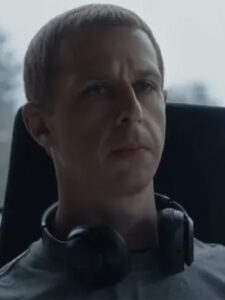
In a radically different context there was The translator, film directed by Rana Kazkaz and Anas Khalaf that takes us to the lands of Syria. Sami is an English translator who has fled the country after Bashar al-Assad came to power. Sami lives a new life with his wife in Australia, far from the problems caused by the dictator's repressive regime. However, remains linked to the conflicts that affect his country. After the uprisings caused by the so-called Arab Spring, things have gotten complicated. Before the riots, Al-Assad has redoubled the repression on opponents with the kidnapping and murder of many of them before the impassive gaze of the international community.. One of the last to disappear was his brother. Sami, affected by this event and the memory of his own father's disappearance at the hands of the police, decides that he must return to Syria to find him. And here the difficulties begin.
Con The translator Rana Kazkaz and Anas Khalaf remember a situation that, although it has occupied a good part of the international interest, today it seems to have been forgotten. Ten years after the celebration of the Arab Spring, There is nothing left of the democratizing airs that were demanded in that revolt. Faced with forgetfulness, both directors force us, with this job, to look again at the past to understand what happened. Something similar happens to Sami. Forced by circumstances, he is forced to abandon the comfort of life in the West and look at his country with new eyes. “The first idea we had for the film was the story of two brothers, one of them was an activist and the other was someone completely opposite. So, what is the opposite of someone who uses their voice? a translator, "someone who hides behind the words of others", commented Anas Khalaf at the press conference given after the screening of the film at La Mostra. “[Sami] He never speaks in his own voice until the end of the movie.. This is the main idea, that search for your own voice. but the eye, represented by Karma, the ophthalmologist, the protagonist's sister-in-law, It is very important because while the translator is translating what is happening in Syria to the audience, Karma is giving Sami his eyes so he can see what's really going on., a country he left so long ago.”, concludes the director.
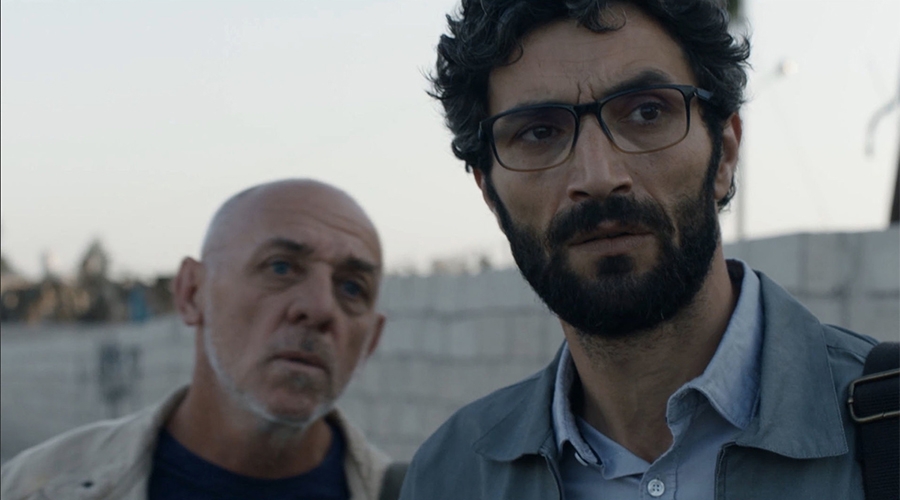
If there are two feelings that articulate this story, they are the weight of guilt and the lack of normality.. Guilt for having abandoned your loved ones, those who suffer, to build a more comfortable life, away from the conflict and the moral responsibilities that come with. Normality that is lacking in a society that is deprived of its most basic rights. This contrast between two worlds is perceived throughout the film, articulating the adventures of its protagonists.. “What we wanted was to show the beginnings of this revolt, showing the lack of normality even within Syria, inside Damascus. At first, we see a series of people murdered and, suddenly, We go to a five-star hotel where the protagonist meets with Martin Haven, a Western journalist. They are all there calmly, drinking, talking as if nothing had happened. It was that atmosphere of schizophrenia that was experienced. This was something we wanted to emphasize in the film.", comments Anas Khalaf.
Now, ten years after the conflict, with the country mired in a humanitarian crisis and the regime more strengthened, We wonder what could have been done better., where are those responsible. Were the Western media perhaps too cautious in their presentation of the facts??, we ask ourselves following some of the film's sequences. “I don't think the press was cautious. “I believe that the press taught everything that needed to be taught as proof of the violence and repression of the regime.”, Anas Khalaf reflects. "Again, Attention must be drawn to the fact that the beginning of the revolution was peaceful. People took to the streets unarmed, and very quickly the weapons appeared, those shot, “And there were deaths every day and everything changed towards a civil war.”. Khalaf finds the answer to this question in one of the final sequences of the film, when one of the generals in charge of repressing opponents tells Sami: I know everyone outside has seen what we've done to you, but no one is going to intervene. “And that's exactly what happened. It is known that there were some agreements for Assad to remain in power. Al-Assad remains, He hasn't gone. Not like Ben Ali, not like Mubarak, not like Gaddafi. It's very sad”, the director explained.
The question remained like this, in the air. And now what? "The revolution has failed, of course. The war has been won by the Bashar al-Assad regime. There are people who still say no, that the revolution is still active, that this will take time. And if, revolution always takes time, maybe decades, but not. He won. He has recovered almost all of Syria's territory, and now we must move on to the next page which is rehabilitation in the face of the international community. Many Gulf countries are already talking to him and, as far as we know, Before Christmas there are countries that are going to start doing it, supposedly Greece, that will open a diplomatic path with Syria that will probably be followed by Germany. After, all others will reopen embassies and consulates in the country, flights with European capitals…”, says the Syrian director regretfully. “It's incredible, knowing what we know, what everyone has seen in the media for the last ten years: chemical attacks, torture of civilians, the torture of children, hospital bombings, the destruction of schools… But that is realpolitik. That's why we made the movie, to remind people what happened in the beginning. There was great hope, there was a great movement for freedom and dignity. This was before Daesh. Many people remember Daesh or Isis, forgetting what happened before. And this is what happened, what we wanted to teach people”. G.LEON