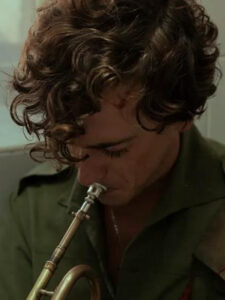

Original title: Sunbathed · László Nemes· Hungary · 2018 · Script: László Nemes, Clara Royer, Matthieu Taponier · Interpreters: Jakab Juli, Vlad Ivanov, Susanne Wuest…
Original title: Limit · Ali Abbasi · Sweden · 2018 · Script: Ali Abbasi, Isabella Eklöf · Interpreter: Eva Melander, Eero Milonoff, Viktor Åkerblom…
The Hungarian László Nemes burst onto the international scene with a work that captivated audiences and critics around the world and with which he would win the Oscar for best foreign film of the year. 2016, Saul's son. When we thought everything had been said about Nazism, Nemes showed us that there were still new ways to approach it. With an overwhelming staging, Saul's son I achieved the most difficult, put the viewer in the skin of a man of flesh and blood, witness to that atrocity. For it, he skipped the classic rules of identification in order to take a somersault forward. The drama of its protagonist involved us as we suffered the same difficulties as him., but not as mere spectators involved politically or emotionally with what is told; Nemes literally brought the past to turn it into a real present, concrete, necessary. It is worth remembering this film to see the cracks through which his second feature film cracks..

Sunset It shows us, from the foreground, the Iris, a young woman arriving in the city of Budapest, one of the most prosperous centers of the Austro-Hungarian empire, with the intention of finding work in a fashion hat store. We are in the year 1913, very shortly after the outbreak of the First World War that would devastate the European continent for the first time in the 20th century. Bucharest is a commercial hotbed, cultural, also human. Everything here is movement, activity. After the death of his parents, Irisz has set her sights on working at the company that was once owned by her family, but his plans are disrupted when he is informed of the existence of a brother whom he did not know until then.. Perhaps driven by the desire to find a solid anchorage in a world in which she feels alone and unprotected., Irisz starts, So, the search for that brother. that world, Nemes tells us, seems plunged into absolute chaos.
As I already did in Saul's son, László Nemes places the camera a few centimeters from the protagonist and follows her wherever she goes. This strategy allows you, as he did in his previous film, maintain a permanent tension between that body that we follow from here to there and the space that surrounds it. Playing intelligently with the framing and depth of focus of the image, Nemes withholds part of the information from us with the intention of putting us in the same situation of helplessness and confusion in which, suggests us, Irisz is found. So, It is not difficult for us to feel like newcomers to a city of which we do not know any spaces., distances or the people who assault us at every step. Everything seems confusing and overwhelming..

However, yes in Saul's son This strategy served as a spur to the plot or what was at stake., here it remains a style exercise with less emotional impact. If in his previous film that severed gaze of the viewer served to make him participate in the same difficulties that his protagonist suffered, here that identification is not complete. Unable to physically locate ourselves, We share with Irisz that same feeling of bewilderment. where are we? where are we going? What happens in that outside that is hidden from our sight and that threatens us?? These are the questions we ask ourselves. But where in Saul's son that feeling served to push the conflict (the need of its protagonist to save the life of a child from death in an extermination camp) here both objectives are disconnected. We perceive and understand that impression of loss, immersion in a labyrinth with no apparent exit in which Irisz finds himself, but his wandering is nothing more than the result of a detective search, with no further implication than the different obstacles that it encounters at every moment and that it will overcome, most of the time, not by his own action, but thanks to a third party who appears at the right time to rescue her. The main cause of this feeling of exhaustion that finally assails us is also found in a plot, a conflict with which we fail to feel fully involved. Who is this brother that Irisz is looking for so desperately?? What does the possibility of finding him mean to her?? The answer to these questions is not posed by Nemes.

So, which in Son Saul it was discovery, here it seems capricious concealment, a trick. It's not just that we don't know where we're going, is that we do not know why or for what. And of course, this way we feel confused. We could well be left with that impression of disorder, metaphor of that pre-war Europe that Nemes wants to discover. Thus, we could justify Nemes's proposal by pushing it into the realm of abstraction: no matter what happens, the things that happen, like what happens, the last impression. But we soon understand that that is not the intention behind this work..
We can't stop praising, however, the enormous staging work carried out by Nemes and his artistic team. Each sequence shot with which he composes his work is a delight for the eyes. There Nemes connects with the tradition of great classic blockbusters where extras and sets gain strength in a narrative aimed at a viewer who is overwhelmed by the spectacle., although Nemes dispenses with any intention of grandiloquence by placing the camera at the eye level of his characters, that is to say, of the human being, ultimate protagonist of what we are seeing. The orchestration in the use of the camera with the rest of the elements of the scene is overwhelming and shows that we are facing a true virtuoso in this field.. However, that display is not enough. Even the supposed connection between the events and the historical moment is dissolved. What does Nemes' text explain to us about all this??

Two more questions, to finish. The first would be to ask ourselves if, with this proposal, a film form that shows signs of a certain mannerism is not closed for the Hungarian director. The other has to do with the superb shot with which it concludes Sunset. Plane that perhaps pushes us towards a future story, a will continue, but also to the work that this film could have been. Simply superb.
In another vein, This week one of those more modest premieres hit the screens, but what, little by little, have been earning a well-deserved reputation among the public to create broad expectations. Con Border, second feature film by Swedish-Iranian director Ali Abbasi, We delve into Tina's life, a customs employee who lives modestly in a cabin next to a lush forest. Tina has a special gift: His sense of smell allows him to distinguish the emotions that affect people, very useful skill when trying to capture criminals or traffickers who try to transport their merchandise across your checkpoint. But the first thing that catches Tina's attention is her physical appearance and, more specifically, an apparent deformity that she attributes to a genetic deviation from birth. Tina assumes that deformity as a stigma, but when he meets Vore, a man who has the same problem as her, your whole world will turn upside down.

In Border We did not find any aesthetic fuss or notable formal proposal. The greatest virtue of this film focuses on the construction of a script that knows how to handle its cards and catch the viewer off guard.. A moving plot plays in your favor (and therein lies its greatest originality) between social realism and fantastic story. This miscellany of elements maintains the attention of an audience that is placed in front of the suspicion of something that does not seem to agree., and then be dragged after the clues of that mystery that, one after another, will be revealed before your eyes.

Despite what has been said so far, Border confronts us with certain questions that do not come directly from the plot. A film that seeks to confront us with our own animality. We will not explain how it does it so as not to reveal surprises., just comment on how their characters fight (and they manage to free themselves) of the obstacles of civilization to show us that wild side that nests inside all of us. Too often we use the word freedom as the desire of a human being who struggles to break free from the shackles that bind him to conventions that, more than preserving order, They seem designed to subdue him. On physical delivery, emotional of its characters to that “beastly” nature that surrounds them, Ali Abbasi symbolizes that longing. And materializes it, and in doing so we also feel liberated as spectators. Or double locked, depending on how you look at it.

However, that animal nature contains some traps. While I saw Border, recalled what is perhaps one of the most interesting films that American cinema has produced in recent years and with which Abbasi's film could be compared to a certain level, Bone Tomahawk. But while in Craig Zahler's film that primitive nature referred us to a being without morality, pure survival instinct, here the debate moves along other paths. TRUE, as the movie suggests, That civilized man has many miseries to hide, but these miseries do not justify us giving that morality as a solution.

The other element on which the film reflects is the relationship between the normal and the abnormal or, which is the same, the canon of beauty. And this is when the story definitively crosses the plane of realism to offer itself as a magical moralizing tale. (which is not necessarily bad). Ali Abbasi comes to tell us that beauty is found within. GERARDO LEON