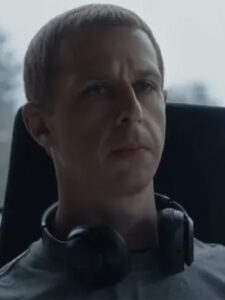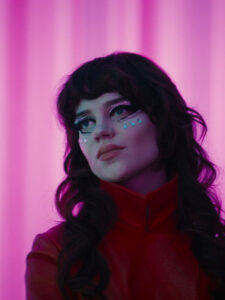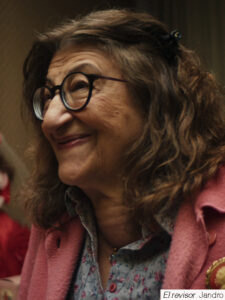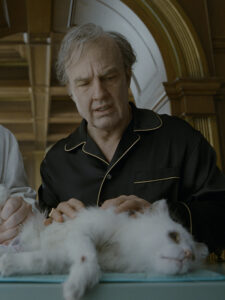
The fourth screening session of the Official Section in competition at La Mostra de Valencia began with the presentation of Willow, latest feature film by Macedonian director Milcho Manchevski, who made the leap to the international scene with before the rain, a first work with which he would win the Golden Lion at the Venice Film Festival. 1994 and with which he would be a candidate for the Oscars for his country.
Willow approaches a topic that had already been addressed in previous sessions by works such as Children o Tereza37, both films discussed in this section: the conflict over motherhood in modern societies. But, unlike her program partners, Manchevski's film challenges the conventions of linear narrative and proposes a game. Willow is divided into three stories, in appearance, differentiated from each other. In the first of them, We are located in an inconcrete time of antiquity. A young couple wants to have children, but she can't get pregnant. To solve the problem, The couple goes to an old healer who will give them the remedy with a condition: that they give him the first of his children. The other two stories take us in the present day and introduce us to two sisters. When I thought it was impossible, one of them becomes pregnant with twins after undergoing several fertility treatments. The problem will arise when you discover that one of your children has a disability, which will force her to make a difficult decision. In the other story, the female protagonist, after another unsuccessful attempt to conceive a biological child of her own, faces the contradictions and fears of a complicated adoption.

This episodic structure allows Manchevski a game of associations or appeals between the three stories that is, definitely, the basis on which, as I already did in before rain, supports your proposal. “I like the deceptive nature of the episodic structure. The three stories have a conventional structure with their beginning, its development and its end, But it is in the way in which they interrelate with each other that the complexity of the film lies.”, commented the director at a press conference after this first screening of his film. “The three parts are not necessarily related in a narrative way, it's a combination. In some cases it is a thematic connection, In others they are echoes or rhymes about similar issues that affect them., the contrasts. Basically, we have an asymmetrical connection between the three stories, which we hope will lead us to experience more of the emotional part than the purely narrative part.”
The question of motherhood is not a new theme in Manchevski's cinema. In fact, This question was already part of one of the stories of before the rain. It is also the case of Dust, his second feature film, in which the narrator of the story is the baby that one of the characters carries inside. Even his third film was titled, precisely, Madre. But, in the words of the Macedonian director, This thematic coincidence does not respond to a pre-established plan. Rather, on the contrary, His way of approaching the scripts on which his films are based follows a working method that shows us that this is nothing more than the result of mere chance.. “I begin with a general feeling and the complication of an argument. From there, I play with these elements, as they grow to that point where they become a movie. Thus, the script becomes something like playing a game. And there I feel that I am only the channel for history”, Manchevsky commented. Once the script is settled, The search for financing begins and the process of translating what had been imagined into a concrete dramatic form.. Para Manchevski, The key is at a point of intersection between the general and the particular. “I believe that any topic should be explored especially at the point where society and the personal come together.”. It is the confrontation between personal choices versus the needs of society.. In the case of motherhood, There is a lot you can extract from that meeting point.. What I have done in this film is touch on some of those themes.".

That search led the director towards these three very different stories in terms of their architecture.. "In the first story, The approach to the story is mythological or fairy tale.”, explains Manchevsky. “It is told in the way a legend or a myth is told.. In contemporary stories there is a more realistic approach. “I like contrasts in dramatic art and the use of these different styles of telling stories helps me reach a conclusion that is the synthesis of both.”
The bet, however, was not without risks. At a time when, from certain platforms and activisms, role plays in society are studied with excessive scruple, and especially in the cinema, Manchevski has built three powerful female characters full of nuances, which invites a permanent rereading or rediscovery of what they represent. On the question of constructing female characters from a male perspective, Manchevsky responded like this: “For me people are people. Sometimes, it is said, can you talk [as a man] of a feminine experience? Can you talk about the experience of an ethnic minority if you don't belong to it?? This is something that is done especially in the United States. And well, risking sounding wrong, I think it is possible. It is not necessarily a personal experience, it's about the human experience. For me, insisting on differences emphasizes those differences, instead of creating a bridge between them. So what I do is try to address the human experience, whether sadness or joy”.
Con Fairy tales, second work of the brothers Fabio and Damiano D'Innocenzo, We were addressing the second session of this day of the festival. Here, We approach a small urbanization of townhouses located in some inconcrete place in contemporary Italy. It is summer and the heat hits the families who live in the urbanization, a frankly extravagant collage of individuals or, maybe, more normal than we would like. Pronto, The differences between them arise in the friction that causes this close and, at times, suffocating coexistence. The image refers us to the dream of the so-called middle class of our time: two-story houses, garden with pool (prefabricated), birthday parties, barbecues, dinners on the back terrace... But that appearance of happiness and well-established community hides numerous monsters. The dream of prosperity will come crashing down when the adults discover that the children are building a bomb to blow everything up..

With these premises, The D'Innocenzo brothers have constructed a story that has shades of a twisted tale by the Brothers Grimm. At the beginning of the narrative, the voice of one of the protagonists of this story introduces us to this peculiar space. From the first moment, what seemed like an idyllic place, discover a nightmarish psychological environment. Fabio and Damiano D’Innocenzo use these narrative elements to make a corrosive criticism of contemporary society and, very especially, to the codes of conduct and ambitions imposed by current forms of consumption. on the surface, The residents of this community show an apparent cordiality among themselves, but differences quickly emerge, sustained by envy and a petty competition that pushes them to constantly monitor each other, an escape route that hides your absolute mediocrity in the face of life.
As Matteo Garrone did in Reality, The D'Innocenzo brothers set their sights on what, too often, is far from the attention of contemporary cinema and that targets the most popular layers of society. A context that shows off its taste for the ugly, lo kitsch; definitely, of everything that arises morally and aesthetically from mass consumption television, Media Markt advertisements and the propaganda of large travel agencies. Everything at your fingertips, but empty inside. In this social environment, The family is presented as the main backbone. A family trying hard to keep up appearances, but what, inside, is corroded. From the outside, everything seems perfect: dad, mom and couple, boy and girl. inside, it's different. Dad lets out his frustration and his inability to educate his children and build a healthy coexistence with a violence that he barely manages to contain despite the fact that, in the background, He is a coward who cannot face problems when they arise. Incomprehensibly, mom plays along. Y, in the midst of the delirious behaviors of their elders, we find the children, victims of a war whose causes they do not understand, while the innocence of childhood escapes them, the games, the natural discovery of sexuality, all buried by layers and layers of fear. The consequences of all this should not surprise anyone.. However, when these jump to the television news, everyone is alarmed, surprised.
At first glance, The world that the D'Innocenzo brothers show us may seem like a hypertrophied recreation of reality.. This can't be happening, we will tell each other. Everything here seems exaggerated and this is helped by a camera that works like a huge magnifying lens that, although it establishes the object of its study, It also distorts the edges or limits of what it shows us.. But a more thoughtful reflection may make us see things differently.. Fabio and Damiano D'Innocenzo look where we don't want to see, They extract what is hidden, what we all hide, just because, in the course of daily life, we are not aware of it. And what emerges is a violence that permeates everything. Violence against others, our neighbors, violence against frustration, in the background, causes us what we say we long for, violence in the face of the insecurities that the modern world offers us and, finally, violence against ourselves and what we love most. G.LEON