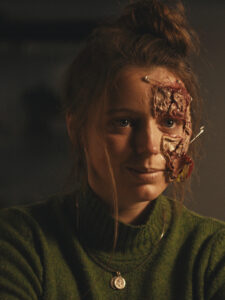

Original title: 14 days, 12 nights · Jean-Philippe Duval · Canada · 2019 · Script: Marie Vien · Intérpretes: Anne Dorval, Francois Papineau, Leanna Chea…
Original title: New order · Michel Franco · Mexico · 2020 · Script: Michel Franco · Interpreters: Naian González Norvind, Diego Bonet, Monica del Carmen…
We are located in a small rural town in Vietnam, In the year 1990. Behind a reed structure, away from everyone's sight, a woman gives birth. The birth, carried out with the sole help of a local midwife, it's complicated. At last, a girl is born. But the mother will not be allowed to take care of the new arrival.. your aunt, a woman with a sullen expression and severe character, He cruelly takes her away and gives her to an orphanage with the order to give her up for adoption.. Almost twenty years later, In the year 2008, another woman, in this case of Canadian origin, arrives at that same orphanage. With him he carries some photographs of the girl, now converted into a luminous young woman. The woman is trying to locate the girl's biological mother for reasons that, at the moment, we don't know. In his gaze we perceive a conflict that, a priori, we want to solve.
Supported by this short argument, Canadian director Jean-Philippe Duval proposes a contemporary melodrama. With a structure that moves in two stages, that past in which the girl was born and the present of the mother who took her in for adoption, Duval reveals to us the secrets that these three women hide.. It is in that parallel structure where 14 days, 12 nights supports your biggest bet. At the beginning of the story, We don't know everything about the characters: no sabemos quiénes son, What problems afflict them or what is the link that relates them?. Little by little, in brief interspersed scenes, They will give us clues about all this until we compose the final painting. We could say that it is that “mystery”, that which we do not know and that will be discovered to us at the right time, what supports the development of this film. Know what the girl's fate has been, will allow us to establish the bond that unites their two mothers. A bond that is not just physical, the director tells us, but emotional, and?, somehow, gives ultimate meaning to their troubled lives.

By combining those brief scenes, Jean-Philippe Duval has created a piece that unfolds more like a musical work than a typical narrative. In fact, will be the background music, present throughout the entire film, what ties each of the segments that trace it. Duval is not so much interested in telling us a story as establishing a relationship that, in your imagination, works on a purely sensory and symbolic level. On one side, the developed west, represented on this occasion by that Canada of origin of the girl's adoptive mother. On the other hand, a more traditional Vietnam, perhaps more economically and technologically backward, but what, however, it appears to us purer and closer, more human, more carnal. The life of the biological mother takes place in a bustling world, full of people moving in a chaotic order. That of the adoptive mother does it in a more orderly and neat space, but, at once, much more aseptic and lonely and, somehow, distant and sterile. To highlight these aspects, Jean-Philippe Duval relies on the use of photography. The world of the adoptive mother is characterized, So, through the white and gray of a landscape immersed in an endless winter, an almost dead space, lifeless. While, in Vietnam, The greens and ochers of an overflowing nature that dazzles us with its exotic beauty rule.. But these differences can be, in part, misleading, Well there is something that, although on the surface it seems different, deep down it is not so much. On one side, we discovered that, before the intervention of chance, There is no money that achieves the desired security and happiness.. Of other, the oppression of a tradition is revealed to us, a culture and a political past that also burdens those who live under its shadow. Both women will have to meet to mend what has been broken and unite., finally, both worlds.

In his eagerness to confront these worlds, Jean-Philippe Duval must be recognized for having a great capacity for composition. In this sense, It is appropriate to celebrate his skill in creating textures that, with a good eye, extracts from the landscape that surrounds it and which it wants to charge with allegorical force. However, that precious desire is at times too obvious, managing to surprise us, at first, for its majesty, but moving away from all this precisely where the director intends to capture us, that is to say, in the emotional. Duval's look is, in the background, the gaze of a tourist who allows himself to be enthralled by a landscape that cannot penetrate beyond the travel agency's postcard (and the metaphor is not gratuitous), especially in the case of that Vietnam that he explores with the protagonist of his story. And the same thing happens with the psychological construction of the characters and the conflicts that afflict them..
We said at the beginning that 14 days, 12 nights It is a melodrama and its structure adheres to that. The characters' conflict is based on a series of tragic and opportune coincidences that will shake their lives.. Too tragic and too timely for a proposal that, on the other hand (that camera that doesn't stop moving and that fractured montage that he resorts to in certain sequences), It has the façade of a realistic story. little help, besides, interpretations that suffer from an excess of affectation. Jean-Philippe Duval's intention is to convey to us that feeling of melancholy that devastates the souls of these two mothers whom, For different reasons, They have taken away what they love most. But his effort to record his suffering in the eyes of his actresses is too ostentatious and, at times, like his prints, somewhat artificial. As a result of all this, 14 days, 12 nights It is presented to us as a drama where the form, that melody we were talking about before, is imposed too visibly on a background whose connotations, finally, It also fails to lock and, therefore, they don't just concern us.

Much more disturbing is the latest work for the screen by Mexican director Michel Franco, New Order. From the very title of the film, we can anticipate part of what awaits us here. Let's imagine a wedding. A young couple celebrates, between friends and family, the imminent link. All that remains is the arrival of the judge to seal the vows of the future marriage. Everything is joy and celebration. Because of the context, that is to say, the clothes, the way to manage money, the splendor of the house where the ceremony will be held, We understand that we are faced with a very wealthy and well-connected family socially and politically.. But, about to celebrate the nuptials, an unexpected event occurs: a group of individuals jump over the walls of the house and interrupt the party. It is then that a threat appears that, until that moment, We only heard a distant rumor through the television news, in the comments of a guest or the house staff themselves. A popular revolt has occurred in the city. The symbol of the revolt is green paint. Drama soon erupts: The robbers are not only looking for money, as the hosts seem to believe, something we discover when the first victims fall.

New order It is a film that appeals directly to the viewer's imagination.. It is not necessary for anyone to explain anything to us to understand, in principle, what is happening. Franco places us in a dystopian society, but that is too similar to the present of that Mexico City where the action is located. Just a couple of attitudes, gestures and conversations caught on the fly to understand who is who in this universe that is presented to us. Celebrants belong to the privileged class, at the top of the social ladder. The assailants seem to target the lower and impoverished classes. So, the popular revolt takes the privileges of those above by storm. But this series of stereotypes on which the film is based contains some traps..
Definitely, One of the greatest virtues that this proposal has is the use of a very well-adjusted choral apparatus.. an event, leaving the girlfriend's house to help a former employee, serves as bait or thread to tie together a complex social and political map that touches many strata, from those class differences to the military establishments. Starting from that core fact, Franco's film moves intelligently in all directions, managing each of these elements so that none escapes your control. Thus, The tension will begin a progressive upward escalation as the situation becomes more complicated.. In the film's promotional notes, Franco appeals to A Clockwork Orange of Stanley Kubrick as one of his references, and although the comparison does not entirely fit, There are some mechanisms that are similar. As the footage progresses, What at first seems like a fruitless event unleashes the irrationality that encourages all parties involved., causing what seems to be an unstoppable escalation of violence. It will be that fear of the unpredictable that conquers the heart of the viewer that keeps him attached to the seat in the movie theater..

It's from here, when our initial impressions will mutate or, rather, They will jump from one feeling to another, as the plot becomes more complicated and new actors intervene in the conflict. They arise, So, the questions. What is the cause that triggered the revolt?? Who really are these exalted ones?? What is your goal? And the military? Which side are they on?? Have they come to put order or are they looking for something else?? But as the film nears its conclusion, we understand that, in the background, none of this matters. What really matters is that we understand how this world they show us works and, by extension, our own world. Who is innocent and who is beginning to be guilty, So, the least. Definitely, What is this new order that the film refers to?? And most relevant of all, is a new order possible (better) in a society so corroded? The interpretations are thus triggered on multiple levels, from the political to the sociological, the psychological or the cultural.
In the end, The only conclusion we draw from all this is that society, at least this society, it's not moving anywhere, but it turns on itself. A spiral sustained by the lies of each other, and where the innocence, true justice or good intentions are literally crushed. The future (the present) that Franco shows us is undoubtedly very little hopeful. However, We will not find a solution if we are not able to look at it head on.. A highly recommended film. GERARDO LEON