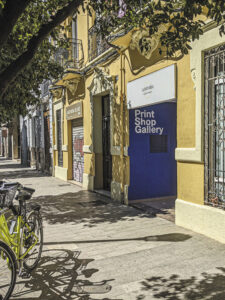

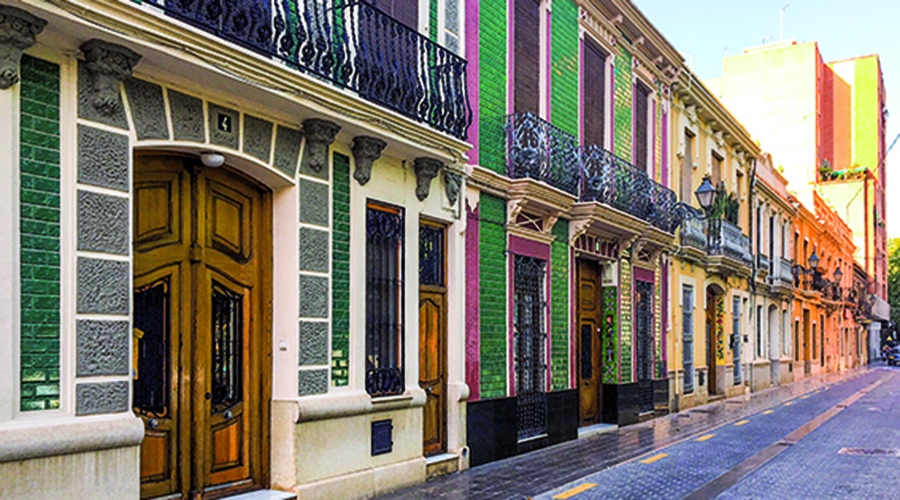
What was never a commercial street in the fishing district of sugar cane It is now a vibrant avenue, where the colorful facades are caressed by the loving breeze that comes from the sea to sneak into every corner and cheer up its people.. rosary It was always a quiet street, where all the neighbors knew each other and were even related, They spent their days sitting in the doors, to the fresh, they lived as a family. There are still inhabitants who were born in the houses where they live, where they have always lived, but many others are gone; Some were scared by the Valencia flood, that brought out the fear of living on the ground floors; others were scared by the degradation of the neighborhood; many, simply, have been missing due to the inevitable passage of time. After many years of neighborhood struggle against the demolition of what is one of the most beautiful and valuable neighborhoods in our city, the street has come back to life, with businesses that fill terraces or shop windows; In the square we see the doors of its theater and its church open, and two museums show how much this road and this diverse neighborhood can offer us., where young people who have invested in a home now live together, foreigners occupying tourist apartments, gypsy families who come to the door with their guitars and elderly people who have experienced all the changes that a sugar cane resistant has insisted on showing them.
MARINERA HOLY WEEK MUSEUM
— rosary, 1
This great building that inaugurates the street rosary It is the house of a Sailor Holy Week that crosses the borders of time, exhibiting every day the treasures of the most anticipated party in the world Cabanyal-Canyamelar. We walk among symbols of passion, crowns of thorns, facsimiles and original images, ancient banners, scenes of Christ and colorful steps full of flowers and lights dating back to 1882, the oldest, until 2017, the most modern. We feel the devotion, that of the 31 brotherhoods that still live in this seaside neighborhood and that exhibit here the costumes they wear every year in the holy day processions. Temporary exhibitions of photography and posters energize the place that is testimony to a festival that was born next to the Mediterranean, of the faith of the women and men who lived from fishing, and that continues to be celebrated under the protection of the sea.
RICE MUSEUM
— rosary, 3
After many years of deep and lonely sleep, the old rice mill on the street rosary was launched again in 2002 to invite us to travel in time. Since its construction, at the beginning of 1900, The mill was an industrial reference for being one of the most modern in Valencia, since it ran on electricity and highly mechanized processing. We tour the three floors of the building, where selection machines live, cleaning, bleaching and classification of grains of the cereal most deeply rooted in our city. We hear the breathing of wood and metal machinery, bella, robusta. We look at photographs from the last century, some related to the museum theme (rice harvesters, family paellas) and others only as testimony of a shared history (the inauguration of the first electric tram in 1900, the flood of 1957, to nevada of 1960). Today the museum is nourished by foreign visitors and schoolchildren., all of them distant from this time and place, but with their visit they keep alive the memory of a time of revolutionary advances, of historical news that forged our destiny.
CLOCK OVEN
— Escalante, 29
Upon leaving the museum we observed how, a little further, the ground turns white. The trail zigzags from one door until it reaches the next one. It looks like flour. A man runs from one place to the other, carrying trays of bread. We meet in the Clock Furnace workshop, two enormous basements where all the delicacies that nourish the showcases of the premises located on the other side are made in an artisanal way., on Escalante Street. once there, a client says, convinced, that this is the best bakery in the world Cabanyal-Canyamelar. He has bought bread here since he was a child., Only before the war I picked him up on Chapa Street, its previous location, a road that was destroyed by the bombs that frightened the neighborhood. after the war, the oven moved here, and also opened a stall inside the market. We do not take away man's reason, everything is delicious, But if we have to highlight something we will say that their ratatouille and sweet potato dumplings are especially well known., as well as the typical recipes of Cabanyal-Canyamelar: raisin and walnut cake, short donuts or coke rim.
THE TREE
— rosary, 17
It's only been a few weeks since this place opened its doors., leaving us amazed at the rehabilitation that its new owners have carried out: where the walls of an old boat workshop once collapsed, Now stands this beautiful bar-bookstore in which wood predominates, books and plants. The tree It is a neighborhood project, It is the idea of several partners who have wanted to join the new dynamics of the neighborhood, to the rehabilitation of the precious spaces that hide the streets of the sugar cane. The tree born from the intention of promoting ecology and social movements, for the defense of the territory, for the love of the world we live in and nature. On our future visits we will be able to attend the screening of documentaries or workshops on ecology, take a book giving the will (that will go to the association Brufoll, helping neighborhood girls and boys at risk of social exclusion), try the tapas from around the world prepared by the members of the Valencia Acoge association (organization that works for the integration of immigrants in the city), or simply enjoy a beer on their beautiful patio, next to his lemon tree.
BAR LA PACA
— rosary, 30
La Paca was one of the first bars that opted for Cabanyal-Canyamelar, and that gave the starting signal to the current recovery race of the neighborhood. Its unbeatable location, in front of the TEM and the plaza rosary, makes it a very appealing option for a beer or a vermouth in the sun, accompanied by a tapa at a very good price. Famous for its tortillas, fat, tasty, varied, and for its eclectic and diverse clientele, made up of regulars from the neighborhood and people passing through who make their obligatory stop before or after the theater. Its interesting and colorful decoration gives the place a particular charm.: Don't lose sight of the curious couple that occupies the central pillar, a crucifix and a Ken (Yeah, Yeah, Barbie's boyfriend), its red checkered floor, black and white, and the wonderful Horror vacuum of its walls, where Jesus Christ coexists, Gustav Klimt y Salvador Dalí.
TEATRE THE MUSICAL
— Pl. of the rosary, 3
We arrived at the square rosary, the heart of the road. Our eyes fall on a building with a monumental door, simple and delicious facade. It is the theater The Musical (TEM), which occupies the space of the old Musical theater and cinema of the Cabanyal-Canyamelar, closed in the years 70 and abandoned from then until 2004. It was then that the renovation by architect Eduardo de Miguel gave the building the highest door in the entire city., with nothing more and nothing less than eleven meters high. From then on the theater revived with the wonderful management of the company you were coming back, but plummets eight years later, with the arrival of the new and disastrous management of Crystal Forest, company of the famous José Luis Moreno. The new government once again changed the fortunes of this legendary theater in 2015, with the decision to manage its programming directly from the town hall, without the threat of Blasco Ibáñez's expansion in the environment. The TEM is now, at last, a reference on the cultural map of the city, a place for local people, that acts as a social connector through quality contemporary artistic programming, with training proposals, creation laboratory and participatory activities.
THE PILONA
— Pl. of the rosary, 3
Last year the cafeteria of the Teatro El Musical y Marta went to competition, publicist and cultural producer, He won it with his proposal for cultural revitalization of the bar, an idea that went far beyond a hospitality service for visitors. In line with TEM, La Pilona also seeks a constant relationship with the residents of the neighborhood, That is why it opens its doors to heterogeneous artistic projects., as talks and colloquiums related to theater programming, Children's activities, improvisation theater or exhibitions. Any day we can find interesting proposals, but, definitely, It is best to go on Sunday, when La Pilona becomes a meeting place and free dance, with music, dance and gastronomy from different countries like Brazil, Argentina or Cuba. In no time, This space has been consolidated as a tributary of the waters of the TEM, a more casual version, but just as interesting.
CHURCH OF OUR LADY OF THE ROSARY
— Pl. of the rosary, 3
The Church of Our Lady of the Rosary now stands on an 18th century hermitage., a 19th century temple declared an Asset of Cultural Interest and unknown to the majority of Valencians. She and her twin sister, the Church of the Angels (the first, the Church of sugar cane, the second, that of cabanyal), They were once the original temples of Poble Nou del Mar, the maritime town that lived next to the city of Valencia without integrating into it. Inside the church, the simplicity of white and gold predominates., and the fresco that covers the main chapel draws attention, painted by the Valencian José Ros Ferrandis. Its exterior shows influences from Herrerian architecture., and has some touches of baroque taste. This little great unknown is still frequented by many inhabitants of the sugar cane, people from the neighborhood who still claim to go “to Valencia” when they visit the city center.
CHURRERÍA ICE CREAM LOS OLIVARES
— Just resting, 17
The corner of this place has been appearing on the street for more than twenty years. rosary, although its lively terrace is located in the pedestrian part of its neighbor Just Vilar. The secret of its success hides no more mystery than making everything on offer at home.: churros, batons and donuts, hot chocolate, ice cream, horchata, fartons, orange and apple coke, natural juices… Depending on the time of year, the star product is one or the other: in summer the queen is horchata, that comes from the harvests of Almássera, and in winter, your chocolate with batons or pumpkin fritters. And since we're talking about fritters, We have to know why theirs are so famous. It seems that you have to use the right amount of pumpkin, a new mass every few hours (yeast spoils over time, so you have to knead it and use it soon) and clean oil. It is in this last point that, they tell us, Many street stalls fail during the Fallas, so they claim not to have competition problems during the holidays. we believe them.
THE BORRUMBALLES
— rosary, 126
In this space the objects carry the weight of time on their shoulders., show the patina of what has been lived, They tell their long journey to get here. The small room that we see when we arrive is just the prelude to a great workshop, packed with great wonders waiting to be discovered by the eyes of its next buyer. Three women work there., they are the soul of this place: Eva, Virginia and Valentina take care of and transform these unique pieces and teach restoration workshops. We asked them what the secret is to getting hold of these gems from the past., and they tell us that everything consists of an agreement with its former owners, who allow them to take them in exchange for a portion of the profits when they are sold. And they will be sold, because it is impossible to resist Art Deco pieces from the early 20th century, to the precious apothecary jars, to an antique spinning wheel or a Japanese tea set, to an armchair Tathir Italian, to the classic ceramics of Peiró, or an original work chosen with taste (lithographs and engravings). What do you think of a Chester sofa in perfect condition?? Vaya, it escaped us. Sold.