
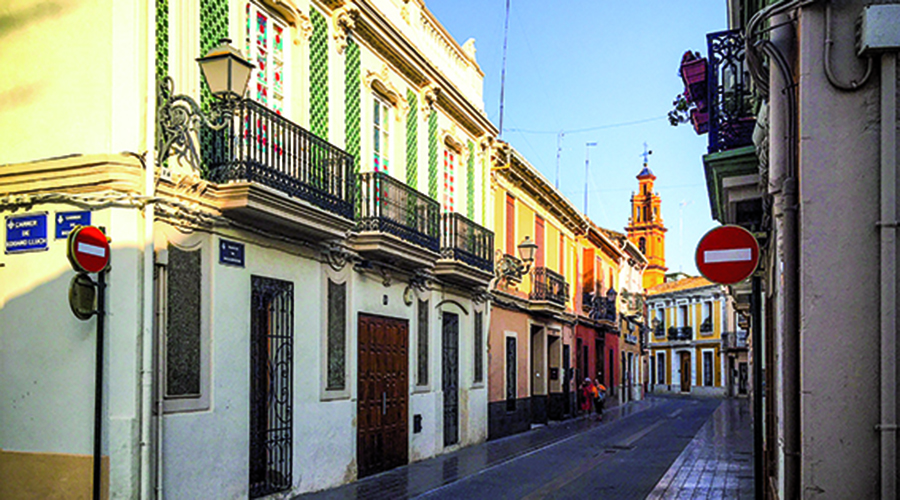
The continuous overflows of the Turia River added layers of sediment to the Campanar area and transformed it into a very flat area., hence its name, a derivation of the Latin word “Campus”, plains area, not cultivated. Muslims created the first orchards, In the 19th century, the district had its own town hall for the first time and, despite lasting only sixty years, Today the neighbors continue to say that: “We are going to Valencia”. The area was isolated for a long time and the modern construction of large communication routes crowded with traffic around it (Pope XII, Vall de la Ballestera and Master Rodrigo), More than communicating it, they have turned it into a small island of low houses (s. XIX-XX) and facades that captivate with their modernism and art deco popular. But there is a lot we have lost. between the years 1997 y 1998 The Nou Campanar sector was urbanized on the territory of the ancient district of Pouet, destroying mills, irrigation systems, farmhouses, some barracks, irrigation ditches and the Camí del Pouet – which articulated a rosary of centuries-old farmhouses – out of pure speculative greed and despite citizen mobilization. Today Campanar is one of the few neighborhoods that has its own cemetery (from the end of the 19th century), but it lacks cultural infrastructure and has very few shops in the old town, butcher shops have been disappearing, stationery and greengrocers, and they can't come back because there are no empty houses. Furthermore, the price of land has become prohibitive., what has its good side: there has been no gentrification process. Urban Agenda has traveled through what was once the town's main street (today three streets: Monsignor Rausell, Benidorm and Doctor Vicent Torrent), with a stop at the Parish of Our Lady of Mercy and the Campanar Bar in the square and at craft stores, vegetables and ham in the adjacent streets.
THE CORNER OF THE PAELLA
– Father Raussel, 17
Between the smoke and the cars, We arrive at the roundabout that connects the avenues of Mestre Rodrigo and General Avilés. There, That's when we escaped down a small cobblestone street that was once the main artery of an independent town surrounded by orchards.. The first thing is to fill your stomach in a beautiful farmer's house, with its imposing wooden doors, beams on the ceiling, original floor and tile walls. Inside there are ten tables where people are served., above all, Valencian paella (with a little duck) made with orange firewood. In few places in Valencia we can find this delicacy, in substance and form, Casa Carmela and little else. And for Valencians who hate paella a little, a few alternatives that make you salivate: Iberian secret rice with seasonal vegetables or creamy rice with lobster, For example. The starters, either they are as Valencian as paella itself or they have a touch of the land: carob hummus, loved, wood-fired esgarraet, sautéed cuttlefish with broad beans, tender and blanched garlic, clotxines (in season), pumpkin and boletus fritter, and the Valencian pepito, They are just some of them. For €30 you will eat wonderfully, from Tuesday to Sunday (only at noon), in the most authentic neighborhood of Valencia. Don't forget to reserve!
MANUELA'S OVEN
– Benidorm, 12
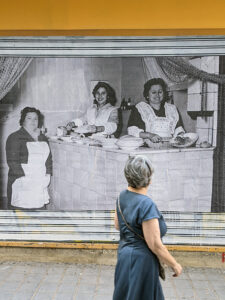
We arrive at the authentic nerve center around which the old neighborhood of Campanar revolves.. It is a family oven that three sisters and a brother tend to with love and sympathy, heirs of a legacy that is still to come., at least, from his great-great-grandparents. It remains to be investigated when exactly it all began., but today they have documentary evidence that the oven existed in 1866, in the same place and that belonged to the family. Her name is Manuela in honor of her great-grandmother., who was widowed at 37 years, pregnant and with two children, and she still had the strength and desire to help everyone who needed while she was carrying the business and the family alone.. He was a very beloved person in the town. As you get closer, The smell already warns that very good things are cooking in there.: artisan bread, sweet potato cakes, pepper cokes and tuna, and the three typical cakes of the famous neighborhood festivals that are celebrated in February: Cristina almond cake, the sachí and the fina, made with anise. They have won prizes whenever they have entered the competitions organized by the bakers' guild of Valencia., It is normal for people from “outside” to come and buy at Forn de Manuela!!
CAMPANAR CASINO RECREATIONAL SOCIETY
– Benidorm, 6
Paqui welcomes us behind the bar of the Campanar Casino, a society of 1891 that started out as colombaires and had its headquarters on the upper floor of the Forn de Manuela, where the Spanish flag was hung with black crepe every time a member died. Today there are about a hundred, practically all men, some still farmers, that by paying their fee they earn the right to play cards and dominoes. Here what prevails is lunch at popular prices: mouthpieces (blood sausage, pepper, Well, stitch), with cocoa and olives, drink and coffee 4.50 €. Pueblo, pueblo.
PARISH OF OUR LADY OF MERCY
– Pl. church, 11
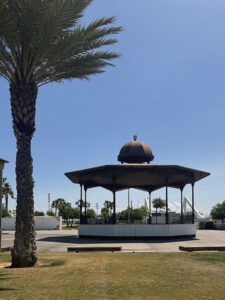
In 1507, The small hermitage of Campanar became the parish church of Our Lady of Mercy. Rectangular in plan, with two vaulted sections and a dome, This baroque style parish was decorated in 1695 with paintings by Dionís Vidal, Also author of the so-called Valencian “Sistine Chapel” in the Parish of San Nicolás. Inside, the transegrary with biblical scenes stands out. (characteristic piece of Valencian baroque architecture that guards the Eucharist when it does not receive public worship) and on the outside the stylized bell tower with slender finials, a first-rate architectural reference in the urban landscape of the city built between 1735 y 1741 following the traces of the architect José Mínguez, author of other bell towers such as that of Foios. Here they worship the Virgin of Bell Tower, the first to be canonically crowned in 1915 (even before the geperudeta), whose great festival is 19 February, day of appearance. These days, in Campanar, it is easy to stumble upon paellas on the street, Moors and Christians or medieval market. But since the weather is not usually good in February, a week of celebration is saved for June, with concerts, children's games and much more.
CAMPANAR BAR
– Pl. church, 16
Very close to the church, Lorena has run Bar Campanar with her husband since 2010. At seven in the morning they open the blinds and the bustle begins: popular lunches, Menu of the day at €8.50 from Monday to Friday with drink, homemade coffee and desserts, suckling pig and oxtail as specialties (custom made) and a good string of tapas (Squid, blood covered in onions…) in a showcase where offal abounds.
FLAG FRUITS AND VEGETABLES
– Bisbe Soler, 16
The owner of this fruit shop lived with her family in a farmhouse in Pouet, what is now Nou Campanar, where they ran the business until the administration gave way to urbanization in the area in the years 90 and expropriated the neighbors' lands. When they were expelled, His father bought this property in Bisbe Soler, They lived upstairs and attended the new grocery store downstairs., named “Flag”, a family nickname. They sell their own products grown on Paterna lands, like artichokes, onions and the famous Campanar potatoes, and product purchased (eggplants and zucchini), plus bags of legumes, dried fruits and candied fruit.
ARTURO DELIVERY
– Bisbe Soler, 15
From 2001 Concha attends the counter of this small neighborhood grocery store that is distinguished by the personal treatment and the quality of the product., a small selection of common use: asparagus jars, cafés, ajoarriero, cheese , lomo, sausage, turkey breast… and the star product of any delicatessen, Serrano ham. From Huelva, Trevelez, Salamanca and Teruel, the one that works the hardest due to its good quality-price ratio.
SILVER HANDS
– Joan Aguilar, 2
In this beautiful craft shop-workshop we find Marina and Carmen (sisters), and Maria (almost sister already) transforming the illustrations of the first into hand-painted objects that exude personality. Jewelry made with cold ceramic (that does not go through the oven and is more resistant), coffee cups, bags, lamps and cushions decorated with designs by Marina Puche, fallera artist like his father and grandfather. He has already designed a good handful of children's failures that draw directly from the world of illustration., like Bolsería, Exhibition or that of Reino de Valencia-Císcar in 2018, call My heart is happy, where he recreated with his unmistakable style situations and things that make children happy, like playing with your pets or diving into the pool. Before leaving we took a look at the beautiful coffee set with different illustrations for each cup (a boy hanging out panties…) and the porcelain plates illustrated with vitrifiable decals for ceramics. We know for a fact that Marina designed a set of beautiful plates for El racó de la paella and they have never been used, They remain locked away for fear of breaking.. A true treasure that at AU we are willing to unearth!!