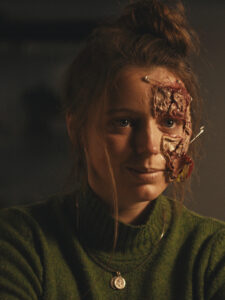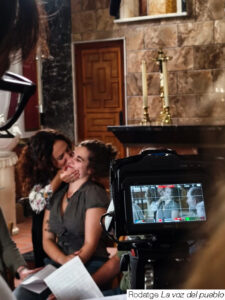
Original title: An optical effect · Juan Cavestany · Spain · 2020 · Script: Juan Cavestany · Interpreters: Carmen Machi, Pepón Nieto, Luis Bermejo, Lucia Juarez…
Original title: The middle of the horizon · Delphine Lehericey · Suiza · 2019 · Script: Joanne Giger, Roland Buti · Interpreters: Luc Bruchez, Clémence Poésy, Laetitia Casta…
Although his filmography already had some titles behind him, either as a director or as a screenwriter, The name of Juan Cabestany would not attract the attention of specialized critics until his second solo feature film., I have boats. In this piece, Cabestany was going to plant the seeds of what would become, with nuances, his later work. A cinema whose character or personality was built on the mixture of traditional elements with a caustic surrealism that pointed to the pillars of contemporary society.. Cabestany part of everyday life, with a pirouette of the argument, give it a twist that pushes it into the realm of the absurd and return, later and in one last turn, to the starting point of that everyday life whose cracks were, So, exposed, revealed. These same criteria inspire An optical effect, his last movie.

Here we meet Alfredo and Teresa, a couple from Burgos who embark on a brief vacation in the brilliant city of New York. The couple is not exactly going through their best moment: The departure of their daughter to university and the death of her mother have left a deep void in the house and in their lives.. Hence the trip. Alfredo and Teresa have decided to put some distance, get away from their problems and reconnect with themselves to recover the joy of a relationship that seems dull. But, upon reaching the city of skyscrapers, They quickly realize that something is wrong.: the taxi driver who picks them up at the airport speaks in perfect Spanish, The food in restaurants is the same as what they eat at home and on the streets., the museums, They are the usual ones. That looks too much like the Burgos they have just left behind. what is happening?

On a first level, An optical effect It's a black comedy (or very dark) around the many gaps that our society of consumption and, above all, tourism as a source of dreams and hopes of the average citizen (Spanish and much of Europe). For Cabestany, This form of contemporary entertainment represents a clumsy attempt to escape from our reality that, let's get on how we get on, always waits for us when we return from our trip. Alfredo and Teresa wander around that city of New York and follow the itinerary set out for them by the guide that Alfredo takes everywhere.. The couple tries to show the enthusiasm that the opportunity to discover new spaces and customs deserves., different from their own. Is it what is expected of them or, maybe, It's what they demand of themselves.. However, nothing seems to satisfy them and, other way round, although they refuse to acknowledge it, everything is boring to them, indifferent, another void. Even, when, for the sake of putting some fun into the matter, They try to break the program, it also goes wrong. In one of the most poignant sequences of the film, Alfredo leaves his guide forgotten at the hotel where they are staying. In a burst of courage, Teresa asks him not to come back to pick her up and encourages him to take “the day off” and let himself be carried away by his intuition.. The couple ends, So, lost in an inhospitable place on the outskirts of that city where they are lost, disoriented. As often happens, The trip turns out to be a complete failure and, in the end, The only thing that remains are some sad photographs in which they appear happy, but in which they cannot be recognized. Who are those people who smile and look at us?, they wonder.

However, passed this first reading, where I think An optical effect represents a step forward in Cabestany's career, It is found in the way it approaches and exposes the conflicts that affect its protagonists.. There is no doubt that one of the challenges that any director faces is to ensure that the public, don't just understand what happens to your characters and get involved with it, but that you get to feel the same thing that they feel, dragging it, definitely, to that intimate world where what is tormenting them is cooked. In that sense, The Madrid director displays great expertise when putting together the structure of this new foray into his film universe.
In the best tradition of science fiction cinema, Cabestany makes his characters relive their journey over and over again. In each new recreation of the same events, foolish, however, a small swap. Sometimes we experience events from his perspective.. Others do it from her point of view.. At a given moment, Cabestany breaks the fourth wall by showing the film camera that records the images, which further affects that feeling of strangeness, in that fictional tone, like something fake, taxation, that has what Teresa and Alfredo are experiencing and that is, in turn, other fiction. With this going and returning to the same situations, Cabestany ends up entangling the viewer in the same spiral of inconsistencies in which marriage is entangled.. Your confusion is, at last, our own confusion. Bewilderment in the face of a strange and threatening world that leaves us as if abandoned in front of a reality of which, in the background, We no longer know if we are part. Bewilderment in the face of life changes.

Con An optical effect, Juan Cabestany overcomes the episodic structure, by chapters, that characterized his previous feature films (People in places, That feeling) and offers us a unitary and well-cohesive piece, that goes beyond the shock of the mere anecdote to tell us a story with very long implications. Production notes count, that this film was being composed, in good part, during filming, something that cannot surprise anyone who has seen it. Some of that slightly faded puzzle impression, hurried, has remained in the final composition. However, This does not harm the impression of unity that the tape conveys.. The interpretations of Carmen Machi and Pepón Nieto also remain in memory, very restrained with respect to their usual television gestures, necessary collaborators in this adventure, essential contributors to this delicious game with the camera and the viewer.
We are now in the summer of 1976. A heat wave devastates the European continent, endangering plantations and livestock in a rural area of Switzerland. In this context, Gus, a thirteen year old boy, He divides his time between work on his parents' farm and his escapades around the surrounding area with his inseparable bicycle.. In principle, and despite the constant arguments with his father, man of strong character who fights to save his business in the face of relentless heatwave, Gus's world remains in a certain balance. But Cécile's visit, a classmate of his mother from a book club he attends in town, will come to disrupt everything. Accidentally, Gus will discover that there is more than just friendship between the two women..

The horizon, second feature film by Swiss director Delphine Lehericey proposes a story that questions us, on a first reading, the conventions of traditional social cohesion models. The relationship that Nicole, Gus's mother, has with Cécile will blow up the, until now, solid family nucleus. Everyone raises accusing fingers against Nicole. accuses her, of course, Your husband, who feels betrayed, abandoned, not only sentimentally, but in that tough battle that is being waged against the weather and, beyond, against a world that wants to muzzle him, subject him to the system of dependencies to which an economy pushes him that goes beyond the humble philosophical ambitions of a small farmer. and accuses her, of course, Gus, who feels that his mother has preferred to be with her lover than to take care of him, as he has always done. But, beyond, The case will also jump to the rest of the small rural community in which the characters live., a petty world of petty betrayals and quarrels, jealousy and mediocre ambitions who will see in all this a sign of weakness that they will try to take advantage of.

But, leaving aside this first approach, There are two elements why Delphine Lehericey's film arouses our interest. The first of them is a deliberate effort on the part of the director to make nature the protagonist of her story.. Lehericey describes the landscapes of this harsh land with simple delicacy, approaching them with respect and honest admiration, rescuing their beauty from them, but moving away from any attempt at empty preciousness. A landscape that is not only the setting for history, but rather participates in it as another actor in the plot. Landscape that adheres to the skin and that affects and conditions the reactions of the characters. A beautiful and harsh nature, at the same time, that exploits the human resistance capacity to the limit. At some point in the footage, We'll wonder who Gus's dad is really angry at., against that woman who has abandoned him for another or against the sky itself? What is Nicole running from?? About her relationship or about that farm that feels like a prison that imprisons her?? To what extent is this oppressive heat not the cause of a good part of the conflicts?

But where Delphine Lehericey's work really shines is as a mirror of that difficult stage of life in which her protagonist finds herself.. In this sense, It is necessary to highlight the work of the young actor Luc Bruchez, who shows signs of a truly commendable intuition and sensitivity for a role that, seen the result, it may not seem like it, but that required a wide range of nuances. Bruchez's Gus is a young man who, although the opposite appears, you feel lost in a situation you don't know how to handle. As a result of this experience, Gus will make the definitive transition from the tranquility and fantasy of childhood to the complex world of adults.
Delphine Lehericey envelops us in this earthquake of sensations and takes us on a walk through our own memory and, maybe, for that intimate desire that we all have to return to that space, place or time, where everything was simpler. That which is lost, we are also lost. Let us remember here one of the most beautiful and suggestive scenes of this modest but very notable production.. In the middle of the crisis in which his family is involved, Gus accompanies a friend to her secret place, a kind of fresh water lagoon that no one knows about. In the middle of the dog days, the two young people undress and take a bath. The effect of water on their bodies, in the middle of so much heat, It's downright cathartic.. And there, in the water, bodies refreshed, nearby, problems are seen in a different way and new feelings and sensations appear. At last, on that horizon that gives the film its title, a feeling or idea arises: freedom. A delicious film and a pleasure in these times of disagreements. [The Horizon opens in theaters next Wednesday 31 of March]. GERARDO LEON