
Our little sister.
Original title: Kamakura Diary · Hirokazu Kore-eda · Japón · 2015 · Script: Hirokazu Kore-eda · Interpreters: Haruka Ayase, Masami Nagasawa, Suzu Hirose, Construction.
Leaving aside certain interests or purely subjective tastes, it seems that, for a long time, There is an irreconcilable distance between specialized critics and the general public.. What the specialized critic likes rarely coincides with what is most popular or box office.. And so it has to be by force. The commentator cannot (nor should) surrender your judgment to passing fads or mere commercial interests. The critic must be required to present and argue his criteria with the greatest possible solidity., not that he adjusts his preferences to the tastes of the majority on principle just to win their approval. Yours has to be about something else, otherwise it would be, plain and simple, advertise, not critical.

Defending a certain type of auteur cinema is not exactly fashionable these days. Today the most widespread slogan insists on stating that cinema is pure entertainment, a concept that, although it avoids the main debate (what is entertainment?) seems closely related to the success or failure at the box office of a production. Leaving aside that the commercial success of a film is not only due to its benefits (techniques, as narration), also leaving aside for a moment that, among a certain signature cinema there are complex proposals, difficult to digest for a public unaccustomed to taking formal risks, This commentator finds it difficult to understand how a film like the one in question fails to attract greater attention from distribution, the critics or the public that goes to the theaters. Something strange happens in our societies when a work like the latest from Japanese director Hirokazu Kore-eda barely deserves a marginal space on our billboard.. And what happens is that the current public (I'm generalizing, of course) It almost no longer seems to conceive that cinema can put its attention on a type of story like this. A serious story, for its rigor, both formally and in the construction of characters, of the conflicts it narrates, a transparent look, clean, simple in its approach, but who does not give up delving into the complexities of life, of an enormous and very powerful emotional charge and, thanks to her, of extraordinary beauty: a masterpiece.

The plot of Our little sister can't start in a simpler and more direct way. Sachi, Yoshino and Chika attend their father's funeral, who they haven't seen in a while 15 years. In the moments before the ceremony, the three sisters meet Suzu, a teenager, her father's little daughter with the woman with whom he left, abandoning the mother of the three and first wife of the deceased. After the death of the father of the four sisters, the young Suzu has been left alone and Sachi, Yoshino and Chika decide to take her in at the old family house where they live.. Thus begins a new stage in their lives for the four of them.. Suzu's presence awakens in the sisters the memory of their father and with this the pending debts are reopened., old grudges, wounds not completely resolved that will seek a way out to resolve themselves.

The first thing that catches your attention about the director's latest work From such a father, such a son, It is its narrative structure. There is no on this tape, as happened in his previous job, a catalyst for the drama that will unfold later. In Our sister… What Kore-heda does is immerse us directly in the world of these four women, a specific universe of which, at the beginning of the story, we know few details, that will be revealed to us as the film progresses. It's not that there isn't a conflict to resolve here. (there are several, in fact), what happens is that, bypassing conventional rules of storytelling, the conflict does not break out as a result of a specific event. In reality, the conflict has been carried on by the characters for a long time.. What happens here is that the influence of some events, of the daily development of relationships we could say, will end up undoing the knots that the characters that Kore-Heda puts on screen carry with them long before the beginning. Nothing is completely over when the movie ends and, with credit titles, we get a glimpse of the new complications and emotional problems that these four sisters will face in the future..

But I would dare to say that not even the resolution of these problems or conflicts is the most important thing in Kore-Heda's work.. In reality these pending conflicts (with deceased father, with the mother still alive who also abandoned her daughters) are the excuse, the pretext that Japanese people use to talk to us about something else.

We said a few paragraphs ago that Kore-Heda immerses us in a world, that of these four sisters. A complex universe and, at the same time, recognizable, as simple as the world of any common person. From Suzu we will learn about her problems adapting to the new world of the sisters and their environment.: the new school, relationships with new family members, the new friends, etc. With these, We will also attend labor conflicts and for mere survival, the love disappointments that the three older sisters face, the simple frictions resulting from living together, elements that will occupy a good part of the attention of this feature film. It's about life, nothing more... And nothing less.

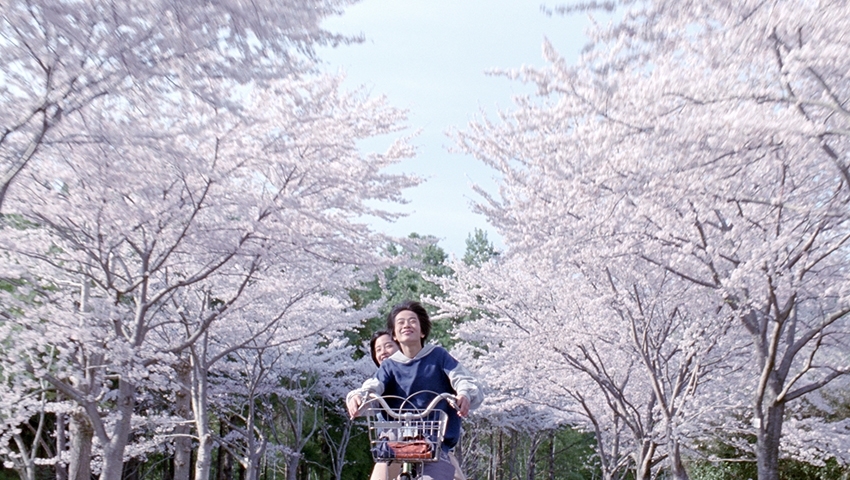
It is in the chain of all these daily conflicts where Kore-eda's film gains all its strength.. A work that exalts the joy of being alive and the need to rely on others to channel our problems.. Kore-eda thus escapes the main lines of the personal drama to pay attention to details such as the relationship of the four sisters with their grandmother., with the owner of a small establishment that they frequent, in the memories, small talk, the food, everyday gestures like a simple bike ride (one of the most beautiful and exciting sequences in the film). All of this is as relevant a part of this drama as any other element.. There is undoubtedly an instructive intention in all of this.. Kore-eda wants to tell us that life's dramas do not have to be great calamities, but those small conflicts. Likewise, Happiness will not be found in achieving great achievements either.. what is there, in the small, in those objects, in the gestures, in the people next to you.

Our little sister It's a movie about forgiveness, or more than forgiveness, about the ability to put ourselves in the shoes of others and try to understand the reasons that push them to undertake certain actions. Abandoned by a father who leaves with another woman and a mother traumatized by this event, Sachi, the older sister, He keeps the resentment towards his parents crossed in his heart. Responsible and protective, Sachi has been in charge of supporting and maintaining the balance of the family since they disappeared from their lives.. Sachi is a woman of principles who, although she is extraordinarily understanding of the dalliances of her little sisters, has a strong character and a strict code of values. However, Her own mistakes will push her to understand that life cannot be observed from such a severe perspective.. Whoever is free from sin, let him cast the first stone, it will be said.

Against fashions, Kore-eda offers us, besides, a story that is a plea in favor of the family. A story about brotherly love, about the need to rely on the people around us, a song to the idea that, although sometimes it seems like it, we are not so alone. All you have to do is reach out your hand to find a support point to hold on to.. But not only in people. Also in the spaces that are everyday to us we will find good reasons to keep going when things go wrong.. In a globalized world where we are pushed to move away from our roots as a form of a new order to which we must adapt, Kore-eda offers a story that goes completely against the grain. The old family house is the refuge in which the four sisters have built their universe and which they will fight to preserve.. A world made to measure, with its rules, in which, despite the doubts, all four feel comfortable. When the opportunity arises to make certain important changes, The need to preserve this common space will have a relevant weight.
The passage of time is, definitely, the real enemy to beat. Passage of time that lurks like a carrion bird over the simple order that makes up the world of the four sisters.. An underground presence that threatens to ruin everything. Time that will bring changes, inevitable, that will gradually undo this little universe. We said a few paragraphs ago that the story this film tells does not end with the credits. At the end of the footage we know that the world of these four sisters, even if we want it, will not be preserved forever. It is worth highlighting the masterful way in which Kore-eda leaves signs here and there, marks of the threat that the passage of time and those changes that will come pose to the world of its characters. without anyone mentioning it, manages to transmit its presence to us. Nor should we worry. We now also know that Sachi, Yoshino, Chika and Suzu will know how to cope and the strong bond that unites them will never be broken..

Kore-eda has composed what seems to me to be his most complex work, most beautiful, which is saying a lot if we talk about a filmography that, always raising very simple conflicts, He approaches them from a sublime sensitivity. When you thought you felt completely satisfied, when you thought I couldn't give you any more, The Japanese director comes to offer us an even greater dose of his sensitivity. Hay, at least, three fundamental elements in your work: character building, a casting and direction of actors incomparable in today's cinema, and a way of filming that approaches the world with a subtlety that few active directors can offer us.. Kore-eda's cinema, although it seems modest, I think it is very ambitious. But his ambition does not translate into emphatic exhibitionism., pretentious and, thus, finally hollow. Kore-eda is ambitious in his intention to move us, in his modest and sincere humanity, in its ability to stir our feelings from joy, but without giving us anything. It is the cinema of a true master.
When the doomsayers insist on singing the death of cinema as a means of expression in favor of other media, Maybe they should carefully review works like this. Maybe then they will realize that it is not that cinema is dying., it's just that they don't know where to look.
I don't mind saying it again: Our little sister it's a masterpiece. GERARDO LEON.