
Original title: Ema · Pablo Larraín · Chile · 2019 · Script: Guillermo Calderon, Alejandro Moreno, Pablo Larraín · Interpreters: Mariana Di Girolamo, Gael Garcia Bernal, Santiago Cabrera…
Original title: About the infinite · Roy Andersson · Sweden · 2019 · Script: Roy Andersson · Performers: Martin Serner, Jessica Louthander, Tatiana Delaunay….
In the career of every self-respecting director, There are excellent jobs and other failed ones.. It's the human experience. Although there are some rules, In the end, artistic creation is the fruit of our mind and imagination., and there we find all kinds of pitfalls, convictions, not a few contradictions or, even, big mistakes. Contrary to what is believed, art is not a science, but a long path of happy discoveries and great mistakes. But apart from these two extremes, we can find a third category in which we would find works that, managing to communicate what is intended, Its message does not touch the delicate muscle of emotion, avoiding leaving a lasting mark on our spirit.. In the filmography of Chilean filmmaker Pablo Larraín, his latest proposal, Ema, could be among the latter.

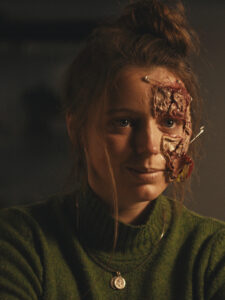
Larraín puts us in the footsteps of Ema, a young dancer who lives and shares work with her partner, Gaston, a choreographer entering middle age. At the beginning of this journey, Ema follows the trail of an eleven-year-old boy, Polo, which was adopted by both, shortly before. After a first experience in the difficult terrain of motherhood, Ema decides to return Polo to the institutions that offered him, what is worth the reproach of acquaintances, public officials and Gastón himself, condemnation that weighs on his soul, plagued by a feeling of guilt. But Ema does not give up and, despite the criticism, seems willing to repair the mistake and get Polo back.
Among the strongest points of Ema, The movie, we find Larraín's indisputable capacity for creating visually powerful images. Ema rocks, on the one hand, in the symbolic value of some of these images that serve as counterpoint and set the pace of the story. The Chilean director's film comes together, So, as if it were a great musical theme. A piece made from rhymes and stanzas, a phrasing that gives coherence to what is narrated. in this game, Larraín consciously manages a viewer to whom he doses the details of the plot, that it offers in an only apparently chaotic way and whose meaning and order will be structured as it progresses. That concealment exercise, to reserve for himself the keys to history, keeps the public's attention, being, at the same time, your biggest problem. First of all, because that plan that Ema, The character, hides to achieve its objectives and that is the center of the plot of Larraín and his scriptwriters, appears earlier than is convenient, losing, So, part of its mystery. And then because that musical structure is difficult to maintain, weighing down the artifact in a good part of its central development that falls into a certain reiteration. Nor do it benefit from some secondary plots whose evolution, being necessary to apprehend a part of the whole, They remain somewhat off the center on which the tape pivots.

Larraín puts all his effort into the construction of his main character and his world (Your friends, his passion for street dances, etc.). Ema responds to the model of a new generation whose search for itself calls into question the foundations of the society that precedes it and of which Gastón himself is a part.. and here, Larrain, with the invaluable help of the actress Mariana Di Girolamo, who does an admirable job, build a powerful character, suffering, but it seems like he knows what he wants, who feels freer than others. Free to do what you want with your life, free to break the preestablished social design, to surrender to what you feel, free sexually, Well, for Ema there are no longer watertight patterns., only love and desire. But that portrait is also a bit false., as if we were moving more in the field than imagined, the assumption, an idealized cliché, that on the level of reality. It does not exactly help to strengthen this idea that, Although Larraín makes every effort to let us know intimately and connect with Ema, neglect the rest of the characters, that remain as simple troupes, pawns of a speech whose conclusions are stated before the party begins.

Pablo Larraín wants us to reflect on cultural models that, supports, It seems that they have made the previous ones obsolete. Cultural models that also affect the concept of family, basic unit of society and, above all, that remain attached to forms of expression that the film claims. Against this, the preceding culture, Your culture, she is literally naked, helpless, doesn't understand what's happening, He doesn't know how he should deal with it., when it does not reveal its shortcomings just by approaching this new universe. This new culture has fewer prejudices about itself or how things should be, which puts her in a better disposition to face the emotional conflicts that, since always, have affected our lives. However, in the end, the film leaves us with a certain void. And all the pieces of his puzzle fit together so well for Larraín., the direction that Ema walks is so straight, he seems so generous, protective and accommodating with his creature that we cannot help but think that we are missing something. Perhaps it would have been more interesting if he had given us the other side of this story and revealed to us where the faults of this new culture are. (In fact, not so new) that only very timidly appear in some scenes of the film. So, at a given time, Gastón is cruel to Ema when she criticizes the reggaeton, musical and dance style that subjugates Ema and her group of friends. It's the old versus the new. The young versus the old. A long history. But Larraín cheats, submitting to this music, like everything it touches, to a styling exercise so refined that it takes away all its ugliness kitsch. Plot finally resolved, We wonder what the future will be of these characters whose relationship is sustained, We will see, in a big lie.

There are movies that tell stories and there are others that play on another board. Pretender, therefore, that the latter adjust to structures that are not even in their initial intention, as happens to some viewers after watching the film that concerns us now, can only lead us to logical frustration. It's like eating a vegan burger and then complaining because it doesn't taste like beef.. No, even if it has the same shape, it's something else. However, once one clears certain expectations from one's mind, can be found, as in the case of the latest production by Swedish director Roy Andersson, About the infinite, a fresh proposal, clean in its pretensions and, above all, very exciting and fun. You just have to try.

About the infinite It starts with a beautiful image: a couple in love flies, hugged, above the clouds. This image will mark, from the first moment, the tone and ambitions of this work. From that moment, we will see a series of scenes apparently independent of each other. In one of these scenes, a man, after climbing stairs with great effort, narrates the meeting with a former classmate. In another scene, a couple observes the landscape of the city at their feet, sitting on a bench at the top of a hill while they certify that it is no longer cold and that spring has arrived. In another, a shop assistant cleans the floor of the sidewalk in front of the business where she works, when a boy arrives who stops to look at her, promise of a future love story. And so until the end.
Andersson repeats the strategy he already used in films like The comedy of life or in the wonderful A dove perched on a branch to reflect on existence, his previous work. In this sense, About the infinite It offers little that is new beyond the fact that here it composes smaller paintings in terms of duration and allows itself to break the rules by establishing small plot nods that establish relationships between some of them.. Little to discover, so, for those viewers already familiar with Andersson's recent work, which does not prevent, Of course, May we enjoy this new inclusion in your moral and aesthetic world..

leaning, as usual, in an impeccable production and staging job, Andersson composes his paintings as paintings in motion. The use of lighting, The composition and chromatic texture reinforce this idea in the viewer.. inside the image, the characters move, besides, very slowly, as if they lived in a different world where time runs at a different speed, as if life weighed on their shoulders, burden that prevents them from acting faster. All these elements give (bit) that a certain aroma of unreality occurs. A sensation that contrasts strongly with the everyday situations that the film proposes to us.. There is something strange in all of this that, however, it is recognizable to us. So, in another of these paintings, a dentist deals with a patient who must have a tooth extracted. The patient refuses to have anesthesia because he feels an uncontrollable fear of the needles.. The dentist agrees to satisfy the man's demand, who then complains every time they touch his mouth. Fed up, The doctor leaves the room to the surprise of the client and the nurse who excuses the doctor's slight by saying that he has had a bad day.. And who hasn't had a bad day at some point?? That confrontation between everyday (slightly exaggerated), and the way it is presented on the screen reveals the best card with which this new piece by Andersson plays: the humor. A humor that reflects the tenderness with which the Swedish director faces the world, your vision of life.

About the infinite It is a tape that tilts, So, between the drama, the tragic, and the biting, between life and death, between the beautiful and the bizarre, between the logical and the surreal, between the divine and the earthly. But, Isn't all of this the sum of what we consider "human"?? Andersson's aesthetic and philosophical discourse resonates today more necessary than any other slogan or claim of the many we hear every day.. Faced with the speeches of the new moralists of the information market, Politics, digital networks or even so-called social activism, Andersson shows us the pious side and, at the same time, ridicule of our existence in contemporary society. In the face of grandiose speeches, but empty of content, in the face of the pretensions and traps that an idealized and self-complacent view of life prepares for us, Andersson tells us that, in the background, we are a rare thing. But not strange in a pejorative sense, but rare as unpredictable and, at the same time, perfect in the very nonsense with which we have built our world. A woman's shoe heel breaks, a very simple event that contains, however, a whole universe. A waiter fills the wine glass of a customer at the restaurant where he works so much that the liquor ends up overflowing and, when it happens, The stain he leaves on the immaculate tablecloth seems to be the sign of an unforgivable sin that will condemn him., when, in the background, It was just a mistake. In the Wolf's Lair, Hitler waits for the end of the war. Elsewhere, in our present, A man cries uncontrollably on a bus while trying to explain to the rest of the passengers that the cause of his distress is, simply, who “does not know what he wants”. While another passenger reproaches him for not keeping his problems for the privacy of his home, another defends it, claiming for man the holy right to be sad, even ever. Do we have the right to be sad? Do we even know what we want? A great question. GERARDO LEON