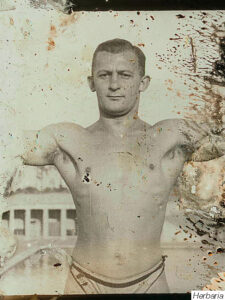

Third day of screenings of La Mostra and three very different films in its Official Section. The first of them brings us closer to the realm of documentary with a most defining title.: Marshal, the joy of living by Laura Grande, production by the Valencian Estrela Audiovisual. This work offers us an intimate approach to the figure of one of the most recognized Valencian designers in the country., whose work became popular for being responsible for the very famous Cobi, the Barcelona Olympics mascot of the year 92. But to stay in this reference is to ignore the figure of Mariscal, which is why Grande proposes a journey from the same origins.. Son of a bourgeois family, The personality of the young Mariscal begins to emerge after the death of a very severe father who had the family exhausted..
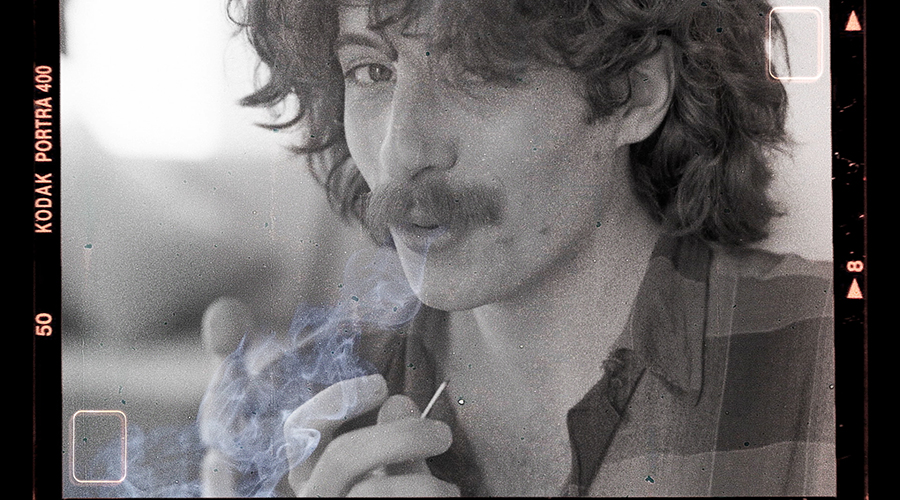
Laura Grande's documentary opens, from that moment, through two ways of working. The first of them deals with, at least, sketch a broad overview of the designer's career. A journey that seeks roots in culture underground from the end of the decade of the 70 and the decade of 80 what, as the Marshal himself comments in an archival interview, became the decade of his generation, a decade that would end up being appropriated. From self-published works such as the magazine The masked roll, where he would coincide with personalities like Nazario (Mourning) o The divine piranha, whose pages forced its authors to escape from Barcelona and take refuge in Ibiza where they would make the anthological album Nasti de Plasti, going through his first professional commissions for various places in that post-Franco Barcelona, the cover design of the first novel by a certain Pedro Almodóvar, his first forays into furniture design, to crown the covers of magazines as prestigious as The New Yorker. Throughout this journey, The images of Grande's work show us the evolution of an artist aesthetically united to a way of seeing the world.
That way of understanding the world, life, part of the other line of work of this piece, that will try to get closer to the peculiar personality of the designer. This aspect is perhaps the strong point of this work., hook for a viewer who will be seduced by a character who still maintains or tries to maintain that free spirit that nourished that generation he imitated, if you want something later, the old demands of the North American hippie movement mixed with the most casual touch of Mediterranean culture and landscape. This way of facing life, with its ups and downs, happy and jovial, persisted over the years in his professional career and that Mariscal brought both to his aesthetic approaches and to his way of approaching his different companies..
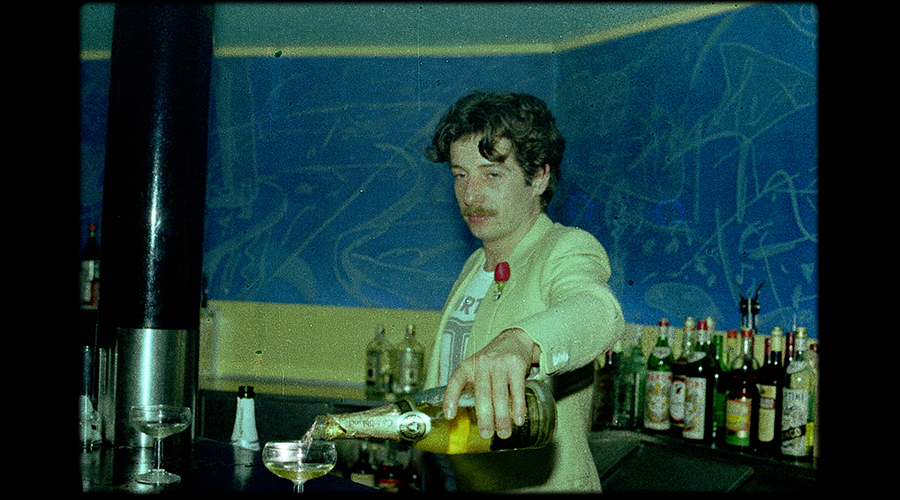
We are guided on this personal journey by personalities of Valencian culture such as Carles Pastor, Mc Diego, along with others at a national level such as the aforementioned Nazario, Miquel Barceló, The Great Wyoming, Paco Roca or Fernando Trueba, with whom he would make two animated films, (Boy and Rita, y They shot the pianist), in a work that stands out for its formal correctness, in any case and as usual, perhaps too correct for an Official Section of a festival like this.
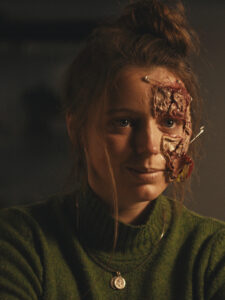
From the Mediterranean coasts to the lands of Tunisia, protagonists of Promised heaven film directed by French director Erige Sehiri. Here we will meet Marie, Naney y Jolie, three Ivorian women trying to survive as illegals on the margins of the system. One day, Marie picks up Kenza, another Ivorian girl who has survived a boat trip in which most of the passengers died and her entire world was going to be destabilized.
This dramatic excuse will serve the director to introduce us to the complex lives of her protagonists.. And it does so in at least three parallel dramatic lines.. Outwards, Sehiri strives to create a thorough description of the harsh conditions in which these women live.. Sehiri makes an effort to ensure that the viewer ends up understanding what exactly it means to live when one has lost all rights that protect you.. The lack of documentation that formally regularizes your situation turns you into a pariah in the face., first of all, to a state apparatus that is as capricious as it is implacable. On the one hand, it seems like it lets you live, but, on the other, throws you into a dungeon at the most unexpected moment. Sehiri takes his time so that the viewer understands what it means to spend your life looking back., afraid of the police showing up, an invisible presence that haunts its characters in every frame of the film.

The second dramatic line looks within the community to which these three women belong., a network of healthcare connections, necessary for your survival, but not without conflicts. Conflicts, first with other illegal communities residing in the country, against those who fight to strip each other of the crumbs that the system leaves them. When there is little to share, Solidarity is a luxury that not everyone can afford. But also conflicts with his own compatriots who, In some cases, They support other types of corruption networks in which exploitation occurs with the same lack of scruples..
And there is still a third dramatic line that refers us directly to the protagonists themselves and that Erige Sehiri uses to talk to us about another issue equally relevant in this case.: the failure of expectations. So, Marie puts all her hopes of rebuilding her lost motherhood in Kenza's arrival.. Wounded motherhood that Naney also suffers because of the distance she has put with the daughter she left in her country and whom she has not hugged for three years. And hope or frustrated expectations of the young Jolie who sees how reality is eating away, little by little, his innocence. The three women will have to find a way out to redirect their lives after realizing a failure that may never have been part of their plans..

Erige Sehiri shoots all these situations with formal correctness and, thanks to a well-oiled cast of actors and elaborate work from the art departments, with a certain documentary truth. But it is, curiously, That achievement is the biggest problem of a proposal that lacks some pulse. Sehiri more than fulfills his objective of describing the world he seeks to portray and, at the end of the footage, we can treasure that we have learned something, but, taking his proposal to the realm of fiction, the viewer is perhaps left orphaned of a dramatic arc that is ultimately absent from the film, which lowers our emotional involvement, beyond mere description, true, but somewhat distant, to build a somewhat more carnal approach, less calculated.
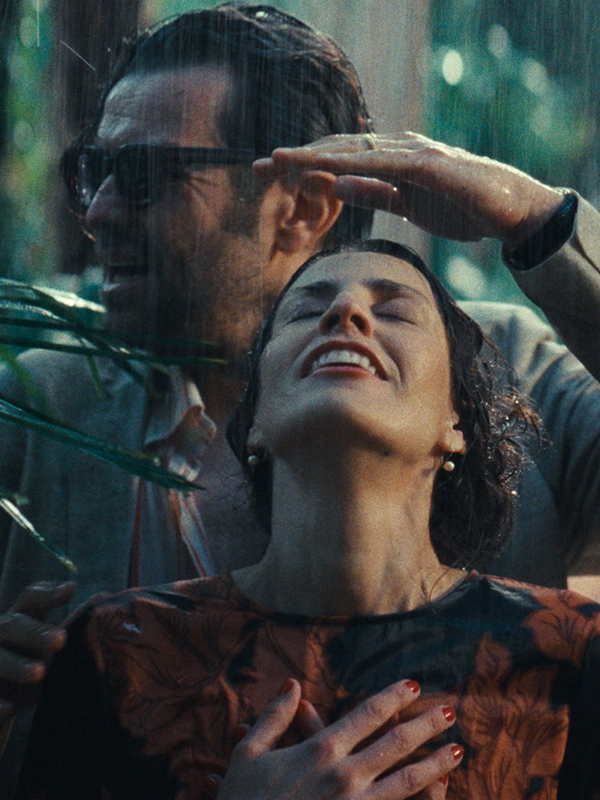
In the latest editions of La Mostra, Portugal has contributed the most radical proposals of its programming to the Official Section and this time it was not going to be different. If we stick to the official synopsis, First person plural from Sandro Aguilar, introduces us to Mateus and Irene, a couple who are going to celebrate their 20 wedding anniversary at a luxurious resort on a tropical island. But, before leaving and during one night, the couple will suffer the side effects of the vaccines they have had to receive, suffering from all kinds of fevers, fainting and hallucinations.

Exposed this way, the argument seems simple. But sticking to the plot in the case of this film is a tremendous mistake.. As the director himself makes very clear in the production notes of this peculiar film, First person plural can boast precisely of not responding to the structures of conventional fiction. So, the initial situation posed, For Aguilar, it is an excuse for a visual waste that is difficult for an ordinary viewer to manage..
It's not that it's difficult to explain what Aguilar wants to tell us in this film., The difficult thing perhaps is to maintain attention on a really thick work where the images impose layer after layer of disguises to entangle their intentions.. Getting into the director's head is, in this way, how to get into a maze, a gibberish within another gibberish: there are streets, corners, but these are arranged in such a way that they make the exit or resolution difficult..
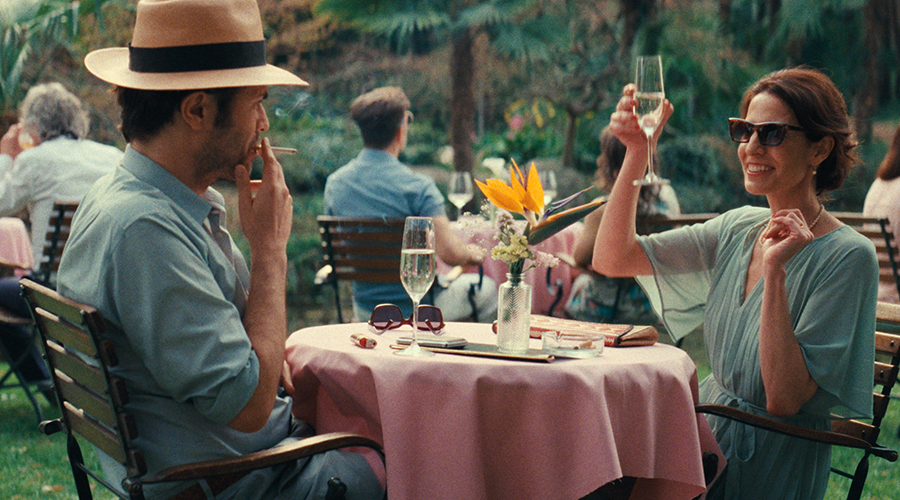
Already from the first images, Aguilar puts the viewer on alert. a man, dressed in a suit and a white mask on his head, He walks through the dark house after writing a strange note for his wife, to whom he indicates the conditions of the trip they are going to undertake. what happens? Why are you wearing that mask?? Is it real or is it a game? Aguilar thus travels the limits of the dreamlike, the hallucinated or fantastic to provoke our strangeness. Strangeness that wants to provoke our curiosity so that we have to force our attention to draw conclusions.
And so, we are adding. In addition to Mateus and Irene, we soon discovered David, the son of the marriage. David does not seem to have a good relationship with his father, whom he constantly challenges.. And the same thing happens at the school he goes to that day.. Aguilar does not draw clear associations between the ideas, These are in the few snippets that it gives us about the relationships (often confusing) between the characters and the symbolism of images of great lysergic power. With those premises, His film shows us a broken society in which individuals no longer understand each other and the distance between them is filled with cynicism.. David can't tolerate his father, as much as this one does not tolerate him. And the same thing happens with the rest of the characters who seem to be adrift in a dark world., where the forms cannot be distinguished and who is who is confused from one subject to the other (Sometimes we do not distinguish Mateus and Irene from other characters that will appear). Hopeless world where feelings, love has been replaced by lust, of subjects trapped in the frame of images that also enclose a viewer who perhaps requires excessive patience in a two-hour long work overloaded with symbolism.. When the lights came on in the projection room, half the audience had disappeared long before. GERARDO LEON