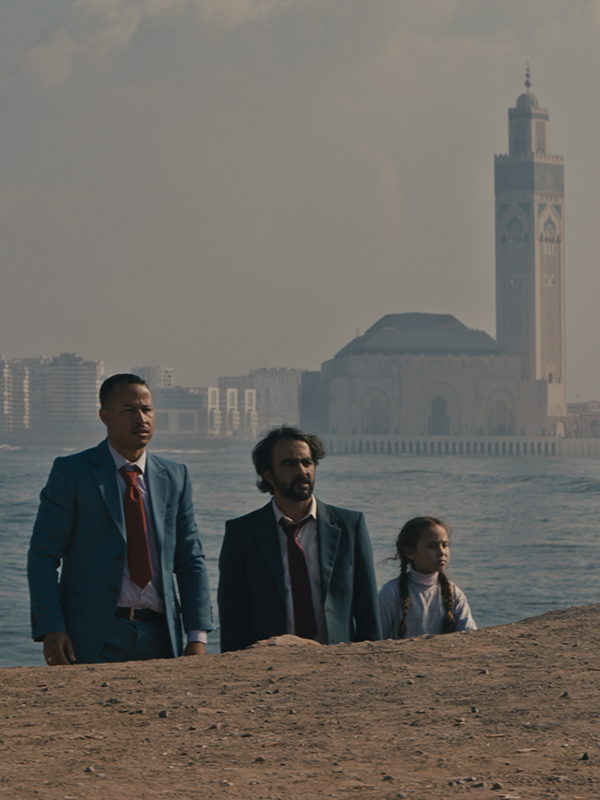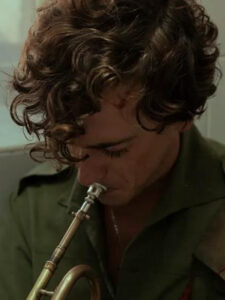
Penultimate screening session of the Official Section of the Show 2023. Con Deserts We return to Morocco with the help of director Faouzi Bensaïdi. Deserts introduces us to Hamid and Mehdi, two agents from a loan company who travel from one side of the country to the other to try to collect debts incurred by their clients. The work is not easy. Clients are reluctant to pay and agents must use their mischief and wisdom to extract, at least, some small payment that justifies your work and provides your company with some benefit. During the trip, differences arise between the two. Mehdi, more experienced, He is relentless with the clients' situation, often plunged into poverty. Hamid is the complete opposite. He doesn't know how to say no, what makes him get fooled, even by his own partner.
But, The truth is that the lives of these two agents are not as simple as they seem.. It's hard enough having to deal with all these situations., let's look at their personal lives. Hamid is in a relationship with a woman he wants to marry, but his in-laws don't respect him, among other things because it is evident that, with your work, He cannot aspire to their economic status and they use him as a vulgar messenger at their service.. For Mehdi things are even worse. His wife has abandoned him with a daughter that he must leave with her mother, and the money she earns from her work is not enough to keep her in good condition..
Despite this synopsis, we are facing a comedy. In Deserts, his fifth feature length fiction, Faouzi Bensaïdi demonstrates an enormous talent for writing truly hilarious situations. Bensaïdi combines the tragic with the grotesque well to give the viewer truly extravagant moments that, however, They refer us to an everyday reality recognizable by the viewer. Helps give this tone, the superb work of Fehd Benchemsi and Abdelhadi Taleb, its two main actors, and a staging that takes us back to the best tradition of the genre of slapsctick, even from the comedy gags of the years 80, but with a patina of social denunciation that gives the proposal a much deeper charge.
It is this social portrait that first interests Bensaïdi. With a road movie structure, Deserts presents us with a map of, at least, a part of contemporary Morocco. In fact, the tape starts like this, with a map. A guide that gives an account of a society that, stripped of everything, practically no resources, survives as best he can in an arid land that offers nothing, of dilapidated towns, where the glory of past history remains a mute ghostly witness, of houses that are barely standing and where the law, as organizer of society, is left out of the game (here a contract doesn't mean much). And the animal presented us with the problems of the upper class, here we are a few steps below.
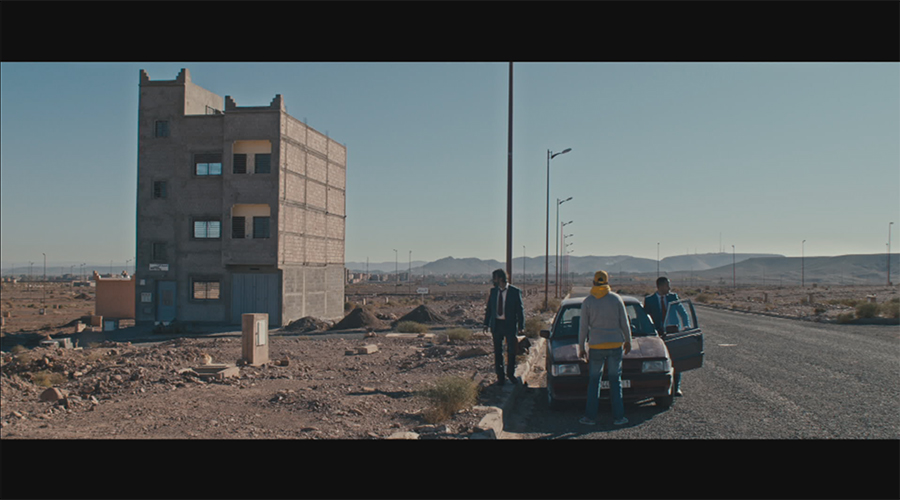
But, as we said before, these people, shots from a distance, almost faceless, They are not the only victims of social inequality. Hamid and Mehdi also suffer from the harsh conditions of the system. After finishing your route, both return to Casablanca, where they must report to their superiors. In an almost surreal scene, The employees of this company appear dressed in colorful suits that classify them according to their status. At an agent meeting, the owner's daughter, after scolding them for poor performance, announces that the company must make some adjustments due to the drop in profits. From now on, They will have to become autonomous, running all your expenses, although the percentage of profit (if they reach certain goals, clearly unrealizable), they will earn more money. A real hoax disguised as motivational rhetoric. Does it sound familiar to us??
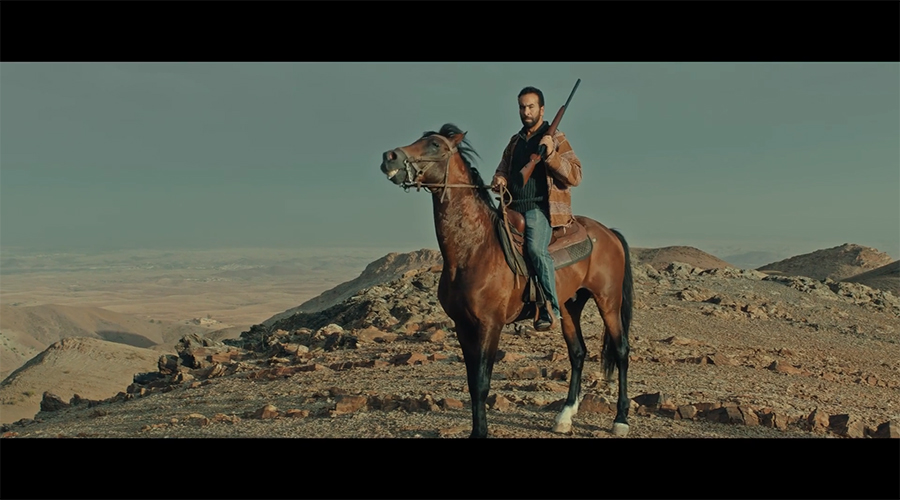
To complete your description, Faouzi Bensaïdi puts the camera's eye on the landscape. Hence the title of the film.: Deserts. Exterior deserts that reflect the interior desert of the characters and society. The world that Bensaïdia presents to us seems taken from a Martian landscape. A barren and rocky space, where the dust eats up the body of the car that Hamid and Mehdi drive. a space, however, which Bensaïdi knows how to take advantage of, thanks to the use of the format in scope, with frames of great beauty that remind us of John Ford's westerns.

Perhaps the problem that every good production has to solve is not having a good starting point., but arrival. And this is where Bensaïdi's proposal goes a bit wrong.. Let us put forward the director's ability to combine, We said, the comic with social realism. However, once the footage progresses, the viewer wonders where it leads beyond the sequencing of more or less effective situations..
Let's recognize Bensaïdi's right to break genre conventions as much as he wants.. The question is whether this turn can satisfy and give coherence to the proposal. Let's think that, after David Lynch, nothing is sacred. Like in the animal, with which this film shares that intention of mixing genres, Deserts also take the path of philosophical introspection. At one point in the tape, the two main characters disappear from the story due to an unexpected plot twist. From that moment, shows us another story starring a mafia boss who operates in the area and who will cross paths in the lives of Hamid and Mehdi.. Both stories will end up connecting again, although their relationship is not as clear as perhaps the brilliance of the first part required.
It's not just that the tape, suddenly, change tone, is that the relationship between both stories appears so diffuse, so abstract, that we cannot link it or if the message it contains is not already highlighted by the initial narrative itself, leaving the viewer, like its protagonists, in a limbo, in a kind of no man's land in which he cannot find a foothold.
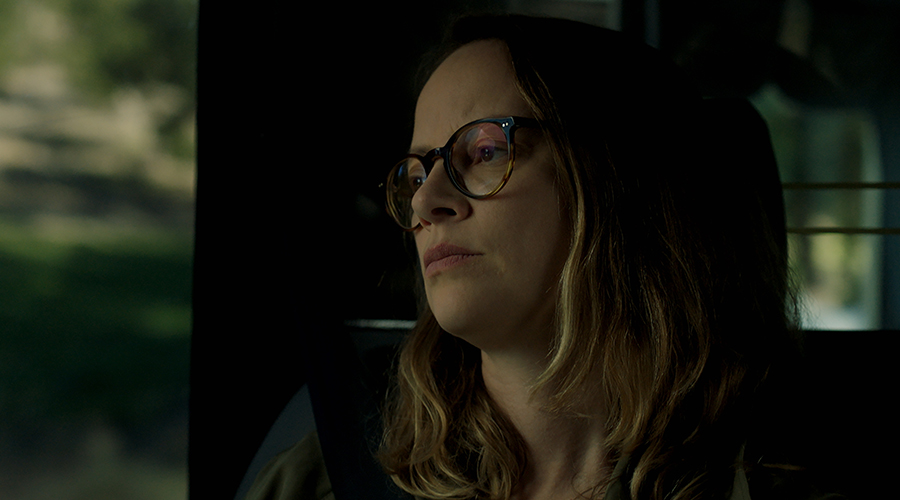
That same possibility of leaving the viewer in no man's land faces the fourth full-length work by Portuguese director Susana Nobre., Rabat City. Nobre's film begins with the plans for a neighboring staircase. The elevator goes up and down between floors, causing games of light and shadow. a voice over, Day of Helena, the protagonist, tells us the story of this neighborhood where she lived as a child and where, we will discover, his mother is still alive.
The voice remembers each of the neighbors, while the camera shows us the closed doors of the homes. We don't see anyone. They are just shadows. In a foreboding scene, Helena's mother is sitting on the sofa in the living room. In his hands he holds a pile of photographs that he is tearing up., one by one, with parsimony. They are photographs from the past, travel, from family and friends, those who remember, although it does not always seem to recognize. Helena attends this ritual, almost a sacrilege, with apparent indifference or, maybe, we don't know, aware that he cannot prevent it. With every gesture, The old woman seems to be accountable with a piece of her memories, from your memory. A memory that, somehow, It is also memory, Helena's roots.
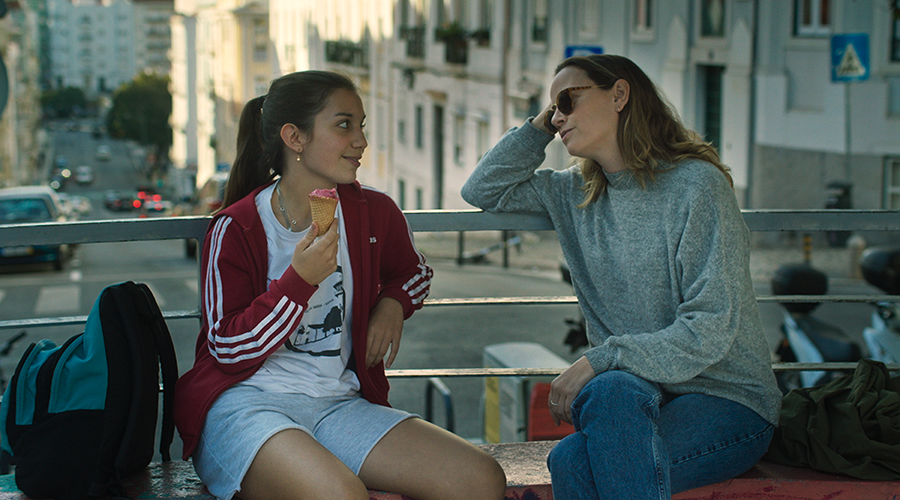
Susana Nobre articulates her proposal in the coexistence of two narrative levels, one metaphorical and another in which the subsequent experiences of its main character become known.. Little by little, with the same rhythm with which his mother is tearing photographs, We will learn that Helena works as a production assistant in the cinema. We also know that he has a daughter whose custody he shares with his father.. One day he receives the news of his mother's death.. with his sister, prepares the burial in a small chapel in the town where he was born. Then, life goes on.
At a press conference, Nobre turned to the cinema of Aki Kaurismäki as one of the references for this modest production. Like the Finnish director, Nobre's camera is careful to ensure that his characters are not overly explicit with their feelings.. This leaves a very wide space between them and the viewer who must connect each situation with their own memories and emotions.. This relationship is gaining strength, above all, in the first third of the footage. In one of the most emotional moments of the film, Helena assists, We said, to his mother's funeral. This is obviously not your place.. However, at a given time, He gets up and makes a heartfelt speech about his mother., a very everyday situation in which we can recognize ourselves.

Susana Nobre plays with these elements, making relationships that the viewer will find along the way, especially at the end of the tape. However, until we get to that point where we can make the right connections, Nobre forces him to go through a long journey in which his attention is slightly diverted from the main story.. If Kaurismäki's characters are contained, They are still more expressive than Nobre's.
We understand that Helena is going through a bad time in her life and, apart from a certain hieraticism, Your reactions are conditioned by that state of mind. At a given moment, Helena attends a wedding celebration with her daughter. during the banquet, seems absent, that does not connect with the spirit of celebration that surrounds it. But as the evening goes on, alcohol has an effect on her. Your behavior will then go to the opposite extreme. In the end, ends up asleep in a chair, provoking the pity of his daughter and his ex. This fact will have some consequences.
The script of Rabat City draws a long connection between beginning and end. It will be there, when Helena returns to her mother's house, when everything makes sense. Rabat City It is the story of a duel or the assumption of a duel, of a loss. Maybe the problem is that, to get there, Susana Nobre makes us travel through an emotional plain, without really getting a glimpse of what this story involves us in. Rabat City It is a film that renounces having an adventure. But there is no conflict. The conflict (for the viewer) is to discover what the protagonist's conflict is. On the way, however, We barely empathize with the character beyond a few scenes, which leaves us out of the plot or narrative development, because until the end we don't know what is happening. GERARDO LEON