A new edition of the Valencia Mostra begins, the 38. And as has been tradition since his new stage began, It does so with a local production and in an exclusive premiere: Marina, unplagged by Alfonso Amador. The tape, which will occupy the opening session of the contest, was presented, So, before the press, in the living room 3 from Babel cinemas, headquarters of the Official Section, accompanied by part of the artistic team that included Amador himself, as screenwriter and director, Jorge Picó, co-writer, Almudena Verdes, as producer, and Claudia Faci as main actress.
Based on a play by Jorge Picó himself, not yet taken to the stage, as explained by those responsible, the film puts a woman on the screen, Marina, of whom we know nothing more than his name, but what, shortly after starting to speak, We understand your ideological affiliation. In front of an empty theater, Marina rehearses a speech that, as the footage progresses, We understand that he will present to the public in later days. In that speech, addresses that absent spectator, to whom he urges with energy to talk about immigration, of freedom, of feminism, in a sense that reminds us of the speeches of a party of what is now called the extreme right.. around you, the technical team of advisors, She is constantly called upon to attend to other matters related to the organization of this event..
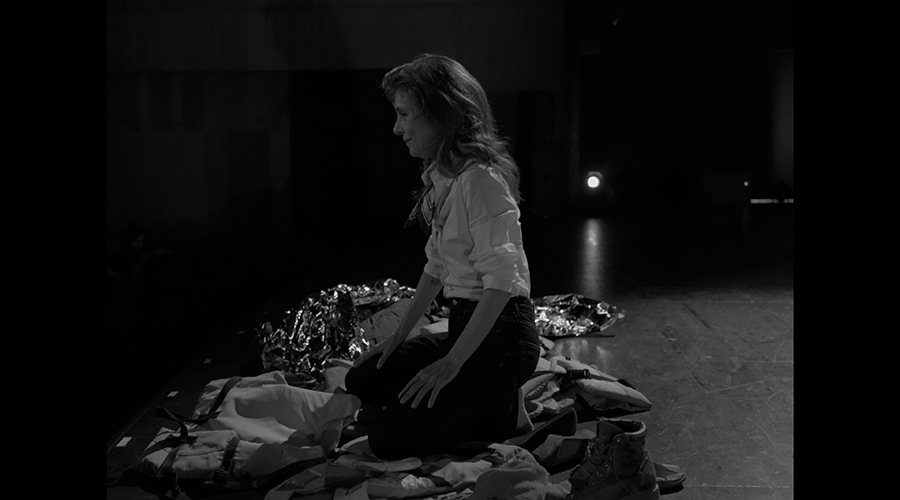
Shot in sober black and white, Marina, unplagged uses documentary forms in an attempt to give verity to a script that takes the speech of its protagonist as the backbone of the narrative. A strategy that makes sense both for what it can impose, according to Picó himself, the original play, like its own intentions. And that is, precisely, the first objective you have Marina…, that of discrediting the fallacies or the meaning hidden behind the logic of his character's words.
So, the word becomes almost the absolute protagonist of the film. And that will also be when the documentary form that has been chosen, covers sense, by allowing Amador to escape the tensions of a representation that, otherwise, it would be too flat, since we are facing a long monologue. The confrontation between Marina and the theater director who directs her in these rehearsals (played by Jorge Picó himself), They serve the director to raise the pulse of the story, making the camera find its prominence, not only as a mere notary of the text, but looking for reactions, relationships that humanize him and take him one step further. This allows, at once, that Marina's speech comes out of itself to break it, by contrasting what was said towards that absent public with their true intentions that, in that constant dialogue with the director, remain, to a certain point, exposed, when shown, also, the very fictional apparatus that supports this woman (In fact, to any politician). Fiction within another fiction.

It is a little missed, however, that this documentary form does not fully explore what the proposal itself contains in itself and that it would have to do with that relationship between fiction and reality that the political discourse of its protagonist has.. The authors of the film say that they wanted to seek a certain spontaneity when accompanying their main actress, who had to face the text for the first time on the same filming set. However, that strategy, hatched behind the scenes, does not reach the viewer, ignoring this circumstance, typical of the intrahistory of production, attend the performance itself, to what the screen shows in raw, not to your intentions, what makes the idea, beyond helping that certain naturalism, that achieves at times, do not remove or add anything in terms of symbolic load.
And the same thing happens in the field of speech.. stands out, In this aspect, Picó's writing, that achieves fluid and coherent lines, as the actress Claudia Faci indicated at the press conference. As the scriptwriters explained, the text brings together a compendium of influences, from authors of the so-called new right, as Alain de Benoist, going through the populism of parties like Vox, even left-wing thinkers like Gramsci or, even, Pasolini who, denounced those responsible for Marina…, have been devoured by these movements to give consistency to their theses.

With these tools, Picó and Amador come out well when it comes to constructing the tone and meaning of Marina's speech. Maybe you miss that the tape stays there, in that representation, and don't dig a little deeper into the contradictions. The spectator stays, So, with the impression that, just when the text seems to catch on, This is interrupted by some circumstance that seems secondary and that does not seem to have any other mission than to break the monotony of the narrative..
This is how the other half of the film appears in which we see Marina dealing with her personal equipment in different situations.. The authors say that these scenes were, although conceptually prepared, totally improvised as far as written text is concerned. Again, the idea was looking for that verisimilitude and spontaneity, typical of the documentary, although this absence of script is perceived to a greater extent than in the parts that take place in the theater, falling into a certain caricature of the character, a temptation that the tape cannot resist at the end of the job (that bride of death, Ay). Or the inclusion of a series of supporting images that Amador inserts in a timely manner at some point in the film, as if it needed to be reinforced, showing it, what the text already expresses, as if he didn't completely trust the viewer. In any case, It is a curious experience to perceive that, when the text is more elaborate, seems more credible to us than when it is given over to pure improvisation, which, indirectly, It tells us a lot about how the discourses and language of cinema are constructed..
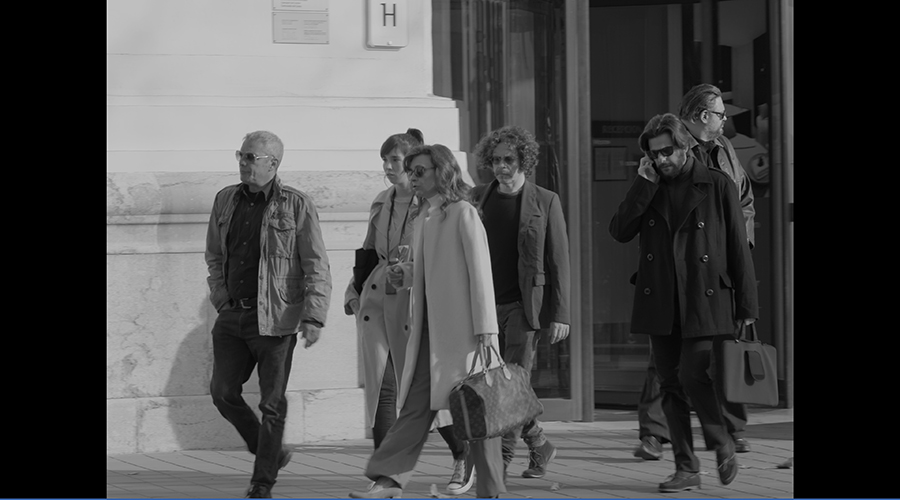
And in the center of all this apparatus, Claudia Faci gives herself to carry the entire weight of the work. His Marina takes a concrete voice and physical body to build a woman who, as the authors explained during the press conference, does not respond to any specific real character, but it is a representation of many other Marinas (yes ok, the reference to Le Pen seems quite clear). Marina is not Marina, as it says in the text, but all the possible Marinas that, in recent years, have been appearing. GERARDO LEON