

I remember a custom that I had and that I lost that consisted of saving flowers and leaves, dry them between pages, photograph them before they completely gave up, and I remember even more the surprise of finding them preserved and forgotten in a book years later, they may still be there, waiting. I think it's not the flower I was trying to keep., but the emotion that looking at it caused me, the experience of that beauty, of that emotion that I wanted to impregnate, freeze or dry, to turn it into an everlasting object. It is in this desire to preserve the moment in which this exhibition exists.
May my wish serve me part of a work system in which Sandra Mar, from an initial contemplation, create a kind of diary, a notebook for recording sensations in which fragments of an experience accumulate, the memory of a body that is no longer close, the texture of a skin, the caress of one hand on another that now only exists in language, the position of lips when kissing. Writing becomes almost a ritual, a way to sustain beauty, with the certainty and frustration of knowing that this is impossible.
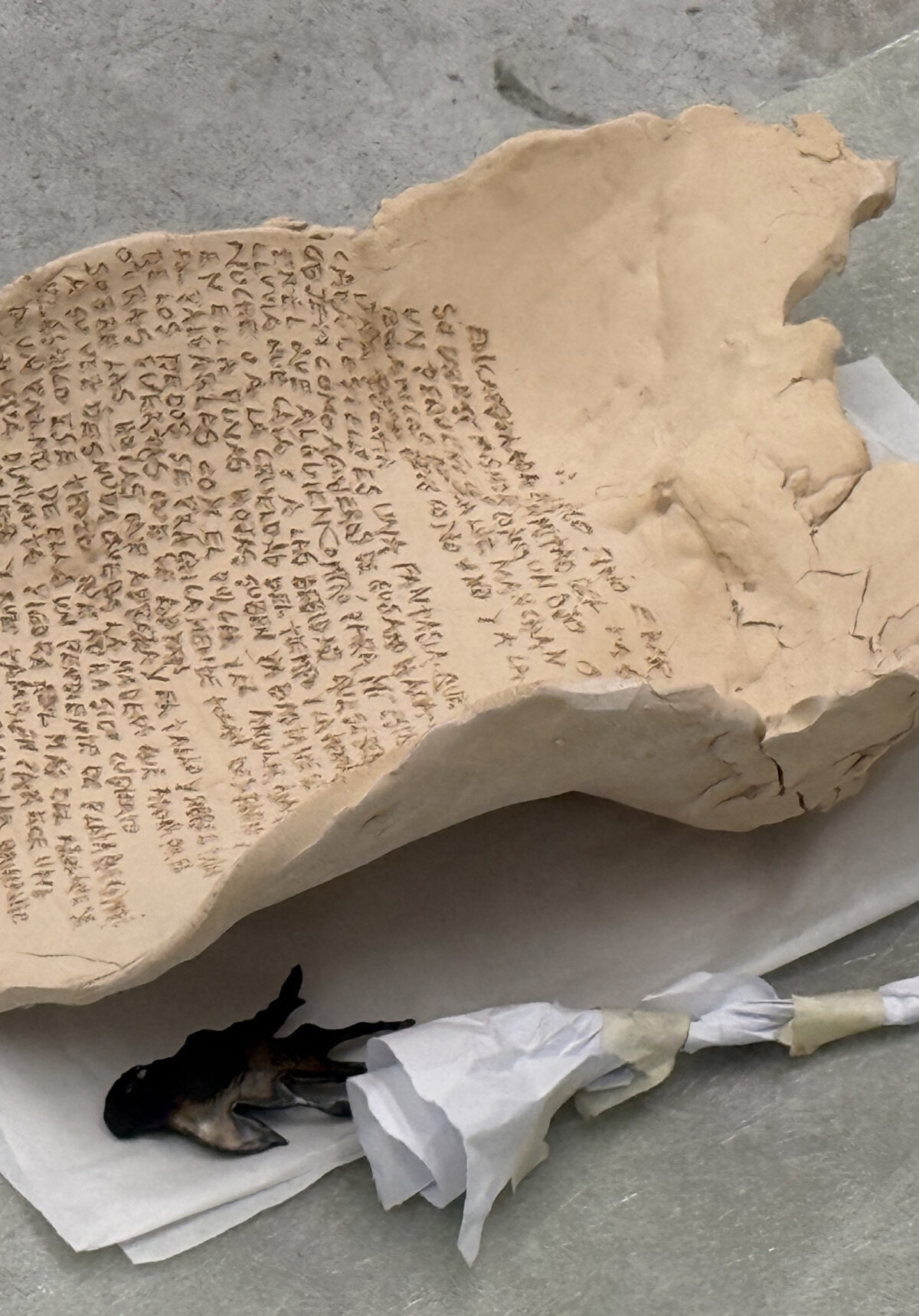
In that impulse to name what fades away, Sandra Mar finds the first mold of her practice, but need, besides, another vehicle, a material on which to impregnate the memory of that experience and make it tangible. Something that is understood from the physical and not only from the memory that accompanies the words. That vehicle is his sculptural practice, which for this exhibition delves into new ways of doing. Abandon the vessels, the vases, the bowls that until now served as supports for his incised writing, to reach pieces that no longer contain, that unfold and fan out, that curve and tangle on themselves, or they just rest, as if the material had decided to stop being useful to start speaking in its own language, closer to the gesture than to the useful object.
With a vocabulary that goes beyond the ceramics in which he has worked for quite some time, In this exhibition there are fiberglass torsos that imitate skin, metal bars engraved as if they were another form of writing, fabric ribbons with images transferred on their surface, reframed objects. The same texts that previously only existed in the notebook now go to the pieces through the artist's own calligraphy., incised on the mud, engraved on metal. Writing then becomes action., a hand gesture as physical as kneading or stretching, and the words are impregnated with that gesture. Next to them, photographs of flowers and plants taken by the artist herself are transferred directly to the material, embodying that same fascination, now through the image and not the letter. What finally reaches the viewer is not a text that is read at once or a photo that is simply looked at., but a poetry bathed in body and matter, that is received in another way, closer to the tactile than the literary.
The pieces are distributed between the floor and the wall. Some supported, almost lying, as if they had just landed there. Other hangings, exposed as a wound or a trophy is exposed. That double condition, what rests and what is exhibited, also goes through the very gesture of photographing, a desire to show and at the same time save. Neither mud nor photography can stop anything, but the attempt, although failed, leave something behind. Like the flower between the pages of that book, every piece stays there, waiting for someone to find her and, for a moment, something that was once again feels close.
Rafa Barber Cortell