

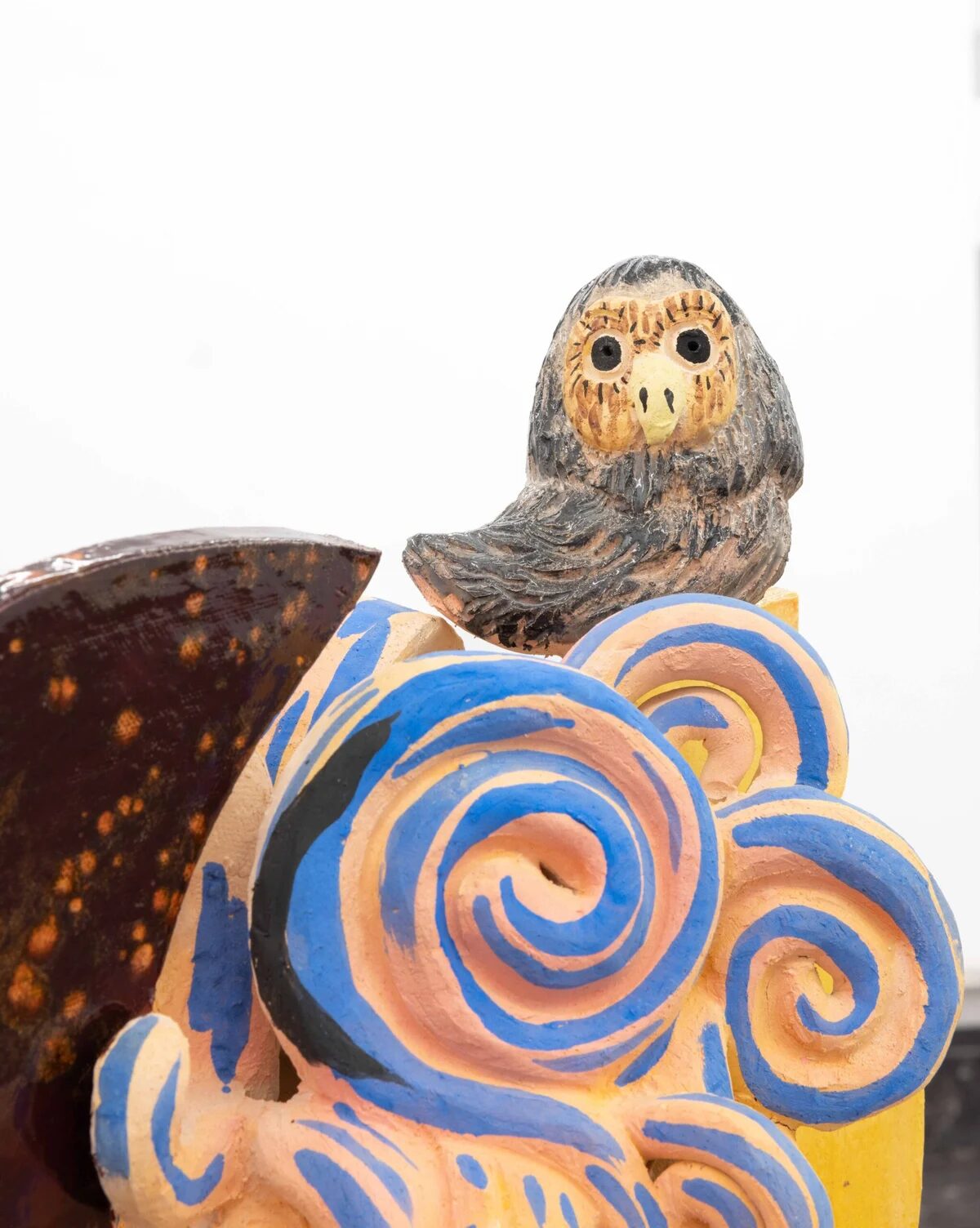
Luis Adelantado presents The foot of the forest, the fourth solo exhibition of the Lamarche-Ovize duo at the gallery, whose practice is situated in a territory of productive friction between drawing, ceramics and installation. Far from a disciplinary hierarchy, His work is articulated as a system of stories in which the material and the symbolic are intertwined.: shapes, figures and objects function as narrative nodes that activate shared imaginaries and question the borders between art and craft, between the everyday and the mythical.
The project brings together drawings, paintings, silkscreens and sculptural pieces conceived as fragments of an open narrative. in them, artists deploy a formal vocabulary that combines graphic precision and attention to manual processes, highlighting the temporal dimension of doing. The drawing operates as a structure of thought and organization of the story, while ceramics and sculpture introduce volume, the weight and physical presence of the images. The installation thus articulates a reading space in which the viewer is invited to recompose links, rhythms and sequences. The narrative does not appear as an illustration, but as a method: a way of thinking through things.
The forest that proposes The foot of the forest It is not a naturalistic landscape, but a symbolic and proliferating territory. Plant motifs, animals and hybrid forms accumulate, they repeat and transform, evoking both historical bestiaries and decorative repertoires and a contemporary sensibility attentive to the relationships between the living, the ornamental and the narrative. Sculptures—between the functional and the fantastic, between the domestic object and the imaginary figure—reinforce this ambiguity, introducing bodies that seem to emerge from the same graphic substrate as the works on paper.
The exhibition thus proposes a slow and attentive observation experience., in which each work functions as a support point—like a “foot”—for a larger story. A project that understands drawing, ceramics and sculpture not only as techniques, but as modes of relationship between images, materials and ways of imagining the world.