

The morning of 26 April 21 1986, the fourth reactor of the Vladimir Ilyich Lenin electronuclear power plant exploded, causing what is considered the largest nuclear accident in history. The radioactive cloud covered almost all of Europe, in an area of 2.600 square kilometers, almost a hundred villages and towns disappeared and had to be evacuated and caused thousands of cancer and skin diseases that remain to this day, they expound as if 8,4 millions of people on the ground.
When in 2011 Peruvian writer and visual creator Sonia Cunliffe is going to visit the Tarará spa, east of Havana, the children bathing on the beach caught his attention. Later, the meeting with the journalist Maribel Acosta en 2015 led to the start of a joint research project where they contacted doctors, the patient, translators, research center, hospitals and visited newspaper archives Granma i Rebel Youth, colleagues who gave them their files… until reconstructing a part of the little-known history that began the 29 March 1990, when the first flight from the former USSR, arrived in Cuba with the first of the 26.000 boys and girls from Russia, Belarus, Ukraine and Moldova received along 21 years, of 1990 fins a 2011, free medical assistance in Cuba, to treat the various diseases that began to appear years later as a consequence of radioactivity.
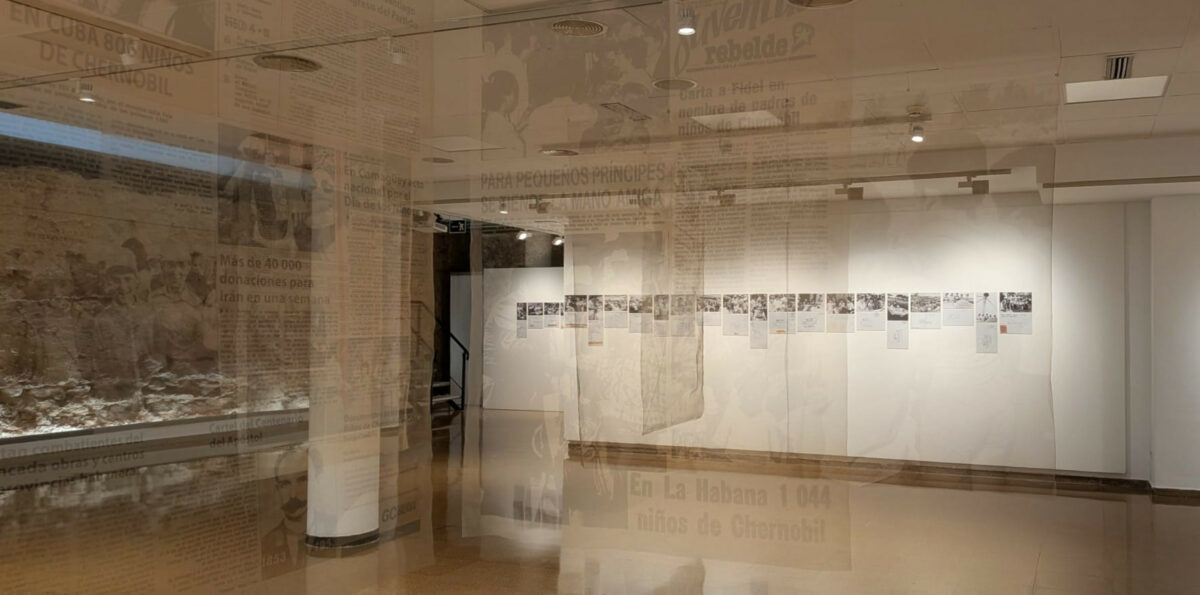
As Maribel Acosta tells us, “the exhibition Misplaced Documents: children from Chernobyl in Cuba constitutes, an orderly search for the context and its actors, from the recovery and reconstruction of textual documents, photographic, sounds, audiovisual and objects and equipment; anchored in the concepts of memory and forgetting, as a present social imaginary. It makes us feel the responsibility of the human act".
For his part, Sonia Cunliffe exhibits a work that has as its radical foundation the art of the archive, the deconstruction and reconstruction of the narrative layers that emerge in new stories when they are activated with audiences, different experiences and contexts. each one, in the face of a partisan narrative, will make his own i, in this way, the documents scattered in almost forgotten archives will tell many stories of those years... and of these. The photographs become clear, gestures of rooting. Front and back explain a name, a time and a longing. They whisper tears and also smiles. Even today they continue to ask for help, they pray for more life so that silence and abandonment do not prevail.
I, as a backbone running through the sample, there is the sound. The young Cuban composer Jorge Antonio Fernández Acosta composed Liusia's Lament, that other story inspired by the testimony of the dying fireman's wife collected by the Belarusian writer Svetlana Aleksievich, Nobel Prize for Literature in the year 2015, in the book Voices of Chernobyl.
Opening ceremony
On Friday 24 d'april to them 19:30 hours the opening ceremony will take place with the participation of Albert Moncusí Ferre, Vice Chancellor of Culture, Sport and Social Link of the University of Valencia, Sonia Cunliffe, visual artist, Maribel Acosta, journalist and curator of the exhibition and David Rodríguez, Valencian Association of Friendship with Cuba "José Martí" and its director Carles Xavier López Benedí.