

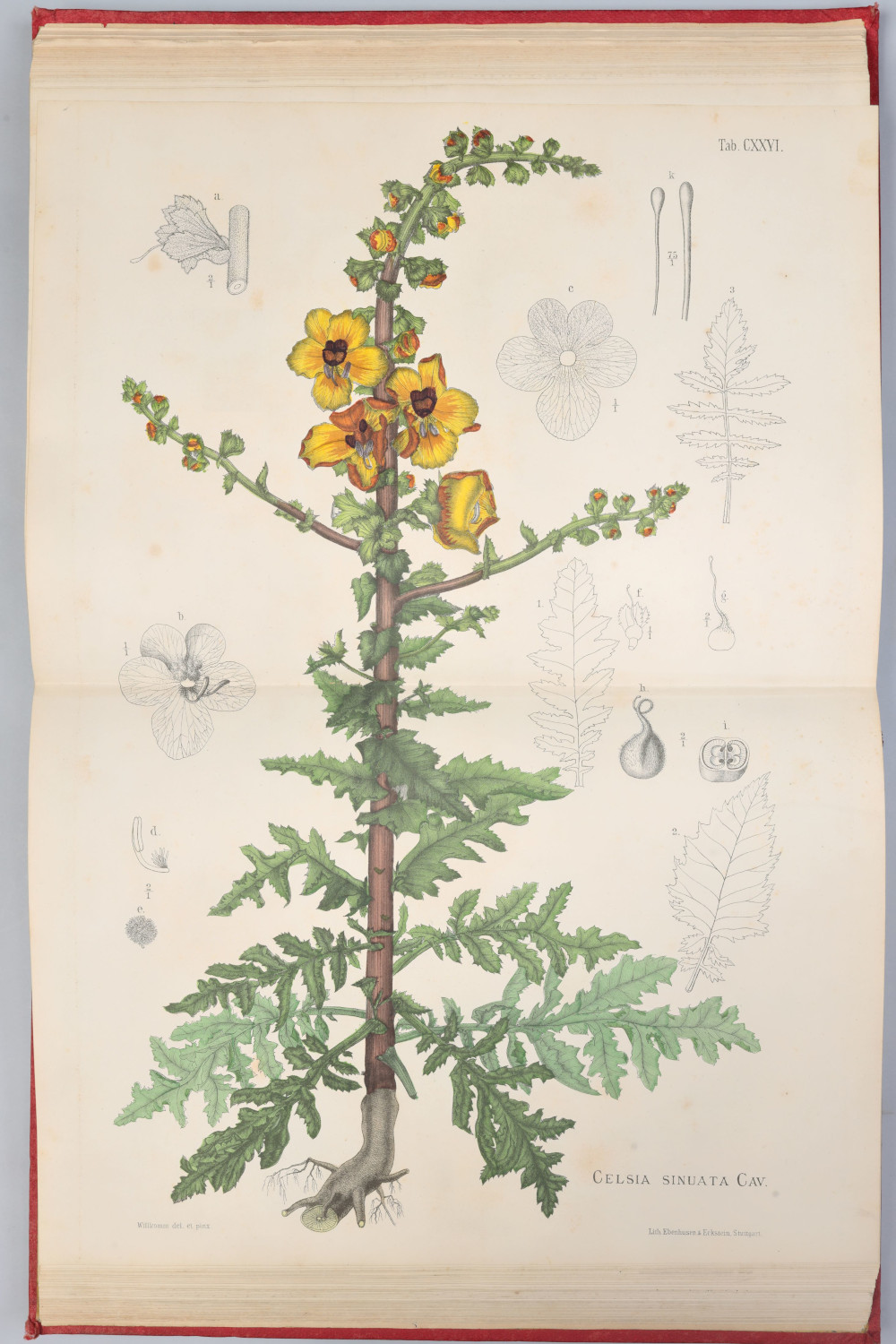
The University of Valencia presents the exhibition Of books and plants. Botanical illustration in the libraries of the University of Valencia. XVI-XIX centuries, a project organized by the Vice-Rectorate for Research and the Historical Library in collaboration with the Botanical Garden of the University of Valencia. The exhibition traces the history of botanical illustration and represents a unique opportunity to rediscover the beauty and scientific rigor that flourish between the pages of a selection of the collections preserved in the Vicent Peset Llorca Historical Medical Library, the José Pizcueta Botanical Garden Library and the Historical Library.
The exhibition opens on Thursday 30 of October, 19 hours, in the Duke of Calabria Hall of the La Nau UV Cultural Center and can be visited until 31 of January of 2026. Through more than fifty works published between 1542 i 1899, the exhibition helps us to know the value of the printed book as a tool for knowledge and scientific dissemination, at a time when screens dominate our environment. From the birth of printing in Europe, in the middle of the 15th century, printers devised methods to include images in books. This innovation marked the beginning of a profound transformation in the way of representing the plant world. Between the 16th and 19th centuries, the engraving technique evolved significantly and allowed for increasingly precise and detailed illustrations.
During the Renaissance, botanical illustration took an increasingly scientific approach. Woodcuts—engravings made on carved blocks of wood—became popular in medicinal plant books, in which they complemented the textual descriptions and facilitated the identification of species. This integration of the image with the text marked a turning point in botanical dissemination. Already in the 18th century, the improvement of printing techniques - especially copper engraving - made it possible to represent plant structures with great fidelity. This technical improvement not only enriched the visual accuracy, but also contributed to a deeper understanding of the plant world.
The exhibition is structured, chronologically, in four thematic areas that show a certain parallelism with the changes produced in botanical teaching and research at the University of Valencia. Since the creation of the first "Herbs" chair, l’any 1567, until the end of the 19th century, a series of transformations in the center of botanical interest occur, that expands and moves toward new study areas. And this can be seen in the illustrations of the books on display. If at first the books of medicinal plants —with different editions and adaptations of Dioscorides—, throughout the 18th century the attraction for knowledge of flora from all the continents and also from the Iberian Peninsula. Later the engravings are put to the service of the systematic ordering and focus on those characteristics that allow species to be grouped or distinguished. The exhibition concludes with the botanical works that significantly influenced the development and configuration of the current University Botanical Garden. They are dedicated to ornamental flora and the cultivation of plants in gardens.
The works on display include several editions derived from the classic work of Dioscórides Pedani Of medical matter, com Remarkable comments on the history of races de Leonhart Fuchs (1542). The singular work is also shown Icons of plants or breeds of Matthias of the Obel, printed by Cristophe Plantin l’any 1581, and several works by the Spanish doctor Francisco Suárez de Ribera, as well as the work of the Valencian naturalist Antoni Josep Cavanilles, and a representation of the splendid lithographs of the work of Heinrich Moritz Willkomm, that marked one before and a after in the study of the Iberian flora. Botanical illustration also reflects the active participation of women, how can be appreciated in the work of Castore Durante, whose engravings were made by Isabella Parasole. In them, the author incorporates background landscapes with human and animal figures and thus brings compositional richness to the vegetal representations.
In parallel, the Botanical Garden is designing a signposted route that will allow you to walk through the Garden identifying many of the species that appear illustrated in the books on display. This route will offer the possibility of seeing the plants in their natural environment alongside their historical representations, taken from the bibliographic treasures displayed in the showcases of the Duc de Calabria room.