

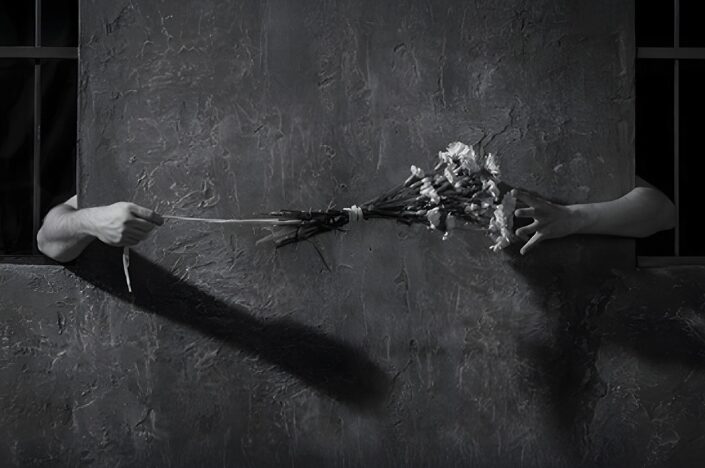
This exhibition proposes a reflection on the concepts of empathy, love and loneliness, from the conception of the subject as a closed circuit. That is to say, as a being perceptively closed in itself, producer and, in turn, recipient of the layers of reality that his consciousness generates to protect himself from the only truth he has available, that of his own death. From this perspective, the image of the other is also a construct, the projection of the subject's own personality modulated by external appearances and signs of life: a modified self. This is how he formulated it in 1903 Theodor Lipps, first theorist of Einfühlung (empathy), by understanding in his treatise on aesthetics the perception of the other as a form of self-perception.
In this context, the network of human relationships, articulated through pacts and linguistic negotiations, It is revealed as another survival device, an illusion of communication that masks the ultimate impossibility of fully sharing inner experience, well, As Georges Bataille pointed out, "it can't be done, discursively, express intimacy. Society would then be nothing more than an operative fiction sustained by language., a consensual way of organizing the experience and keeping at a distance that which overflows all representation. In this sense, loneliness does not appear as an exception, but as a constitutive condition of individual experience.
From this premise, Closed Circuit raises an essential question: How can human beings recognize themselves in others?, as we understand empathy, and share that feeling under the promise of language?Can love cross that barrier of individuality and give rise to forms of shared functional reality?? Through the practice of drawing, video art and cinema, Thirteen artists from different generations and contexts explore these questions whose philosophical basis runs through the history of thought., from East to West, to the present day.