



Science has already issued its warnings... But we have witnessed with pain and horror an unimaginable destruction of our territory due to a supposedly natural catastrophe. actually, it is not. It is one of the consequences of global warming and, that's why, of the greatest challenge humanity is currently facing: that of mitigating the effects of climate change and looking for new and just ways for everyone to live with dignity on the planet. climate change, generated by human action through the emission of greenhouse gases and the use of fossil fuels, is causing the atmosphere and oceans to warm, that the volumes of ice and snow decrease, that the sea level rises and that the transformations of the ecosystems generate changes that are incompatible with human life in many places on the planet. We have seen it in Valencia, with more than 200 dead people in the past 29 of October, and many people in the rest of the planet had already experienced climate tragedies before. This is a reality that can no longer be hidden.
All this not only has an impact on nature, but it also has a serious economic and social cost, producing injustices and violations of Human Rights in already vulnerable populations. Heat waves, the floods, prolonged droughts, fires and rising sea levels affect more and more people, with special incidence in those who are the poorest on the planet; destroying houses, infrastructures, crops, producing diseases, disappearances of animal and plant species, changing the seasonal cycle of the climate and generating violations of Human Rights, com: the Right to Life, to a healthy and dignified diet, to the hello, in the house, access to drinking water and increasing mortality and migration rates, which do not affect all citizens in the same way.
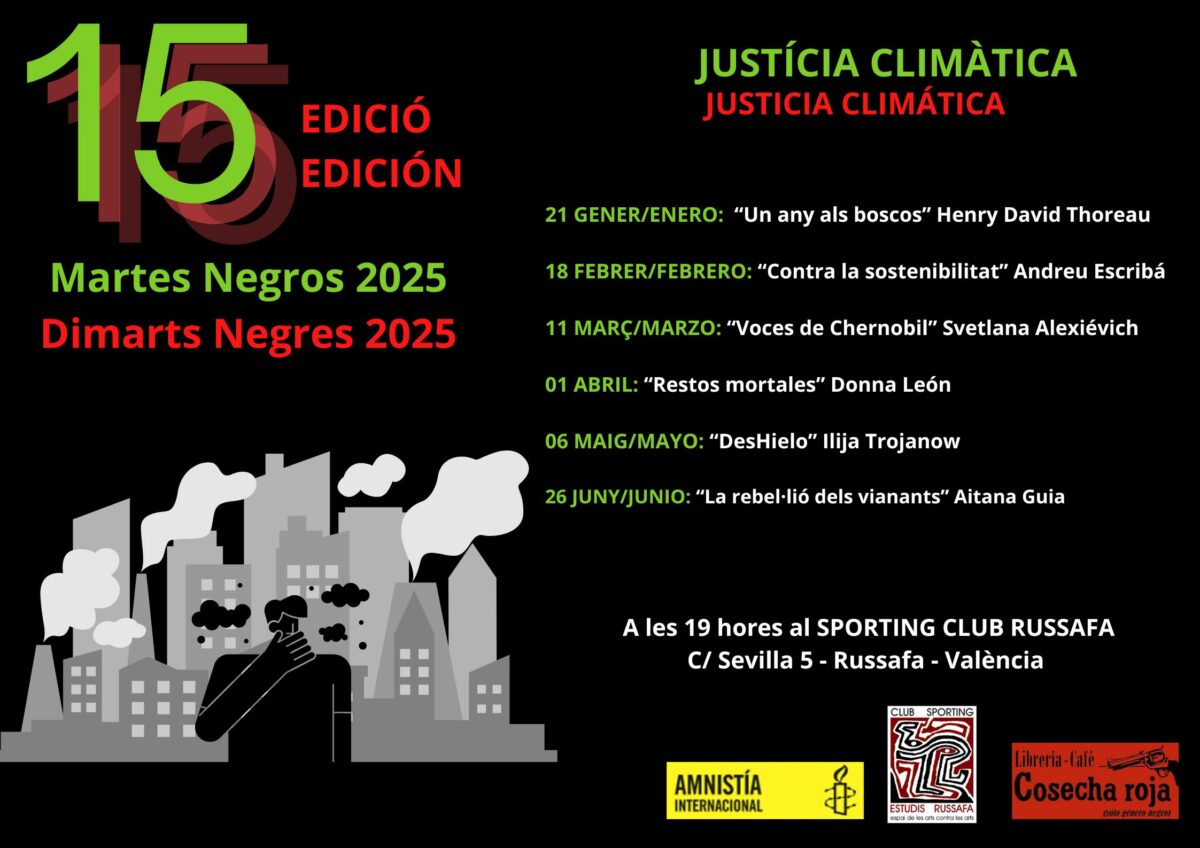
Climate change in addition to being an environmental problem, it is also a problem of social justice and human rights and is therefore addressed by Amnesty International. For that, we want to dedicate the 15th Edition of Black Tuesdays, together with the "Cosecha Roja" bookstore and the Sporting Club of Russafa in the Climate Justice, where we aim to make visible the unequal impact of this process between populations and individuals who are responsible for climate change to a very different extent, since those who receive the greatest impact are usually the least responsible for its causes. An example of this is that the biggest climate catastrophes affect more countries in the Global South, countries and communities that, due to their industrial development, have produced a lower incidence of gas emissions into the atmosphere and a lower pollution of their territories. Another clear example is that, in the most developed countries, environmental catastrophes affect to a higher degree the most vulnerable people in their population, establishing differences by social classes, races, ethnicity or gender. The effects of this climate change affect not only mere existence, but they also destroy: cultures and identities, ancestral knowledge, forms of production, etc., producing diversity of impacts depending on the geographical location, social class, gender, race or ethnicity to which the affected people belong.
To get to know this problem better, that so directly affects our lives, Amnesty International Valencia encourages us to enjoy this ecological catalog of literary works that we recommend you read and discuss on the next Black Mondays and that you can get at the Collita Roja bookstore.
21 of January of 2025: "A Year in the Woods" Henry David Thoreau
18 of February of 2025: "Against sustainability" Andreu Escribá
11 March 2025: “Voces de Chernobil” Svetlana Alexiévich
1 April 21 2025: “Mortal remains” Donna León
6 May of May 2025: “Thaw” Ilija Trojanow
26 of June of 2025: "The pedestrian rebellion" Aitana Guia